
PAU Anglès 2018 · Juny · Sèrie 5 · Part 1 · Reading comprehension
Enunciat
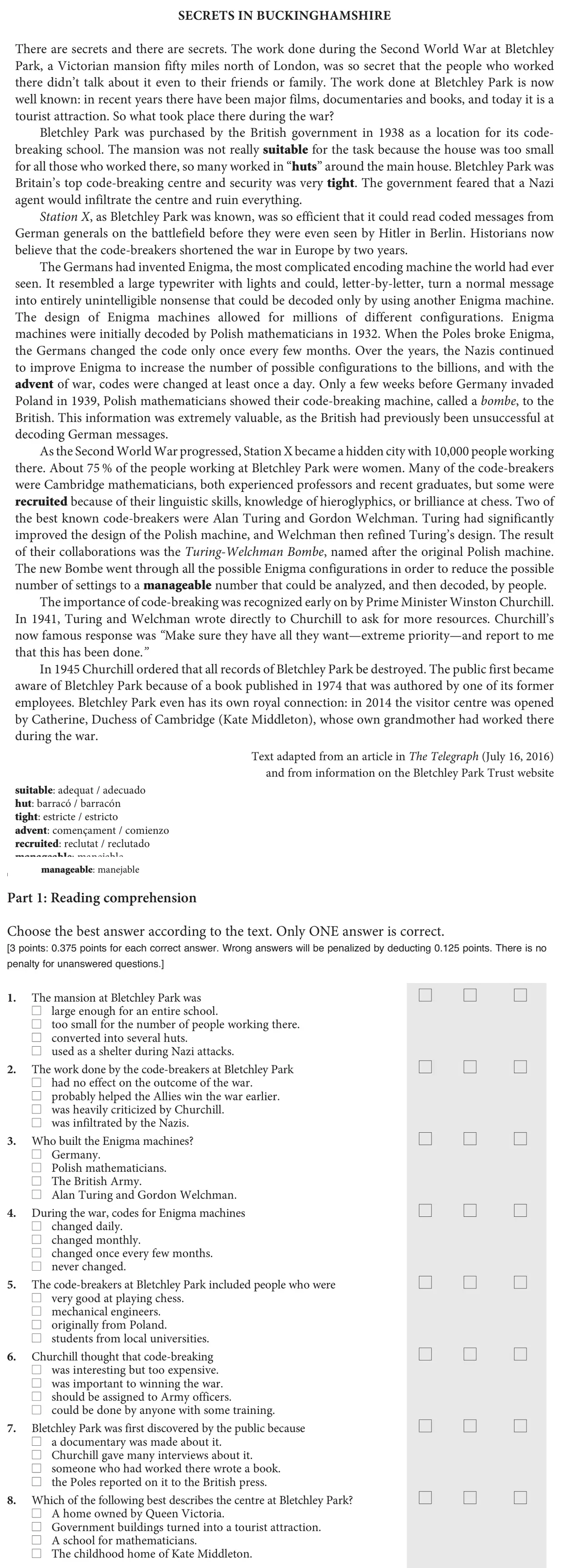
Text de l'enunciat (transcripció automàtica)
SECRETS IN BUCKINGHAMSHIRE
There are secrets and there are secrets. The work done during the Second World War at Bletchley
Park, a Victorian mansion fifty miles north of London, was so secret that the people who worked
there didn’t talk about it even to their friends or family. The work done at Bletchley Park is now
well known: in recent years there have been major films, documentaries and books, and today it is a
tourist attraction. So what took place there during the war?
Bletchley Park was purchased by the British government in 1938 as a location for its code-
breaking school. The mansion was not really suitable for the task because the house was too small
for all those who worked there, so many worked in “huts” around the main house. Bletchley Park was
Britain’s top code-breaking centre and security was very tight. The government feared that a Nazi
agent would infiltrate the centre and ruin everything.
Station X, as Bletchley Park was known, was so efficient that it could read coded messages from
German generals on the battlefield before they were even seen by Hitler in Berlin. Historians now
believe that the code-breakers shortened the war in Europe by two years.
The Germans had invented Enigma, the most complicated encoding machine the world had ever
seen. It resembled a large typewriter with lights and could, letter-by-letter, turn a normal message
into entirely unintelligible nonsense that could be decoded only by using another Enigma machine.
The design of Enigma machines allowed for millions of different configurations. Enigma
machines were initially decoded by Polish mathematicians in 1932. When the Poles broke Enigma,
the Germans changed the code only once every few months. Over the years, the Nazis continued
to improve Enigma to increase the number of possible configurations to the billions, and with the
advent of war, codes were changed at least once a day. Only a few weeks before Germany invaded
Poland in 1939, Polish mathematicians showed their code-breaking machine, called a bombe, to the
British. This information was extremely valuable, as the British had previously been unsuccessful at
decoding German messages.
As the Second World War progressed, Station X became a hidden city with 10,000 people working
there. About 75 % of the people working at Bletchley Park were women. Many of the code-breakers
were Cambridge mathematicians, both experienced professors and recent graduates, but some were
recruited because of their linguistic skills, knowledge of hieroglyphics, or brilliance at chess. Two of
the best known code-breakers were Alan Turing and Gordon Welchman. Turing had significantly
improved the design of the Polish machine, and Welchman then refined Turing’s design. The result
of their collaborations was the Turing-Welchman Bombe, named after the original Polish machine.
The new Bombe went through all the possible Enigma configurations in order to reduce the possible
number of settings to a manageable number that could be analyzed, and then decoded, by people.
The importance of code-breaking was recognized early on by Prime Minister Winston Churchill.
In 1941, Turing and Welchman wrote directly to Churchill to ask for more resources. Churchill’s
now famous response was “Make sure they have all they want—extreme priority—and report to me
that this has been done.”
In 1945 Churchill ordered that all records of Bletchley Park be destroyed. The public first became
aware of Bletchley Park because of a book published in 1974 that was authored by one of its former
employees. Bletchley Park even has its own royal connection: in 2014 the visitor centre was opened
by Catherine, Duchess of Cambridge (Kate Middleton), whose own grandmother had worked there
during the war.
Text adapted from an article in The Telegraph (July 16, 2016)
and from information on the Bletchley Park Trust website
suitable: adequat / adecuado
hut: barracó / barracón
tight: estricte / estricto
advent: començament / comienzo
recruited: reclutat /
Criteris oficials de correcció
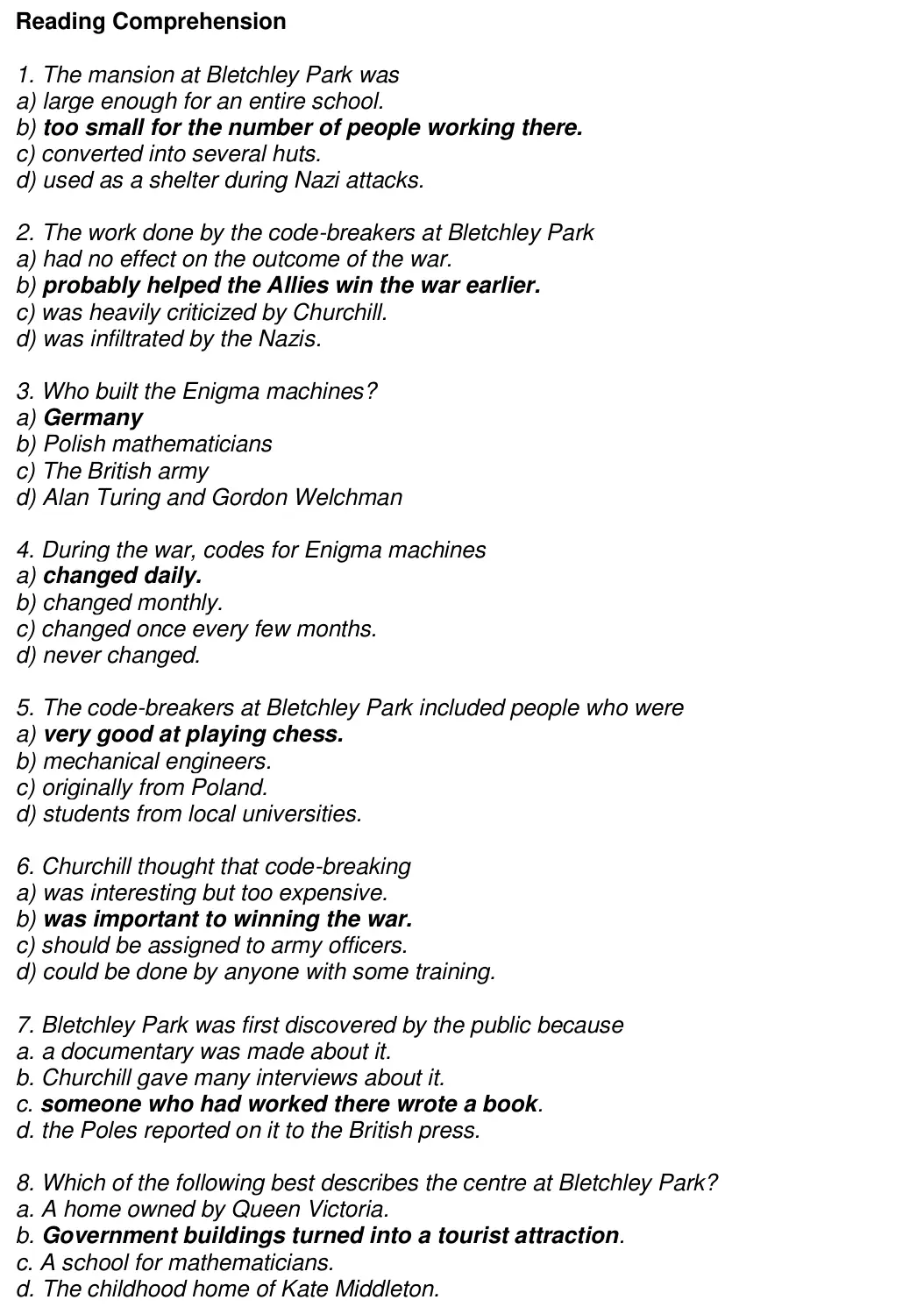
Text dels criteris (transcripció automàtica)
Reading Comprehension
1. The mansion at Bletchley Park was
a) large enough for an entire school.
b) too small for the number of people working there.
c) converted into several huts.
d) used as a shelter during Nazi attacks.
2. The work done by the code-breakers at Bletchley Park
a) had no effect on the outcome of the war.
b) probably helped the Allies win the war earlier.
c) was heavily criticized by Churchill.
d) was infiltrated by the Nazis.
3. Who built the Enigma machines?
a) Germany
b) Polish mathematicians
c) The British army
d) Alan Turing and Gordon Welchman
4. During the war, codes for Enigma machines
a) changed daily.
b) changed monthly.
c) changed once every few months.
d) never changed.
5. The code-breakers at Bletchley Park included people who were
a) very good at playing chess.
b) mechanical engineers.
c) originally from Poland.
d) students from local universities.
6. Churchill thought that code-breaking
a) was interesting but too expensive.
b) was important to winning th […]
Resolució pas a pas
Encara no hi ha resolució pròpia verificada d'aquest exercici. Mentrestant, tens els criteris oficials de correcció a sobre. Si tens dubtes, pregunta'ls al xat de la Sala d'estudi.
Font: enunciat i criteris de correcció oficials de les PAU 2018 de Catalunya, publicats per la Generalitat de Catalunya (universitats.gencat.cat) i les universitats catalanes. La resolució pas a pas és pròpia de L'Acadèmia de Vic.
Altres exercicis d'aquest examen
- Part 2 · Writing Writing
- Part 3 · Listening comprehension Listening comprehension