
PAU Anglès 2018 · Juny · Sèrie 5 · Part 3 · Listening comprehension
Enunciat
Text de l'enunciat (transcripció automàtica)
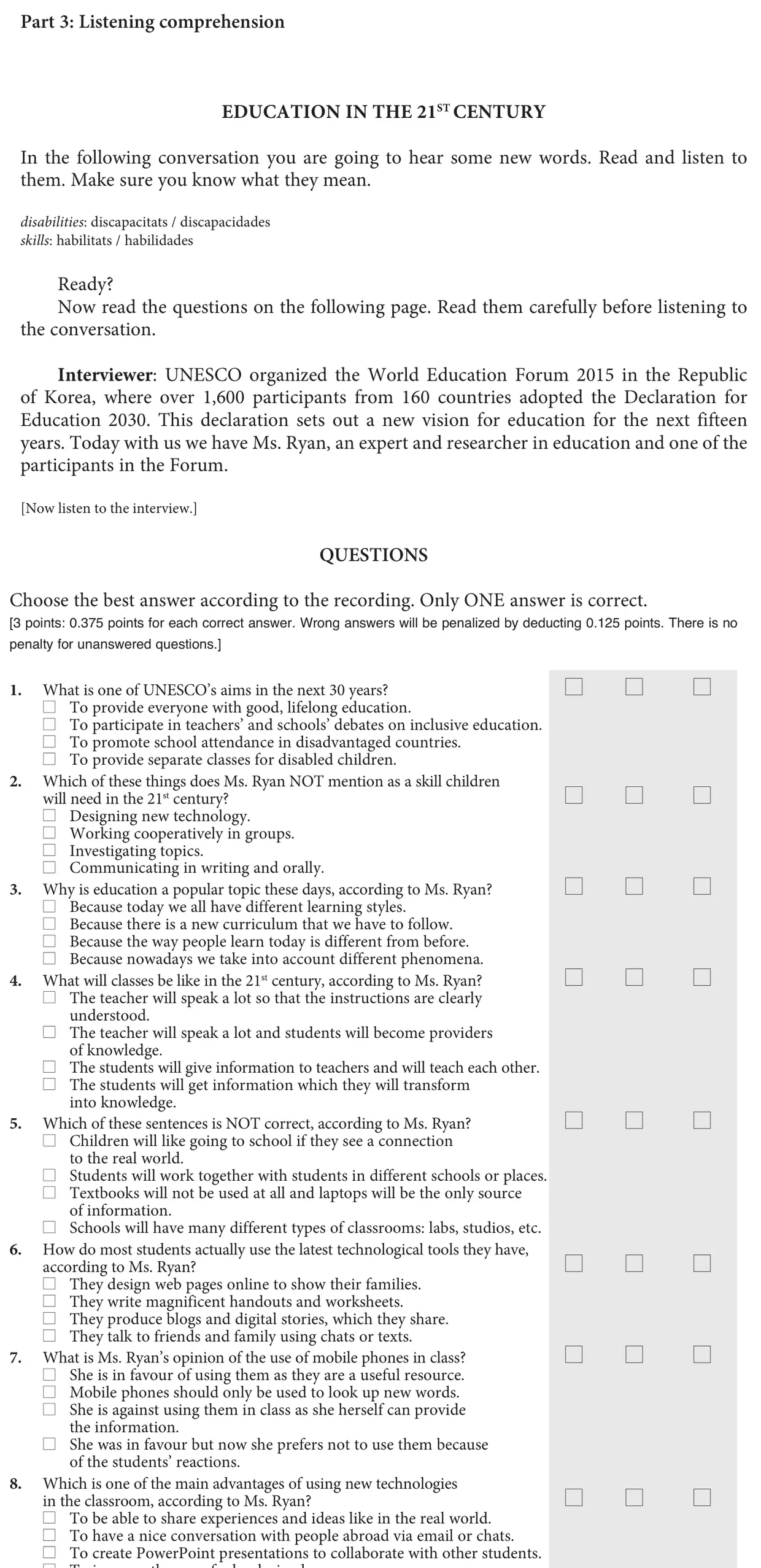
Part 3: Listening comprehension
EDUCATION IN THE 21ST CENTURY
In the following conversation you are going to hear some new words. Read and listen to
them. Make sure you know what they mean.
disabilities: discapacitats / discapacidades
skills: habilitats / habilidades
Ready?
Now read the questions on the following page. Read them carefully before listening to
the conversation.
Interviewer: UNESCO organized the World Education Forum 2015 in the Republic
of Korea, where over 1,600 participants from 160 countries adopted the Declaration for
Education 2030. This declaration sets out a new vision for education for the next fifteen
years. Today with us we have Ms. Ryan, an expert and researcher in education and one of the
participants in the Forum.
[Now listen to the interview.]
QUESTIONS
Choose the best answer according to the recording. Only ONE answer is correct.
[3 points: 0.375 points for each correct answer. Wrong answers will be penalized by deducting 0.125 points. There is no
penalty for unanswered questions.]
1. What is one of UNESCO’s aims in the next 30 years?
To provide everyone with good, lifelong education.
To participate in teachers’ and schools’ debates on inclusive education.
To promote school attendance in disadvantaged countries.
To provide separate classes for disabled children.
2. Which of these things does Ms. Ryan NOT mention as a skill children
will need in the 21st century?
Designing new technology.
Working cooperatively in groups.
Investigating topics.
Communicating in writing and orally.
3. Why is education a popular topic these days, according to Ms. Ryan?
Because today we all have different learning styles.
Because there is a new curriculum that we have to follow.
Because the way people learn today is different from before.
Because nowadays we take into account different phenomena.
4. What will classes be like in the 21st century, according to Ms. Ryan?
The teacher will speak a lot so that the instructions are clearly
understood.
The teacher will speak a lot and students will become providers
of knowledge.
The students will give information to teachers and will teach each other.
The students will get information which they will transform
into knowledge.
5. Which of these sentences is NOT correct, according to Ms. Ryan?
Children will like going to school if they see a connection
to the real world.
Students will work together with students in different schools or places.
Textbooks will not be used at all and laptops will be the only source
of information.
Schools will have many different types of classrooms: labs, studios, etc.
6. How do most students actually use the latest technological tools they have,
according to Ms. Ryan?
They design web pages online to show their families.
They write magnificent handouts and worksheets.
They produce blogs and digital stories, which they share.
They talk to friends and family using chats or texts.
7. What is Ms. Ryan’s opinion of the use of mobile phones in class?
She is in favour of using them as they are a useful resource.
Mobile phones should only be used to look up new words.
She is against using them in class as she herself can provide
the information.
She was in favour but now she prefers not to use them because
of the students’ reactions.
8. Which is one of the main advantages of using new technologies
in the classroom, according to Ms. Ryan?
To be able to share experiences and ideas like in the real world.
To have a nice conversation with people abroad via email or chats.
To create PowerPoint presentations to collaborate with other students.
To increase the use of e-books in class.
Criteris oficials de correcció
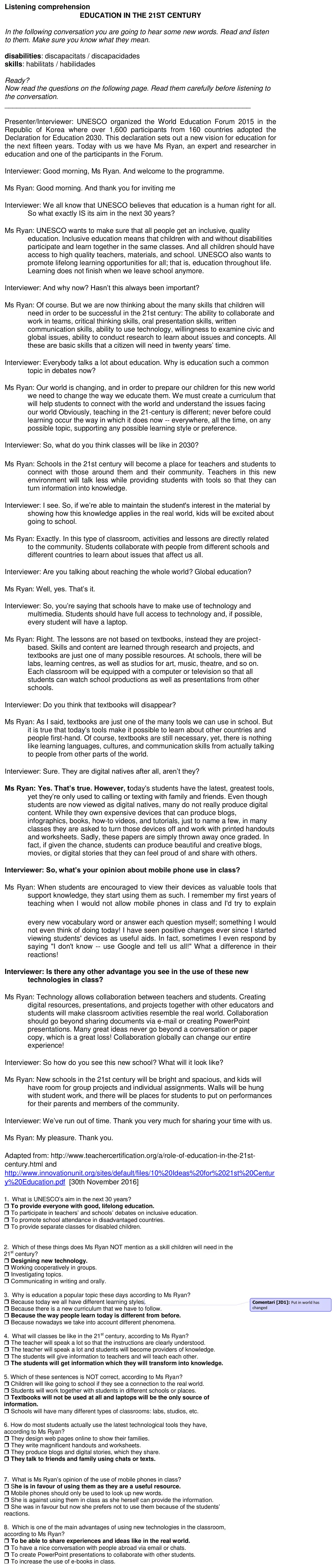
Text dels criteris (transcripció automàtica)
Listening comprehension
EDUCATION IN THE 21ST CENTURY
In the following conversation you are going to hear some new words. Read and listen
to them. Make sure you know what they mean.
disabilities: discapacitats / discapacidades
skills: habilitats / habilidades
Ready?
Now read the questions on the following page. Read them carefully before listening to
the conversation.
_______________________________________________________________
Presenter/Interviewer: UNESCO organized the World Education Forum 2015 in the
Republic of Korea where over 1,600 participants from 160 countries adopted the
Declaration for Education 2030. This declaration sets out a new vision for education for
the next fifteen years. Today with us we have Ms Ryan, an expert and researcher in
education and one of the participants in the Forum.
Interviewer: Good morning, Ms Ryan. And welcome to the programme.
Ms Ryan: Good morning. And thank you for inviting me
Interviewer: We all know that UNESCO believes that education is a […]
Resolució pas a pas
Aquest exercici no té una resolució escrita pas a pas (requereix l'àudio de la prova). Fes servir els criteris oficials de correcció.
Font: enunciat i criteris de correcció oficials de les PAU 2018 de Catalunya, publicats per la Generalitat de Catalunya (universitats.gencat.cat) i les universitats catalanes. La resolució pas a pas és pròpia de L'Acadèmia de Vic.
Altres exercicis d'aquest examen
- Part 1 · Reading comprehension Reading comprehension
- Part 2 · Writing Writing
Tots els exercicis de Listening comprehension · PAU de Anglès