
PAU Anglès 2017 · Setembre · Sèrie 2 · Part 1 · Reading comprehension
Enunciat
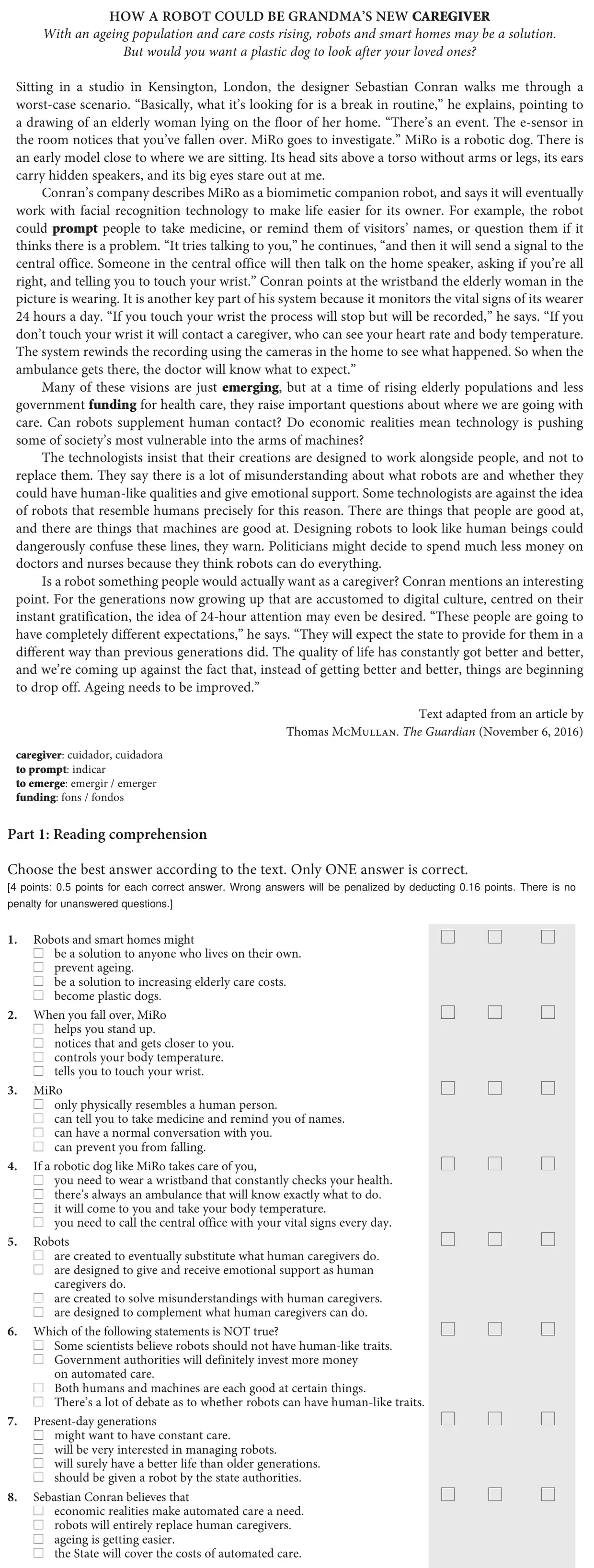
Text de l'enunciat (transcripció automàtica)
HOW A ROBOT COULD BE GRANDMA’S NEW CAREGIVER
With an ageing population and care costs rising, robots and smart homes may be a solution.
But would you want a plastic dog to look after your loved ones?
Sitting in a studio in Kensington, London, the designer Sebastian Conran walks me through a
worst-case scenario. “Basically, what it’s looking for is a break in routine,” he explains, pointing to
a drawing of an elderly woman lying on the floor of her home. “There’s an event. The e-sensor in
the room notices that you’ve fallen over. MiRo goes to investigate.” MiRo is a robotic dog. There is
an early model close to where we are sitting. Its head sits above a torso without arms or legs, its ears
carry hidden speakers, and its big eyes stare out at me.
Conran’s company describes MiRo as a biomimetic companion robot, and says it will eventually
work with facial recognition technology to make life easier for its owner. For example, the robot
could prompt people to take medicine, or remind them of visitors’ names, or question them if it
thinks there is a problem. “It tries talking to you,” he continues, “and then it will send a signal to the
central office. Someone in the central office will then talk on the home speaker, asking if you’re all
right, and telling you to touch your wrist.” Conran points at the wristband the elderly woman in the
picture is wearing. It is another key part of his system because it monitors the vital signs of its wearer
24 hours a day. “If you touch your wrist the process will stop but will be recorded,” he says. “If you
don’t touch your wrist it will contact a caregiver, who can see your heart rate and body temperature.
The system rewinds the recording using the cameras in the home to see what happened. So when the
ambulance gets there, the doctor will know what to expect.”
Many of these visions are just emerging, but at a time of rising elderly populations and less
government funding for health care, they raise important questions about where we are going with
care. Can robots supplement human contact? Do economic realities mean technology is pushing
some of society’s most vulnerable into the arms of machines?
The technologists insist that their creations are designed to work alongside people, and not to
replace them. They say there is a lot of misunderstanding about what robots are and whether they
could have human-like qualities and give emotional support. Some technologists are against the idea
of robots that resemble humans precisely for this reason. There are things that people are good at,
and there are things that machines are good at. Designing robots to look like human beings could
dangerously confuse these lines, they warn. Politicians might decide to spend much less money on
doctors and nurses because they think robots can do everything.
Is a robot something people would actually want as a caregiver? Conran mentions an interesting
point. For the generations now growing up that are accustomed to digital culture, centred on their
instant gratification, the idea of 24-hour attention may even be desired. “These people are going to
have completely different expectations,” he says. “They will expect the state to provide for them in a
different way than previous generations did. The quality of life has constantly got better and better,
and we’re coming up against the fact that, instead of getting better and better, things are beginning
to drop off. Ageing needs to be improved.”
Text adapted from an article by
Thomas McMullan. The Guardian (November 6, 2016)
caregiver: cuidador, cuidadora
to prompt: indicar
to emerge: emergir / emerger
funding: fons / fondos
Part 1: Reading comprehension
Choose the best answer according to the text. Only ONE answer is correct.
[4 points: 0.5 points for each correct answer. Wrong answers will be penalized by deducting 0.16 points. There is no
penalty for unanswered questions.]
1. Robots and smart homes might
be a solution to anyone who lives on their own.
prevent ageing.
Criteris oficials de correcció
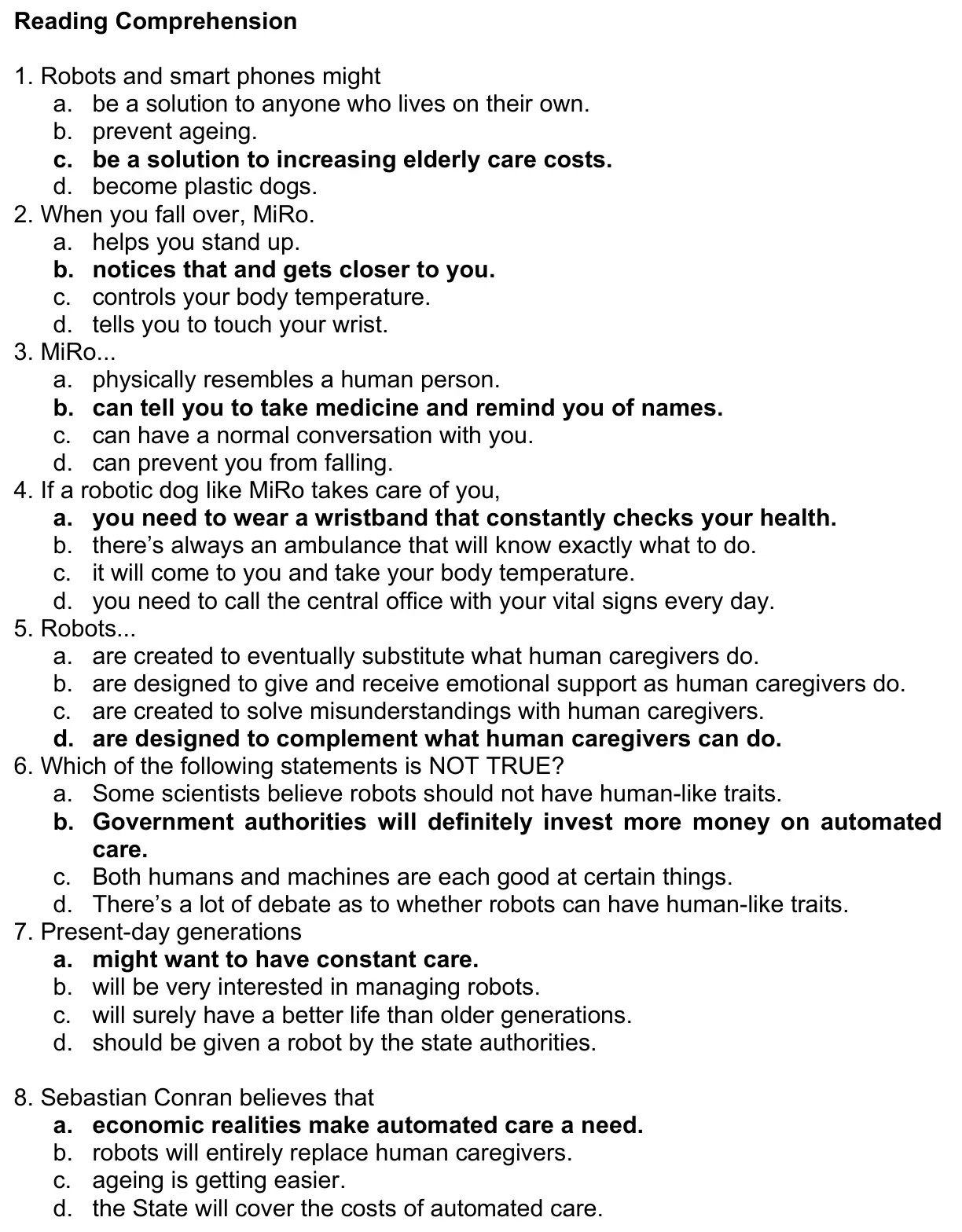
Text dels criteris (transcripció automàtica)
Reading Comprehension
1. Robots and smart phones might
a. be a solution to anyone who lives on their own.
b. prevent ageing.
c. be a solution to increasing elderly care costs.
d. become plastic dogs.
2. When you fall over, MiRo.
a. helps you stand up.
b. notices that and gets closer to you.
c. controls your body temperature.
d. tells you to touch your wrist.
3. MiRo...
a. physically resembles a human person.
b. can tell you to take medicine and remind you of names.
c. can have a normal conversation with you.
d. can prevent you from falling.
4. If a robotic dog like MiRo takes care of you,
a. you need to wear a wristband that constantly checks your health.
b. there’s always an ambulance that will know exactly what to do.
c. it will come to you and take your body temperature.
d. you need to call the central office with your vital signs every day.
5. Robots...
a. are created to eventually substitute what human caregivers do.
b. are designed to give and receive emotional support as human c […]
Resolució pas a pas
Encara no hi ha resolució pròpia verificada d'aquest exercici. Mentrestant, tens els criteris oficials de correcció a sobre. Si tens dubtes, pregunta'ls al xat de la Sala d'estudi.
Font: enunciat i criteris de correcció oficials de les PAU 2017 de Catalunya, publicats per la Generalitat de Catalunya (universitats.gencat.cat) i les universitats catalanes. La resolució pas a pas és pròpia de L'Acadèmia de Vic.
Altres exercicis d'aquest examen
- Part 2 · Writing Writing
- Part 3 · Listening comprehension Listening comprehension