
PAU Anglès 2018 · Juny · Sèrie 1 · Part 1 · Reading comprehension
Enunciat
Text de l'enunciat (transcripció automàtica)
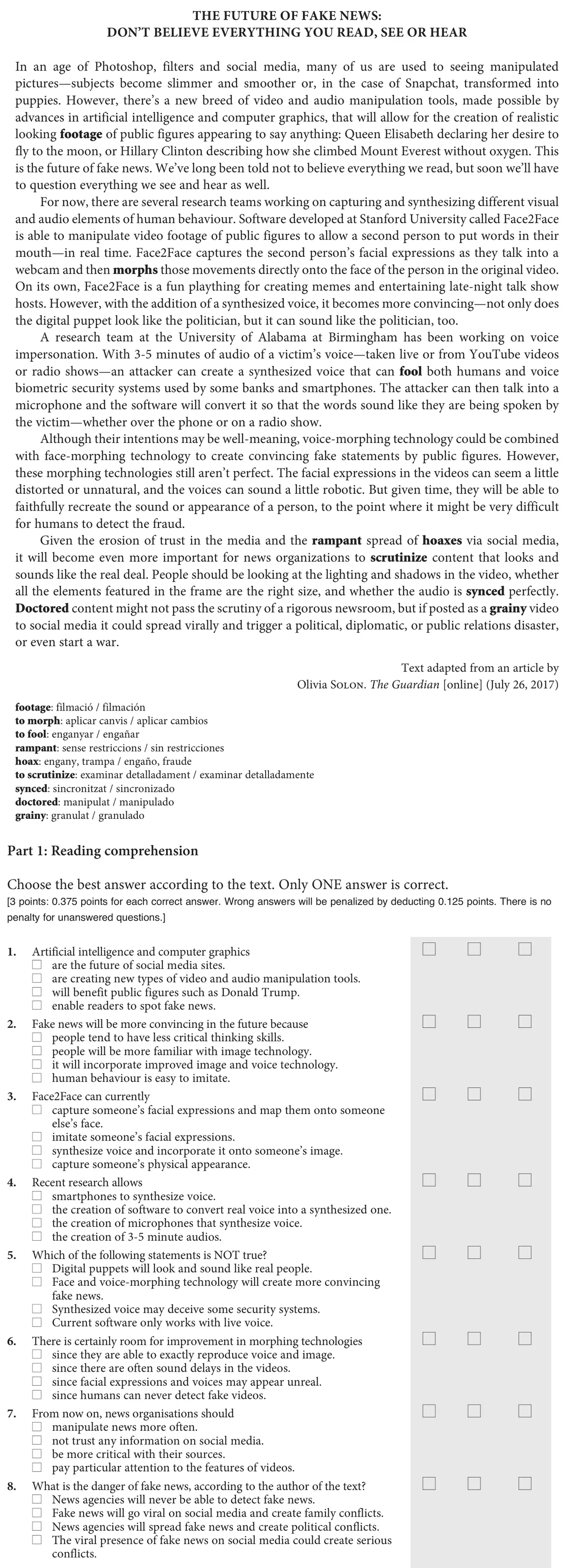
THE FUTURE OF FAKE NEWS:
DON’T BELIEVE EVERYTHING YOU READ, SEE OR HEAR
In an age of Photoshop, filters and social media, many of us are used to seeing manipulated
pictures—subjects become slimmer and smoother or, in the case of Snapchat, transformed into
puppies. However, there’s a new breed of video and audio manipulation tools, made possible by
advances in artificial intelligence and computer graphics, that will allow for the creation of realistic
looking footage of public figures appearing to say anything: Queen Elisabeth declaring her desire to
fly to the moon, or Hillary Clinton describing how she climbed Mount Everest without oxygen. This
is the future of fake news. We’ve long been told not to believe everything we read, but soon we’ll have
to question everything we see and hear as well.
For now, there are several research teams working on capturing and synthesizing different visual
and audio elements of human behaviour. Software developed at Stanford University called Face2Face
is able to manipulate video footage of public figures to allow a second person to put words in their
mouth—in real time. Face2Face captures the second person’s facial expressions as they talk into a
webcam and then morphs those movements directly onto the face of the person in the original video.
On its own, Face2Face is a fun plaything for creating memes and entertaining late-night talk show
hosts. However, with the addition of a synthesized voice, it becomes more convincing—not only does
the digital puppet look like the politician, but it can sound like the politician, too.
A research team at the University of Alabama at Birmingham has been working on voice
impersonation. With 3-5 minutes of audio of a victim’s voice—taken live or from YouTube videos
or radio shows—an attacker can create a synthesized voice that can fool both humans and voice
biometric security systems used by some banks and smartphones. The attacker can then talk into a
microphone and the software will convert it so that the words sound like they are being spoken by
the victim—whether over the phone or on a radio show.
Although their intentions may be well-meaning, voice-morphing technology could be combined
with face-morphing technology to create convincing fake statements by public figures. However,
these morphing technologies still aren’t perfect. The facial expressions in the videos can seem a little
distorted or unnatural, and the voices can sound a little robotic. But given time, they will be able to
faithfully recreate the sound or appearance of a person, to the point where it might be very difficult
for humans to detect the fraud.
Given the erosion of trust in the media and the rampant spread of hoaxes via social media,
it will become even more important for news organizations to scrutinize content that looks and
sounds like the real deal. People should be looking at the lighting and shadows in the video, whether
all the elements featured in the frame are the right size, and whether the audio is synced perfectly.
Doctored content might not pass the scrutiny of a rigorous newsroom, but if posted as a grainy video
to social media it could spread virally and trigger a political, diplomatic, or public relations disaster,
or even start a war.
Text adapted from an article by
Olivia Solon. The Guardian [online] (July 26, 2017)
footage: filmació / filmación
to morph: aplicar canvis / aplicar cambios
to fool: enganyar / engañar
rampant: sense restriccions / sin restricciones
hoax: engany, trampa / engaño, fraude
to scrutinize: examinar detalladament / examinar detalladamente
synced: sincronitzat / sincronizado
doctored: manipulat / manipulado
grainy: granulat / granulado
Part 1: Reading comprehension
Choose the best answer according to the text. Only ONE answer is correct.
[3 points: 0.375 points for each correct answer. Wrong answers will be penalized by deducting 0.125 points. There is no
penalty for unanswered questions.]
1. Artificial intelligence and computer graphics
ar
Criteris oficials de correcció
Text dels criteris (transcripció automàtica)
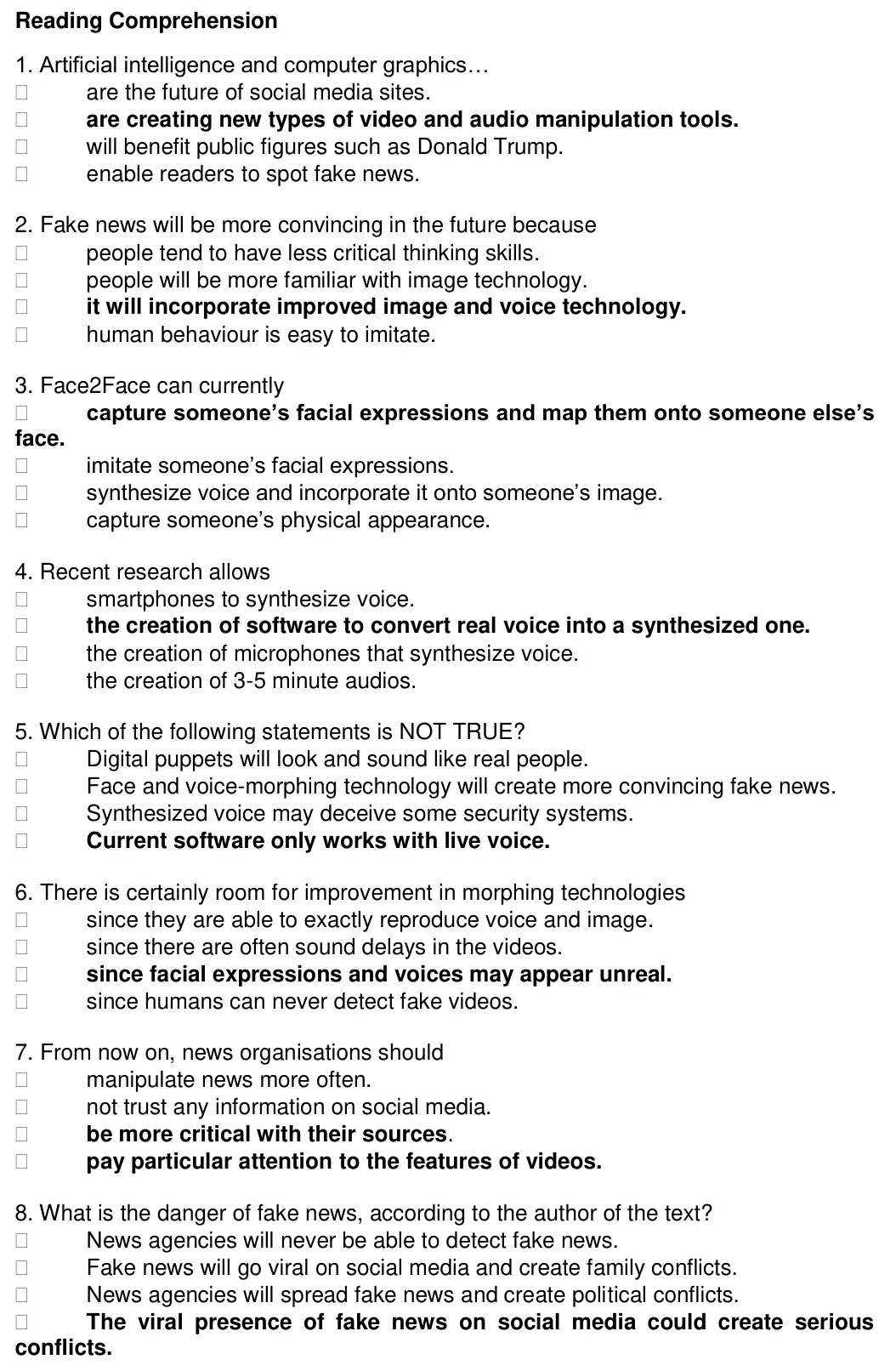
Reading Comprehension
1. Artificial intelligence and computer graphics…
are the future of social media sites.
are creating new types of video and audio manipulation tools.
will benefit public figures such as Donald Trump.
enable readers to spot fake news.
2. Fake news will be more convincing in the future because
people tend to have less critical thinking skills.
people will be more familiar with image technology.
it will incorporate improved image and voice technology.
human behaviour is easy to imitate.
3. Face2Face can currently
capture someone’s facial expressions and map them onto someone else’s
face.
imitate someone’s facial expressions.
synthesize voice and incorporate it onto someone’s image.
capture someone’s physical appearance.
4. Recent research allows
smartphones to synthesize voice.
the creation of software to convert real voice into a synthesized one.
the creation of microphones that synthesize voice.
the creation of 3-5 minute audios.
5. […]
Resolució pas a pas
Encara no hi ha resolució pròpia verificada d'aquest exercici. Mentrestant, tens els criteris oficials de correcció a sobre. Si tens dubtes, pregunta'ls al xat de la Sala d'estudi.
Font: enunciat i criteris de correcció oficials de les PAU 2018 de Catalunya, publicats per la Generalitat de Catalunya (universitats.gencat.cat) i les universitats catalanes. La resolució pas a pas és pròpia de L'Acadèmia de Vic.
Altres exercicis d'aquest examen
- Part 2 · Writing Writing
- Part 3 · Listening comprehension Listening comprehension