
PAU Anglès 2017 · Setembre · Sèrie 2 · Part 3 · Listening comprehension
Enunciat
Text de l'enunciat (transcripció automàtica)
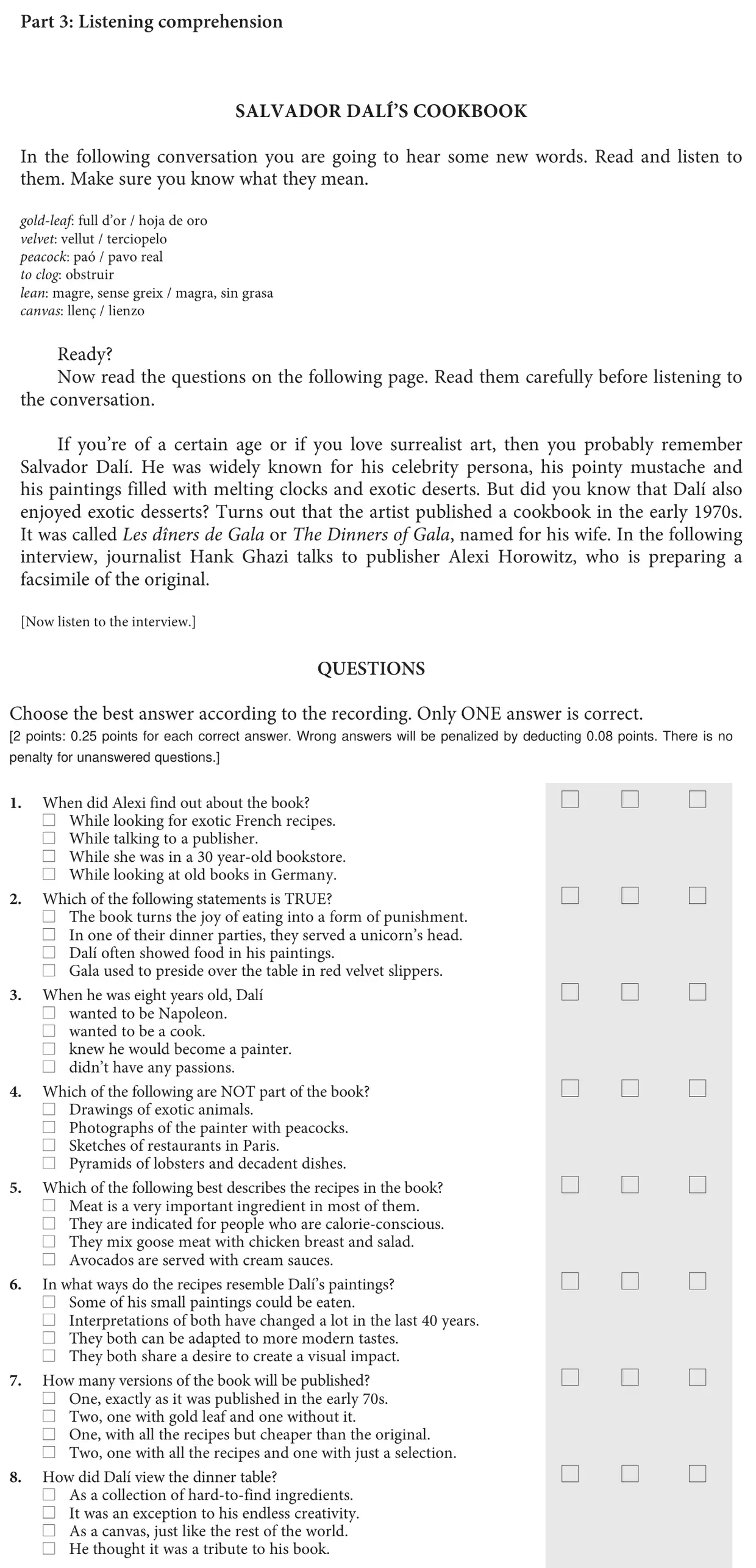
Part 3: Listening comprehension
SALVADOR DALÍ’S COOKBOOK
In the following conversation you are going to hear some new words. Read and listen to
them. Make sure you know what they mean.
gold-leaf: full d’or / hoja de oro
velvet: vellut / terciopelo
peacock: paó / pavo real
to clog: obstruir
lean: magre, sense greix / magra, sin grasa
canvas: llenç / lienzo
Ready?
Now read the questions on the following page. Read them carefully before listening to
the conversation.
If you’re of a certain age or if you love surrealist art, then you probably remember
Salvador Dalí. He was widely known for his celebrity persona, his pointy mustache and
his paintings filled with melting clocks and exotic deserts. But did you know that Dalí also
enjoyed exotic desserts? Turns out that the artist published a cookbook in the early 1970s.
It was called Les dîners de Gala or The Dinners of Gala, named for his wife. In the following
interview, journalist Hank Ghazi talks to publisher Alexi Horowitz, who is preparing a
facsimile of the original.
[Now listen to the interview.]
QUESTIONS
Choose the best answer according to the recording. Only ONE answer is correct.
[2 points: 0.25 points for each correct answer. Wrong answers will be penalized by deducting 0.08 points. There is no
penalty for unanswered questions.]
1. When did Alexi find out about the book?
While looking for exotic French recipes.
While talking to a publisher.
While she was in a 30 year-old bookstore.
While looking at old books in Germany.
2. Which of the following statements is TRUE?
The book turns the joy of eating into a form of punishment.
In one of their dinner parties, they served a unicorn’s head.
Dalí often showed food in his paintings.
Gala used to preside over the table in red velvet slippers.
3. When he was eight years old, Dalí
wanted to be Napoleon.
wanted to be a cook.
knew he would become a painter.
didn’t have any passions.
4. Which of the following are NOT part of the book?
Drawings of exotic animals.
Photographs of the painter with peacocks.
Sketches of restaurants in Paris.
Pyramids of lobsters and decadent dishes.
5. Which of the following best describes the recipes in the book?
Meat is a very important ingredient in most of them.
They are indicated for people who are calorie-conscious.
They mix goose meat with chicken breast and salad.
Avocados are served with cream sauces.
6. In what ways do the recipes resemble Dalí’s paintings?
Some of his small paintings could be eaten.
Interpretations of both have changed a lot in the last 40 years.
They both can be adapted to more modern tastes.
They both share a desire to create a visual impact.
7. How many versions of the book will be published?
One, exactly as it was published in the early 70s.
Two, one with gold leaf and one without it.
One, with all the recipes but cheaper than the original.
Two, one with all the recipes and one with just a selection.
8. How did Dalí view the dinner table?
As a collection of hard-to-find ingredients.
It was an exception to his endless creativity.
As a canvas, just like the rest of the world.
He thought it was a tribute to his book.
Criteris oficials de correcció
Resolució pas a pas
Aquest exercici no té una resolució escrita pas a pas (requereix l'àudio de la prova). Fes servir els criteris oficials de correcció.
Font: enunciat i criteris de correcció oficials de les PAU 2017 de Catalunya, publicats per la Generalitat de Catalunya (universitats.gencat.cat) i les universitats catalanes. La resolució pas a pas és pròpia de L'Acadèmia de Vic.
Altres exercicis d'aquest examen
- Part 1 · Reading comprehension Reading comprehension
- Part 2 · Writing Writing
Tots els exercicis de Listening comprehension · PAU de Anglès