
PAU Anglès 2017 · Juny · Sèrie 1 · Part 1 · Reading comprehension
Enunciat
Text de l'enunciat (transcripció automàtica)
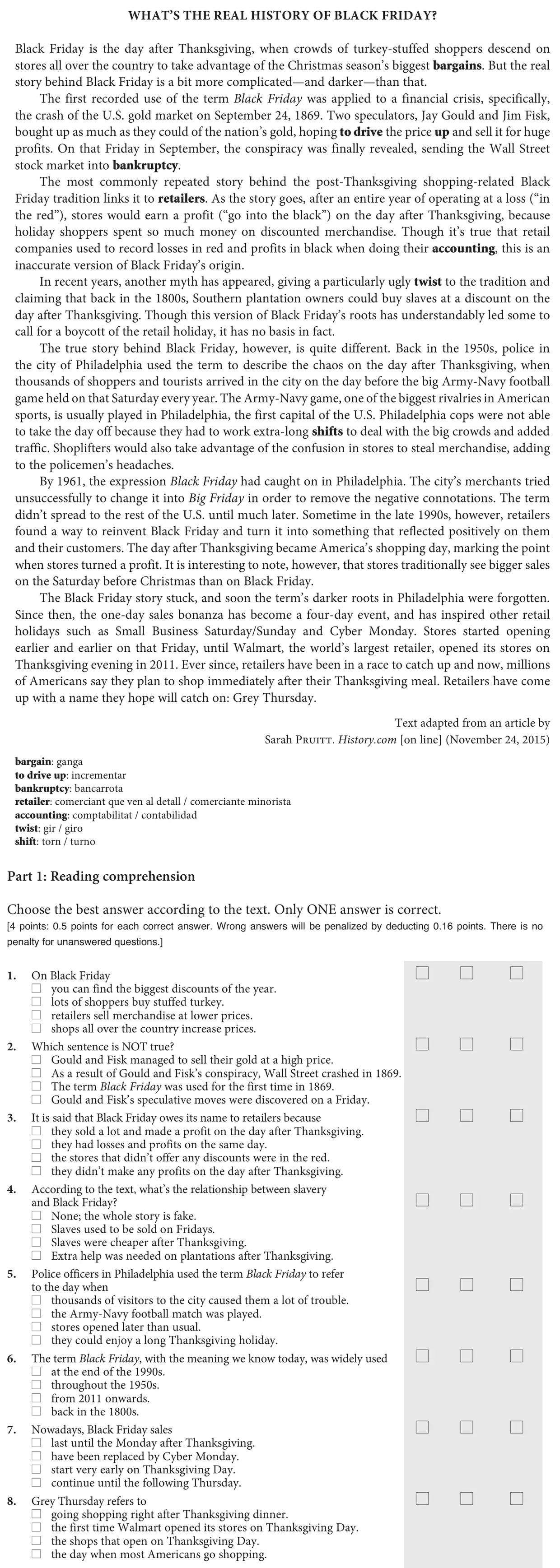
WHAT’S THE REAL HISTORY OF BLACK FRIDAY?
Black Friday is the day after Thanksgiving, when crowds of turkey-stuffed shoppers descend on
stores all over the country to take advantage of the Christmas season’s biggest bargains. But the real
story behind Black Friday is a bit more complicated—and darker—than that.
The first recorded use of the term Black Friday was applied to a financial crisis, specifically,
the crash of the U.S. gold market on September 24, 1869. Two speculators, Jay Gould and Jim Fisk,
bought up as much as they could of the nation’s gold, hoping to drive the price up and sell it for huge
profits. On that Friday in September, the conspiracy was finally revealed, sending the Wall Street
stock market into bankruptcy.
The most commonly repeated story behind the post-Thanksgiving shopping-related Black
Friday tradition links it to retailers. As the story goes, after an entire year of operating at a loss (“in
the red”), stores would earn a profit (“go into the black”) on the day after Thanksgiving, because
holiday shoppers spent so much money on discounted merchandise. Though it’s true that retail
companies used to record losses in red and profits in black when doing their accounting, this is an
inaccurate version of Black Friday’s origin.
In recent years, another myth has appeared, giving a particularly ugly twist to the tradition and
claiming that back in the 1800s, Southern plantation owners could buy slaves at a discount on the
day after Thanksgiving. Though this version of Black Friday’s roots has understandably led some to
call for a boycott of the retail holiday, it has no basis in fact.
The true story behind Black Friday, however, is quite different. Back in the 1950s, police in
the city of Philadelphia used the term to describe the chaos on the day after Thanksgiving, when
thousands of shoppers and tourists arrived in the city on the day before the big Army-Navy football
game held on that Saturday every year. The Army-Navy game, one of the biggest rivalries in American
sports, is usually played in Philadelphia, the first capital of the U.S. Philadelphia cops were not able
to take the day off because they had to work extra-long shifts to deal with the big crowds and added
traffic. Shoplifters would also take advantage of the confusion in stores to steal merchandise, adding
to the policemen’s headaches.
By 1961, the expression Black Friday had caught on in Philadelphia. The city’s merchants tried
unsuccessfully to change it into Big Friday in order to remove the negative connotations. The term
didn’t spread to the rest of the U.S. until much later. Sometime in the late 1990s, however, retailers
found a way to reinvent Black Friday and turn it into something that reflected positively on them
and their customers. The day after Thanksgiving became America’s shopping day, marking the point
when stores turned a profit. It is interesting to note, however, that stores traditionally see bigger sales
on the Saturday before Christmas than on Black Friday.
The Black Friday story stuck, and soon the term’s darker roots in Philadelphia were forgotten.
Since then, the one-day sales bonanza has become a four-day event, and has inspired other retail
holidays such as Small Business Saturday/Sunday and Cyber Monday. Stores started opening
earlier and earlier on that Friday, until Walmart, the world’s largest retailer, opened its stores on
Thanksgiving evening in 2011. Ever since, retailers have been in a race to catch up and now, millions
of Americans say they plan to shop immediately after their Thanksgiving meal. Retailers have come
up with a name they hope will catch on: Grey Thursday.
Text adapted from an article by
Sarah Pruitt. History.com [on line] (November 24, 2015)
bargain: ganga
to drive up: incrementar
bankruptcy: bancarrota
retailer: comerciant que ven al detall / comerciante minorista
accounting: comptabilitat / contabilidad
twist: gir / giro
shift: torn / turno
Part 1: Reading comprehension
Choose the best answer
Criteris oficials de correcció
Text dels criteris (transcripció automàtica)
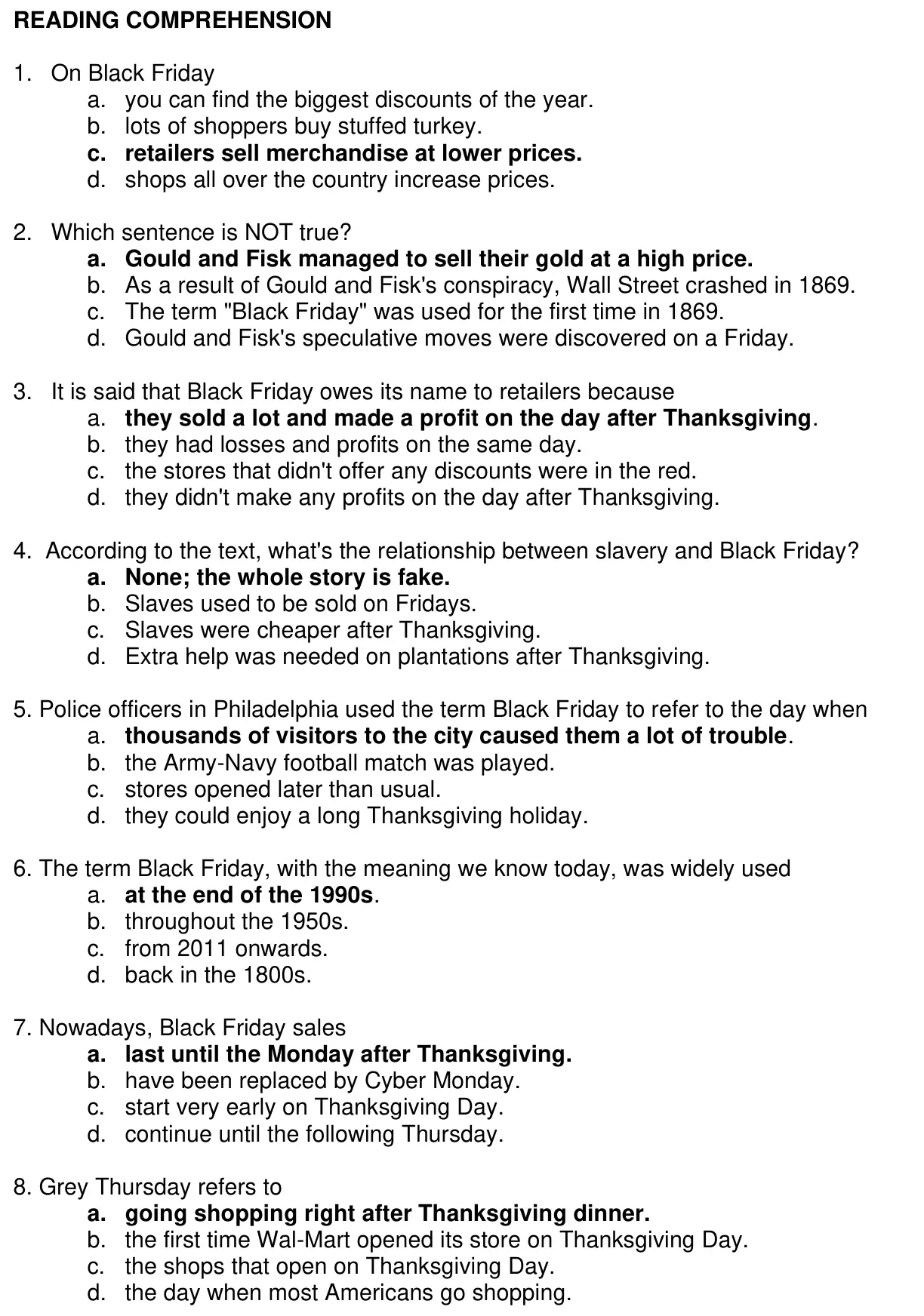
READING COMPREHENSION
1. On Black Friday
a. you can find the biggest discounts of the year.
b. lots of shoppers buy stuffed turkey.
c. retailers sell merchandise at lower prices.
d. shops all over the country increase prices.
2. Which sentence is NOT true?
a. Gould and Fisk managed to sell their gold at a high price.
b. As a result of Gould and Fisk's conspiracy, Wall Street crashed in 1869.
c. The term "Black Friday" was used for the first time in 1869.
d. Gould and Fisk's speculative moves were discovered on a Friday.
3. It is said that Black Friday owes its name to retailers because
a. they sold a lot and made a profit on the day after Thanksgiving.
b. they had losses and profits on the same day.
c. the stores that didn't offer any discounts were in the red.
d. they didn't make any profits on the day after Thanksgiving.
4. According to the text, what's the relationship between slavery and Black Friday?
a. None; the whole story is fake.
b. Slaves used to be sold on Fridays.
c. Slaves […]
Resolució pas a pas
Encara no hi ha resolució pròpia verificada d'aquest exercici. Mentrestant, tens els criteris oficials de correcció a sobre. Si tens dubtes, pregunta'ls al xat de la Sala d'estudi.
Font: enunciat i criteris de correcció oficials de les PAU 2017 de Catalunya, publicats per la Generalitat de Catalunya (universitats.gencat.cat) i les universitats catalanes. La resolució pas a pas és pròpia de L'Acadèmia de Vic.
Altres exercicis d'aquest examen
- Part 2 · Writing Writing
- Part 3 · Listening comprehension Listening comprehension