
PAU Anglès 2016 · Juny · Sèrie 5 · Part 1 · Reading comprehension
Enunciat
Text de l'enunciat (transcripció automàtica)
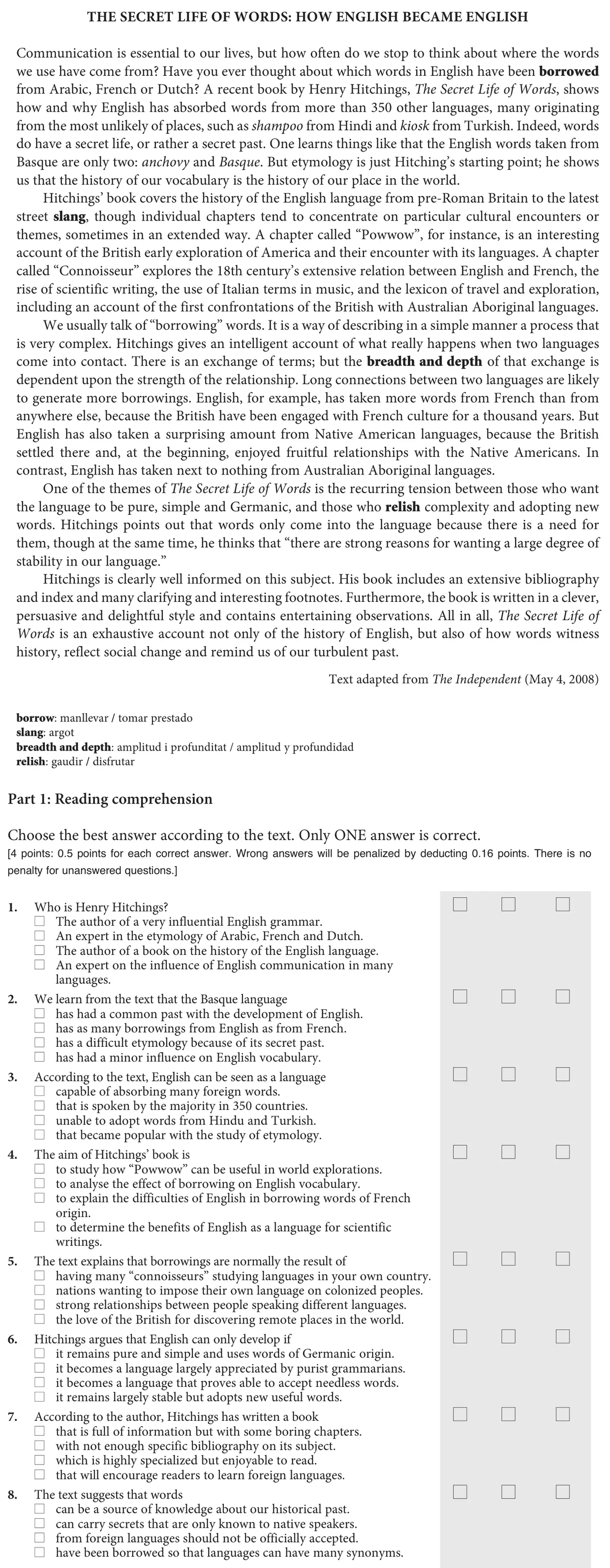
THE SECRET LIFE OF WORDS: HOW ENGLISH BECAME ENGLISH
Communication is essential to our lives, but how often do we stop to think about where the words
we use have come from? Have you ever thought about which words in English have been borrowed
from Arabic, French or Dutch? A recent book by Henry Hitchings, The Secret Life of Words, shows
how and why English has absorbed words from more than 350 other languages, many originating
from the most unlikely of places, such as shampoo from Hindi and kiosk from Turkish. Indeed, words
do have a secret life, or rather a secret past. One learns things like that the English words taken from
Basque are only two: anchovy and Basque. But etymology is just Hitching’s starting point; he shows
us that the history of our vocabulary is the history of our place in the world.
Hitchings’ book covers the history of the English language from pre-Roman Britain to the latest
street slang, though individual chapters tend to concentrate on particular cultural encounters or
themes, sometimes in an extended way. A chapter called “Powwow”, for instance, is an interesting
account of the British early exploration of America and their encounter with its languages. A chapter
called “Connoisseur” explores the 18th century’s extensive relation between English and French, the
rise of scientific writing, the use of Italian terms in music, and the lexicon of travel and exploration,
including an account of the first confrontations of the British with Australian Aboriginal languages.
We usually talk of “borrowing” words. It is a way of describing in a simple manner a process that
is very complex. Hitchings gives an intelligent account of what really happens when two languages
come into contact. There is an exchange of terms; but the breadth and depth of that exchange is
dependent upon the strength of the relationship. Long connections between two languages are likely
to generate more borrowings. English, for example, has taken more words from French than from
anywhere else, because the British have been engaged with French culture for a thousand years. But
English has also taken a surprising amount from Native American languages, because the British
settled there and, at the beginning, enjoyed fruitful relationships with the Native Americans. In
contrast, English has taken next to nothing from Australian Aboriginal languages.
One of the themes of The Secret Life of Words is the recurring tension between those who want
the language to be pure, simple and Germanic, and those who relish complexity and adopting new
words. Hitchings points out that words only come into the language because there is a need for
them, though at the same time, he thinks that “there are strong reasons for wanting a large degree of
stability in our language.”
Hitchings is clearly well informed on this subject. His book includes an extensive bibliography
and index and many clarifying and interesting footnotes. Furthermore, the book is written in a clever,
persuasive and delightful style and contains entertaining observations. All in all, The Secret Life of
Words is an exhaustive account not only of the history of English, but also of how words witness
history, reflect social change and remind us of our turbulent past.
Text adapted from The Independent (May 4, 2008)
borrow: manllevar / tomar prestado
slang: argot
breadth and depth: amplitud i profunditat / amplitud y profundidad
relish: gaudir / disfrutar
Part 1: Reading comprehension
Choose the best answer according to the text. Only ONE answer is correct.
[4 points: 0.5 points for each correct answer. Wrong answers will be penalized by deducting 0.16 points. There is no
penalty for unanswered questions.]
1. Who is Henry Hitchings?
The author of a very influential English grammar.
An expert in the etymology of Arabic, French and Dutch.
The author of a book on the history of the English language.
An expert on the influence of English communication in many
languages.
2. We learn from the text that t
Criteris oficials de correcció
Text dels criteris (transcripció automàtica)
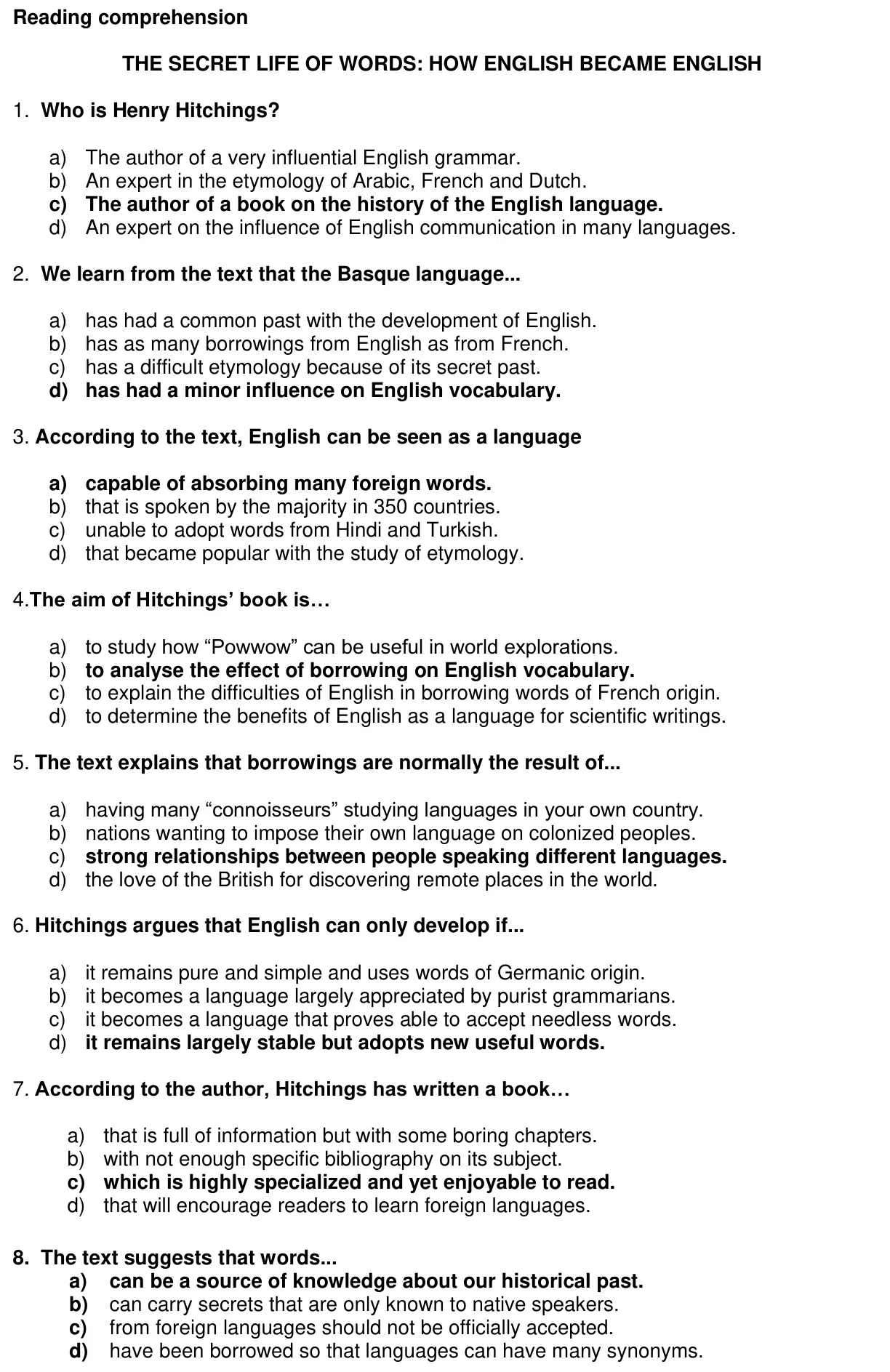
Reading comprehension
THE SECRET LIFE OF WORDS: HOW ENGLISH BECAME ENGLISH
1. Who is Henry Hitchings?
a) The author of a very influential English grammar.
b) An expert in the etymology of Arabic, French and Dutch.
c) The author of a book on the history of the English language.
d) An expert on the influence of English communication in many languages.
2. We learn from the text that the Basque language...
a) has had a common past with the development of English.
b) has as many borrowings from English as from French.
c) has a difficult etymology because of its secret past.
d) has had a minor influence on English vocabulary.
3. According to the text, English can be seen as a language
a) capable of absorbing many foreign words.
b) that is spoken by the majority in 350 countries.
c) unable to adopt words from Hindi and Turkish.
d) that became popular with the study of etymology.
4.The aim of Hitchings’ book is…
a) to study how “Powwow” can be useful in world explorations.
b) to analyse the ef […]
Resolució pas a pas
Encara no hi ha resolució pròpia verificada d'aquest exercici. Mentrestant, tens els criteris oficials de correcció a sobre. Si tens dubtes, pregunta'ls al xat de la Sala d'estudi.
Font: enunciat i criteris de correcció oficials de les PAU 2016 de Catalunya, publicats per la Generalitat de Catalunya (universitats.gencat.cat) i les universitats catalanes. La resolució pas a pas és pròpia de L'Acadèmia de Vic.
Altres exercicis d'aquest examen
- Part 2 · Writing Writing
- Part 3 · Listening comprehension Listening comprehension