
PAU Anglès 2016 · Juny · Sèrie 5 · Part 3 · Listening comprehension
Enunciat
Text de l'enunciat (transcripció automàtica)
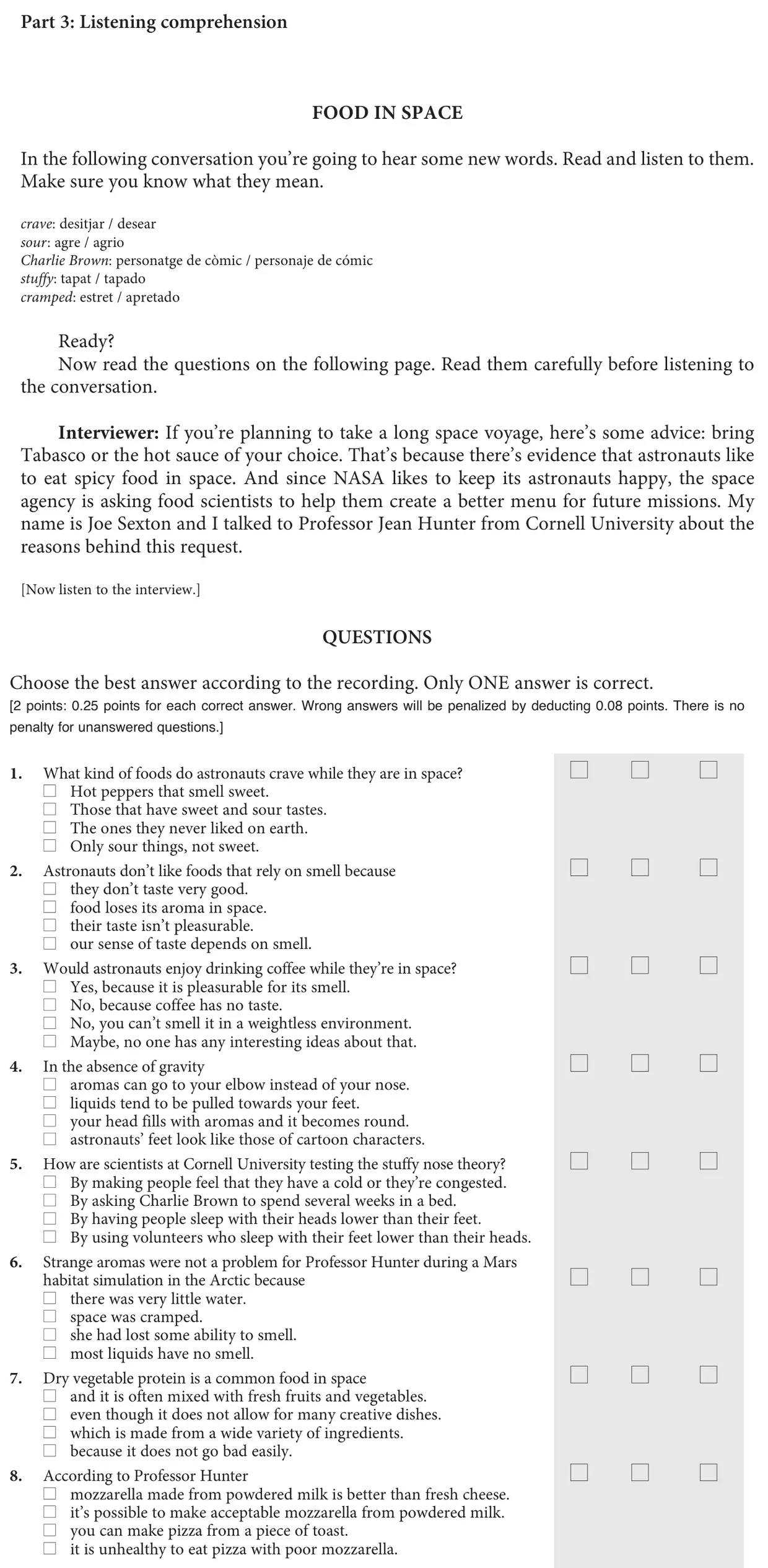
Part 3: Listening comprehension
FOOD IN SPACE
In the following conversation you’re going to hear some new words. Read and listen to them.
Make sure you know what they mean.
crave: desitjar / desear
sour: agre / agrio
Charlie Brown: personatge de còmic / personaje de cómic
stuffy: tapat / tapado
cramped: estret / apretado
Ready?
Now read the questions on the following page. Read them carefully before listening to
the conversation.
Interviewer: If you’re planning to take a long space voyage, here’s some advice: bring
Tabasco or the hot sauce of your choice. That’s because there’s evidence that astronauts like
to eat spicy food in space. And since NASA likes to keep its astronauts happy, the space
agency is asking food scientists to help them create a better menu for future missions. My
name is Joe Sexton and I talked to Professor Jean Hunter from Cornell University about the
reasons behind this request.
[Now listen to the interview.]
QUESTIONS
Choose the best answer according to the recording. Only ONE answer is correct.
[2 points: 0.25 points for each correct answer. Wrong answers will be penalized by deducting 0.08 points. There is no
penalty for unanswered questions.]
1. What kind of foods do astronauts crave while they are in space?
Hot peppers that smell sweet.
Those that have sweet and sour tastes.
The ones they never liked on earth.
Only sour things, not sweet.
2. Astronauts don’t like foods that rely on smell because
they don’t taste very good.
food loses its aroma in space.
their taste isn’t pleasurable.
our sense of taste depends on smell.
3. Would astronauts enjoy drinking coffee while they’re in space?
Yes, because it is pleasurable for its smell.
No, because coffee has no taste.
No, you can’t smell it in a weightless environment.
Maybe, no one has any interesting ideas about that.
4. In the absence of gravity
aromas can go to your elbow instead of your nose.
liquids tend to be pulled towards your feet.
your head fills with aromas and it becomes round.
astronauts’ feet look like those of cartoon characters.
5. How are scientists at Cornell University testing the stuffy nose theory?
By making people feel that they have a cold or they’re congested.
By asking Charlie Brown to spend several weeks in a bed.
By having people sleep with their heads lower than their feet.
By using volunteers who sleep with their feet lower than their heads.
6. Strange aromas were not a problem for Professor Hunter during a Mars
habitat simulation in the Arctic because
there was very little water.
space was cramped.
she had lost some ability to smell.
most liquids have no smell.
7. Dry vegetable protein is a common food in space
and it is often mixed with fresh fruits and vegetables.
even though it does not allow for many creative dishes.
which is made from a wide variety of ingredients.
because it does not go bad easily.
8. According to Professor Hunter
mozzarella made from powdered milk is better than fresh cheese.
it’s possible to make acceptable mozzarella from powdered milk.
you can make pizza from a piece of toast.
it is unhealthy to eat pizza with poor mozzarella.
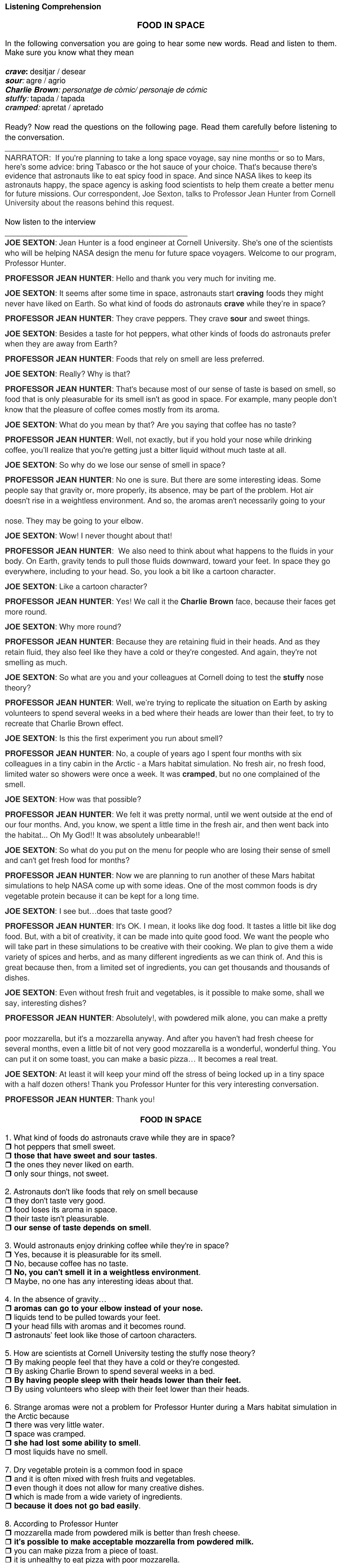
Criteris oficials de correcció
Resolució pas a pas
Aquest exercici no té una resolució escrita pas a pas (requereix l'àudio de la prova). Fes servir els criteris oficials de correcció.
Font: enunciat i criteris de correcció oficials de les PAU 2016 de Catalunya, publicats per la Generalitat de Catalunya (universitats.gencat.cat) i les universitats catalanes. La resolució pas a pas és pròpia de L'Acadèmia de Vic.
Altres exercicis d'aquest examen
- Part 1 · Reading comprehension Reading comprehension
- Part 2 · Writing Writing
Tots els exercicis de Listening comprehension · PAU de Anglès