
PAU Anglès 2015 · Setembre · Sèrie 5 · Part 1 · Reading comprehension
Enunciat
Text de l'enunciat (transcripció automàtica)
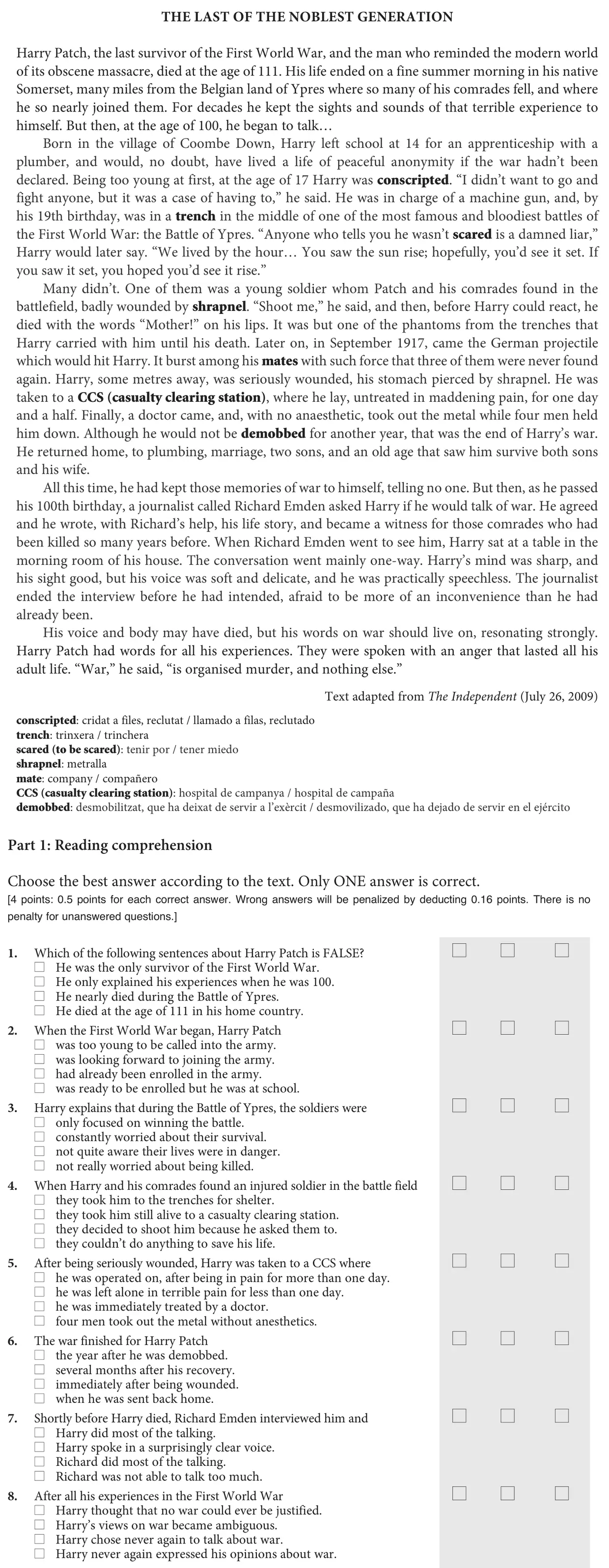
THE LAST OF THE NOBLEST GENERATION
Harry Patch, the last survivor of the First World War, and the man who reminded the modern world
of its obscene massacre, died at the age of 111. His life ended on a fine summer morning in his native
Somerset, many miles from the Belgian land of Ypres where so many of his comrades fell, and where
he so nearly joined them. For decades he kept the sights and sounds of that terrible experience to
himself. But then, at the age of 100, he began to talk…
Born in the village of Coombe Down, Harry left school at 14 for an apprenticeship with a
plumber, and would, no doubt, have lived a life of peaceful anonymity if the war hadn’t been
declared. Being too young at first, at the age of 17 Harry was conscripted. “I didn’t want to go and
fight anyone, but it was a case of having to,” he said. He was in charge of a machine gun, and, by
his 19th birthday, was in a trench in the middle of one of the most famous and bloodiest battles of
the First World War: the Battle of Ypres. “Anyone who tells you he wasn’t scared is a damned liar,”
Harry would later say. “We lived by the hour… You saw the sun rise; hopefully, you’d see it set. If
you saw it set, you hoped you’d see it rise.”
Many didn’t. One of them was a young soldier whom Patch and his comrades found in the
battlefield, badly wounded by shrapnel. “Shoot me,” he said, and then, before Harry could react, he
died with the words “Mother!” on his lips. It was but one of the phantoms from the trenches that
Harry carried with him until his death. Later on, in September 1917, came the German projectile
which would hit Harry. It burst among his mates with such force that three of them were never found
again. Harry, some metres away, was seriously wounded, his stomach pierced by shrapnel. He was
taken to a CCS (casualty clearing station), where he lay, untreated in maddening pain, for one day
and a half. Finally, a doctor came, and, with no anaesthetic, took out the metal while four men held
him down. Although he would not be demobbed for another year, that was the end of Harry’s war.
He returned home, to plumbing, marriage, two sons, and an old age that saw him survive both sons
and his wife.
All this time, he had kept those memories of war to himself, telling no one. But then, as he passed
his 100th birthday, a journalist called Richard Emden asked Harry if he would talk of war. He agreed
and he wrote, with Richard’s help, his life story, and became a witness for those comrades who had
been killed so many years before. When Richard Emden went to see him, Harry sat at a table in the
morning room of his house. The conversation went mainly one-way. Harry’s mind was sharp, and
his sight good, but his voice was soft and delicate, and he was practically speechless. The journalist
ended the interview before he had intended, afraid to be more of an inconvenience than he had
already been.
His voice and body may have died, but his words on war should live on, resonating strongly.
Harry Patch had words for all his experiences. They were spoken with an anger that lasted all his
adult life. “War,” he said, “is organised murder, and nothing else.”
Text adapted from The Independent (July 26, 2009)
conscripted: cridat a files, reclutat / llamado a filas, reclutado
trench: trinxera / trinchera
scared (to be scared): tenir por / tener miedo
shrapnel: metralla
mate: company / compañero
CCS (casualty clearing station): hospital de campanya / hospital de campaña
demobbed: desmobilitzat, que ha deixat de servir a l’exèrcit / desmovilizado, que ha dejado de servir en el ejército
Part 1: Reading comprehension
Choose the best answer according to the text. Only ONE answer is correct.
[4 points: 0.5 points for each correct answer. Wrong answers will be penalized by deducting 0.16 points. There is no
penalty for unanswered questions.]
1. Which of the following sentences about Harry Patch is FALSE?
He was the only survivor of the First World War.
He only explained his experiences when he
Criteris oficials de correcció
Text dels criteris (transcripció automàtica)
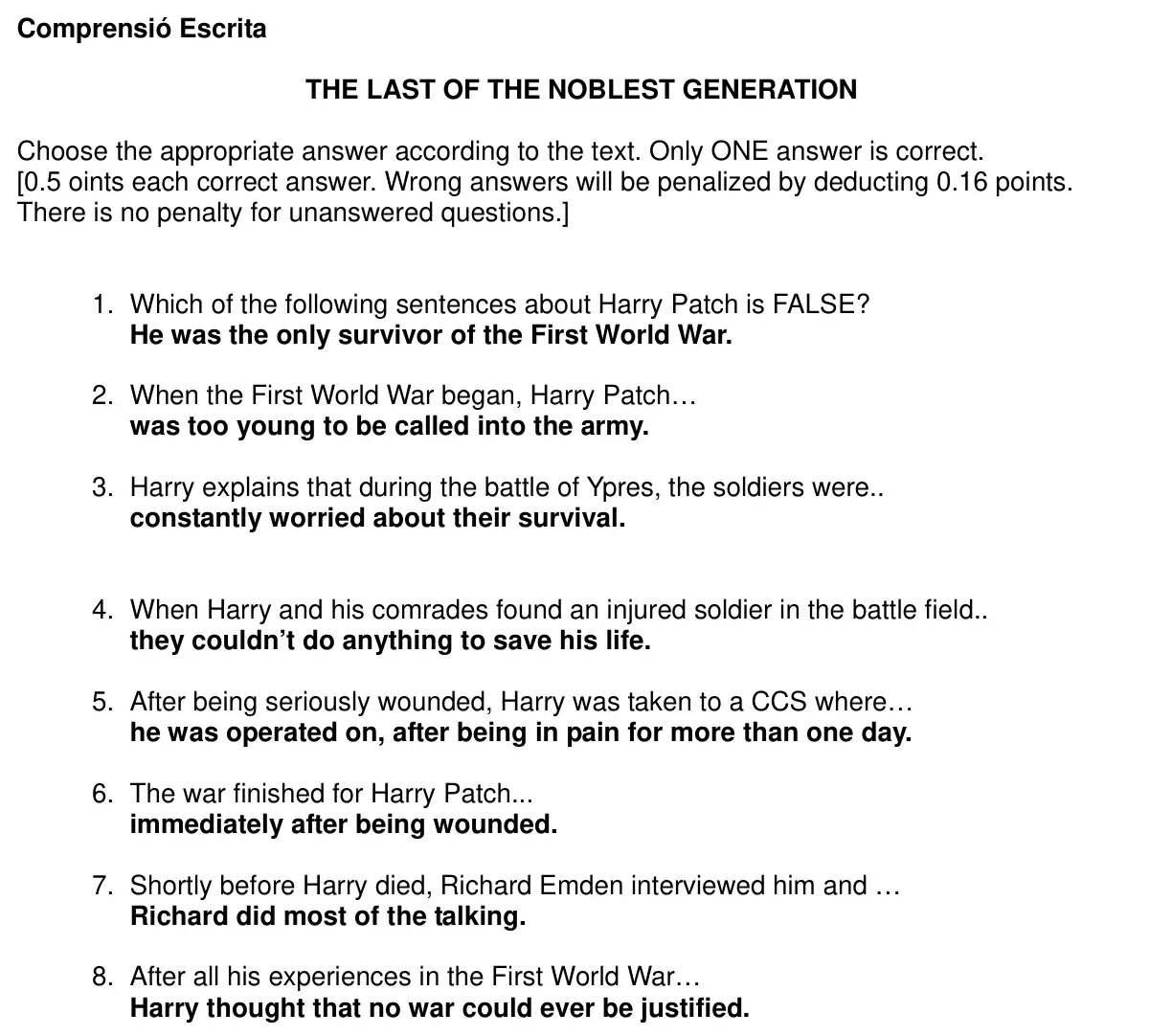
Comprensió Escrita
THE LAST OF THE NOBLEST GENERATION
Choose the appropriate answer according to the text. Only ONE answer is correct.
[0.5 oints each correct answer. Wrong answers will be penalized by deducting 0.16 points.
There is no penalty for unanswered questions.]
1. Which of the following sentences about Harry Patch is FALSE?
He was the only survivor of the First World War.
2. When the First World War began, Harry Patch…
was too young to be called into the army.
3. Harry explains that during the battle of Ypres, the soldiers were..
constantly worried about their survival.
4. When Harry and his comrades found an injured soldier in the battle field..
they couldn’t do anything to save his life.
5. After being seriously wounded, Harry was taken to a CCS where…
he was operated on, after being in pain for more than one day.
6. The war finished for Harry Patch...
immediately after being wounded.
7. Shortly before Harry died, Richard Emden interviewed him and …
Richard did most of the […]
Resolució pas a pas
Encara no hi ha resolució pròpia verificada d'aquest exercici. Mentrestant, tens els criteris oficials de correcció a sobre. Si tens dubtes, pregunta'ls al xat de la Sala d'estudi.
Font: enunciat i criteris de correcció oficials de les PAU 2015 de Catalunya, publicats per la Generalitat de Catalunya (universitats.gencat.cat) i les universitats catalanes. La resolució pas a pas és pròpia de L'Acadèmia de Vic.
Altres exercicis d'aquest examen
- Part 2 · Writing Writing
- Part 3 · Listening comprehension Listening comprehension