
PAU Anglès 2016 · Juny · Sèrie 3 · Part 1 · Reading comprehension
Enunciat
Text de l'enunciat (transcripció automàtica)
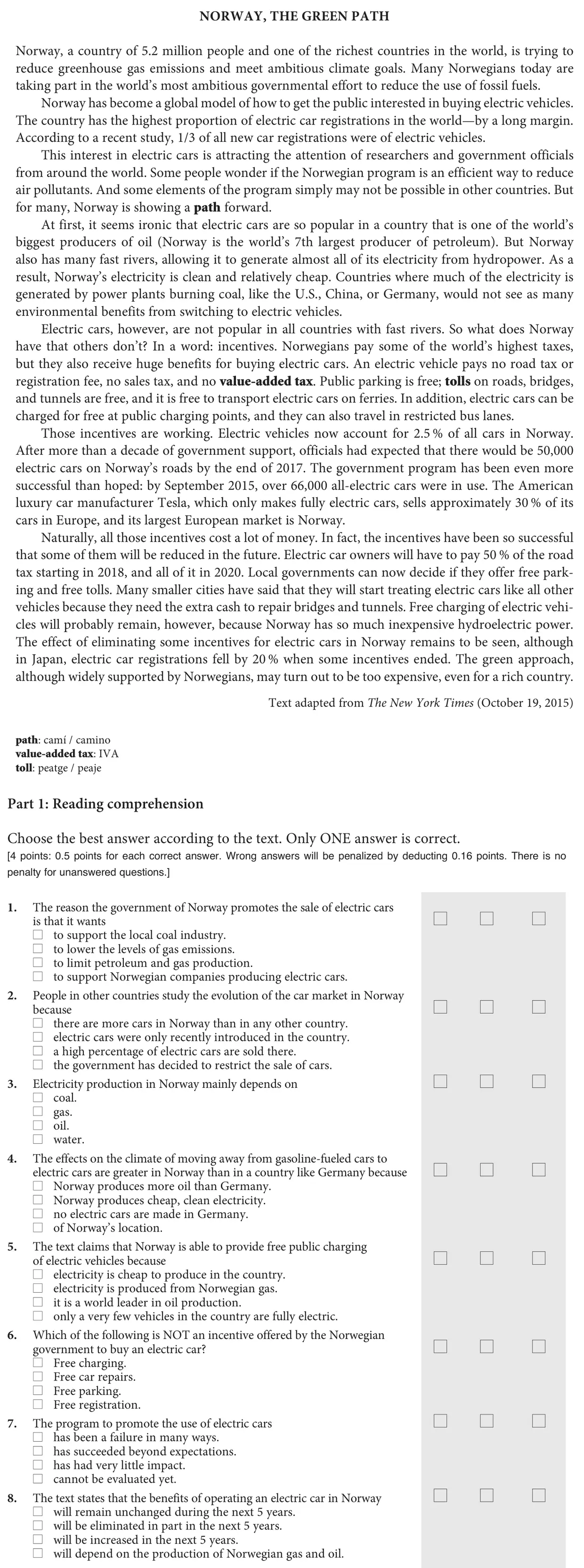
NORWAY, THE GREEN PATH
Norway, a country of 5.2 million people and one of the richest countries in the world, is trying to
reduce greenhouse gas emissions and meet ambitious climate goals. Many Norwegians today are
taking part in the world’s most ambitious governmental effort to reduce the use of fossil fuels.
Norway has become a global model of how to get the public interested in buying electric vehicles.
The country has the highest proportion of electric car registrations in the world—by a long margin.
According to a recent study, 1/3 of all new car registrations were of electric vehicles.
This interest in electric cars is attracting the attention of researchers and government officials
from around the world. Some people wonder if the Norwegian program is an efficient way to reduce
air pollutants. And some elements of the program simply may not be possible in other countries. But
for many, Norway is showing a path forward.
At first, it seems ironic that electric cars are so popular in a country that is one of the world’s
biggest producers of oil (Norway is the world’s 7th largest producer of petroleum). But Norway
also has many fast rivers, allowing it to generate almost all of its electricity from hydropower. As a
result, Norway’s electricity is clean and relatively cheap. Countries where much of the electricity is
generated by power plants burning coal, like the U.S., China, or Germany, would not see as many
environmental benefits from switching to electric vehicles.
Electric cars, however, are not popular in all countries with fast rivers. So what does Norway
have that others don’t? In a word: incentives. Norwegians pay some of the world’s highest taxes,
but they also receive huge benefits for buying electric cars. An electric vehicle pays no road tax or
registration fee, no sales tax, and no value-added tax. Public parking is free; tolls on roads, bridges,
and tunnels are free, and it is free to transport electric cars on ferries. In addition, electric cars can be
charged for free at public charging points, and they can also travel in restricted bus lanes.
Those incentives are working. Electric vehicles now account for 2.5 % of all cars in Norway.
After more than a decade of government support, officials had expected that there would be 50,000
electric cars on Norway’s roads by the end of 2017. The government program has been even more
successful than hoped: by September 2015, over 66,000 all-electric cars were in use. The American
luxury car manufacturer Tesla, which only makes fully electric cars, sells approximately 30 % of its
cars in Europe, and its largest European market is Norway.
Naturally, all those incentives cost a lot of money. In fact, the incentives have been so successful
that some of them will be reduced in the future. Electric car owners will have to pay 50 % of the road
tax starting in 2018, and all of it in 2020. Local governments can now decide if they offer free park
ing and free tolls. Many smaller cities have said that they will start treating electric cars like all other
vehicles because they need the extra cash to repair bridges and tunnels. Free charging of electric vehi
cles will probably remain, however, because Norway has so much inexpensive hydroelectric power.
The effect of eliminating some incentives for electric cars in Norway remains to be seen, although
in Japan, electric car registrations fell by 20 % when some incentives ended. The green approach,
although widely supported by Norwegians, may turn out to be too expensive, even for a rich country.
Text adapted from The New York Times (October 19, 2015)
path: camí / camino
value-added tax: IVA
toll: peatge / peaje
Part 1: Reading comprehension
Choose the best answer according to the text. Only ONE answer is correct.
[4 points: 0.5 points for each correct answer. Wrong answers will be penalized by deducting 0.16 points. There is no
penalty for unanswered questions.]
1. The reason the government of Norway promotes the sale of electric
Criteris oficials de correcció
Text dels criteris (transcripció automàtica)
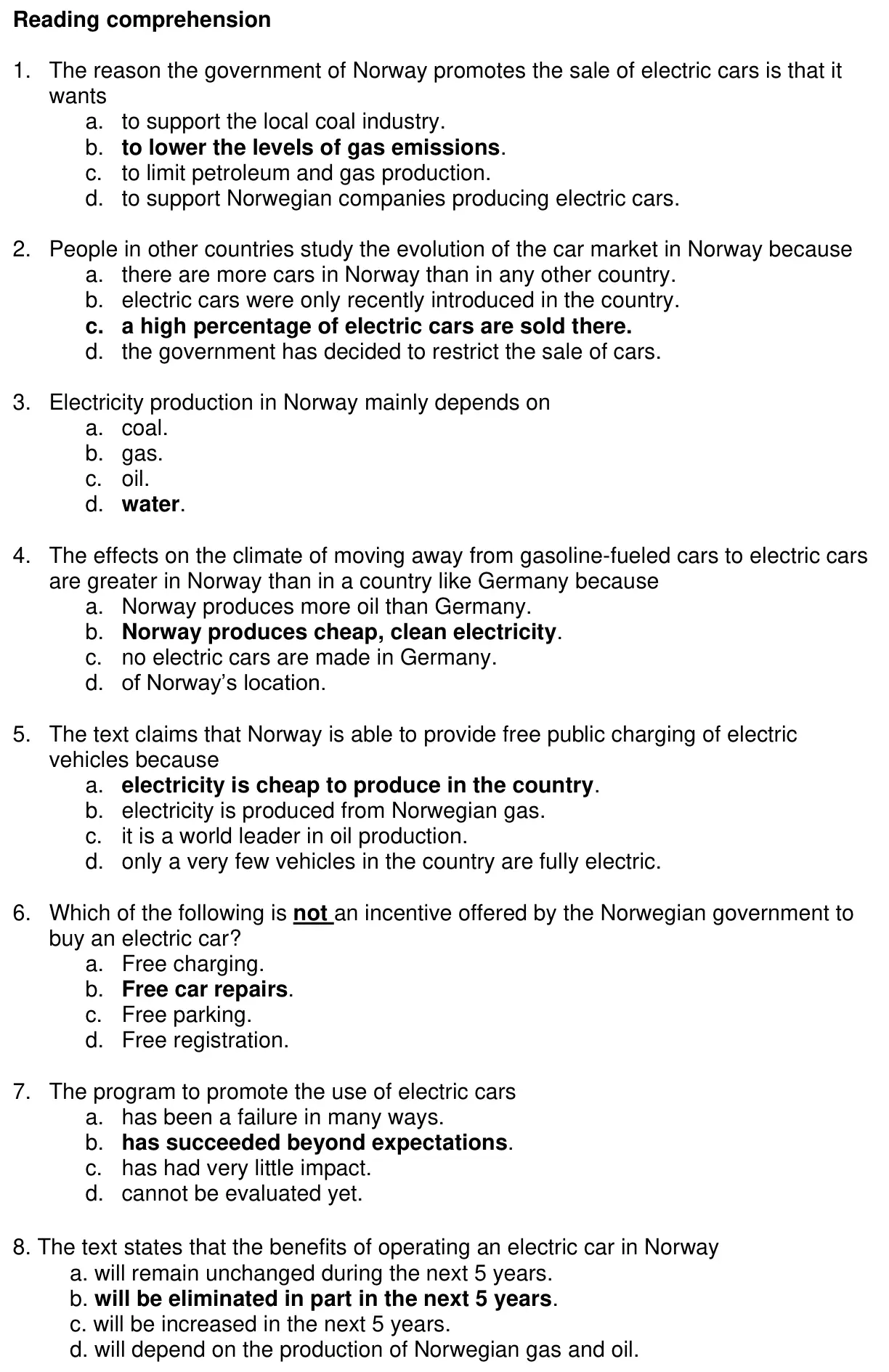
Reading comprehension
1. The reason the government of Norway promotes the sale of electric cars is that it
wants
a. to support the local coal industry.
b. to lower the levels of gas emissions.
c. to limit petroleum and gas production.
d. to support Norwegian companies producing electric cars.
2. People in other countries study the evolution of the car market in Norway because
a. there are more cars in Norway than in any other country.
b. electric cars were only recently introduced in the country.
c. a high percentage of electric cars are sold there.
d. the government has decided to restrict the sale of cars.
3. Electricity production in Norway mainly depends on
a. coal.
b. gas.
c. oil.
d. water.
4. The effects on the climate of moving away from gasoline-fueled cars to electric cars
are greater in Norway than in a country like Germany because
a. Norway produces more oil than Germany.
b. Norway produces cheap, clean electricity.
c. no electric cars are made in Germany.
d. of Norway’s loc […]
Resolució pas a pas
Encara no hi ha resolució pròpia verificada d'aquest exercici. Mentrestant, tens els criteris oficials de correcció a sobre. Si tens dubtes, pregunta'ls al xat de la Sala d'estudi.
Font: enunciat i criteris de correcció oficials de les PAU 2016 de Catalunya, publicats per la Generalitat de Catalunya (universitats.gencat.cat) i les universitats catalanes. La resolució pas a pas és pròpia de L'Acadèmia de Vic.
Altres exercicis d'aquest examen
- Part 2 · Writing Writing
- Part 3 · Listening comprehension Listening comprehension