
PAU Anglès 2015 · Juny · Sèrie 2 · Part 1 · Reading comprehension
Enunciat
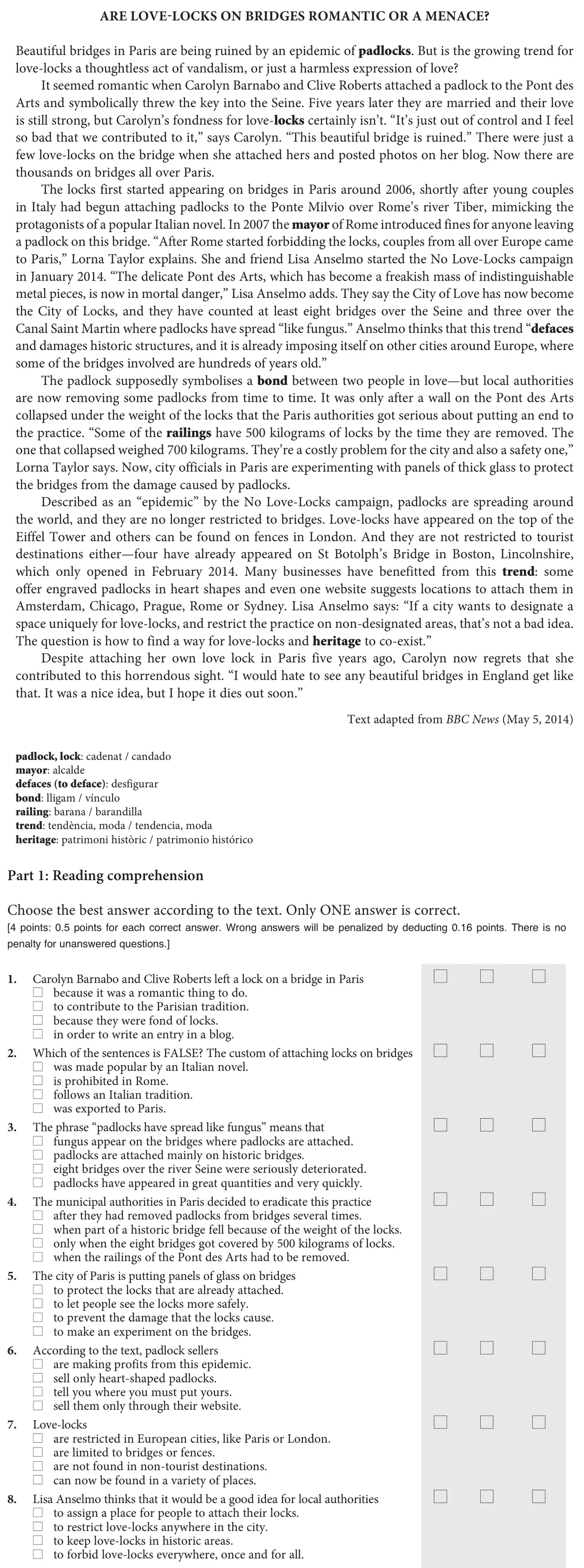
Text de l'enunciat (transcripció automàtica)
ARE LOVE-LOCKS ON BRIDGES ROMANTIC OR A MENACE?
Beautiful bridges in Paris are being ruined by an epidemic of padlocks. But is the growing trend for
love-locks a thoughtless act of vandalism, or just a harmless expression of love?
It seemed romantic when Carolyn Barnabo and Clive Roberts attached a padlock to the Pont des
Arts and symbolically threw the key into the Seine. Five years later they are married and their love
is still strong, but Carolyn’s fondness for love-locks certainly isn’t. “It’s just out of control and I feel
so bad that we contributed to it,” says Carolyn. “This beautiful bridge is ruined.” There were just a
few love-locks on the bridge when she attached hers and posted photos on her blog. Now there are
thousands on bridges all over Paris.
The locks first started appearing on bridges in Paris around 2006, shortly after young couples
in Italy had begun attaching padlocks to the Ponte Milvio over Rome’s river Tiber, mimicking the
protagonists of a popular Italian novel. In 2007 the mayor of Rome introduced fines for anyone leaving
a padlock on this bridge. “After Rome started forbidding the locks, couples from all over Europe came
to Paris,” Lorna Taylor explains. She and friend Lisa Anselmo started the No Love-Locks campaign
in January 2014. “The delicate Pont des Arts, which has become a freakish mass of indistinguishable
metal pieces, is now in mortal danger,” Lisa Anselmo adds. They say the City of Love has now become
the City of Locks, and they have counted at least eight bridges over the Seine and three over the
Canal Saint Martin where padlocks have spread “like fungus.” Anselmo thinks that this trend “defaces
and damages historic structures, and it is already imposing itself on other cities around Europe, where
some of the bridges involved are hundreds of years old.”
The padlock supposedly symbolises a bond between two people in love—but local authorities
are now removing some padlocks from time to time. It was only after a wall on the Pont des Arts
collapsed under the weight of the locks that the Paris authorities got serious about putting an end to
the practice. “Some of the railings have 500 kilograms of locks by the time they are removed. The
one that collapsed weighed 700 kilograms. They’re a costly problem for the city and also a safety one,”
Lorna Taylor says. Now, city officials in Paris are experimenting with panels of thick glass to protect
the bridges from the damage caused by padlocks.
Described as an “epidemic” by the No Love-Locks campaign, padlocks are spreading around
the world, and they are no longer restricted to bridges. Love-locks have appeared on the top of the
Eiffel Tower and others can be found on fences in London. And they are not restricted to tourist
destinations either—four have already appeared on St Botolph’s Bridge in Boston, Lincolnshire,
which only opened in February 2014. Many businesses have benefitted from this trend: some
offer engraved padlocks in heart shapes and even one website suggests locations to attach them in
Amsterdam, Chicago, Prague, Rome or Sydney. Lisa Anselmo says: “If a city wants to designate a
space uniquely for love-locks, and restrict the practice on non-designated areas, that’s not a bad idea.
The question is how to find a way for love-locks and heritage to co-exist.”
Despite attaching her own love lock in Paris five years ago, Carolyn now regrets that she
contributed to this horrendous sight. “I would hate to see any beautiful bridges in England get like
that. It was a nice idea, but I hope it dies out soon.”
Text adapted from BBC News (May 5, 2014)
padlock, lock: cadenat / candado
mayor: alcalde
defaces (to deface): desfigurar
bond: lligam / vínculo
railing: barana / barandilla
trend: tendència, moda / tendencia, moda
heritage: patrimoni històric / patrimonio histórico
Part 1: Reading comprehension
Choose the best answer according to the text. Only ONE answer is correct.
[4 points: 0.5 points for each correct answer. Wrong answers will be pen
Criteris oficials de correcció
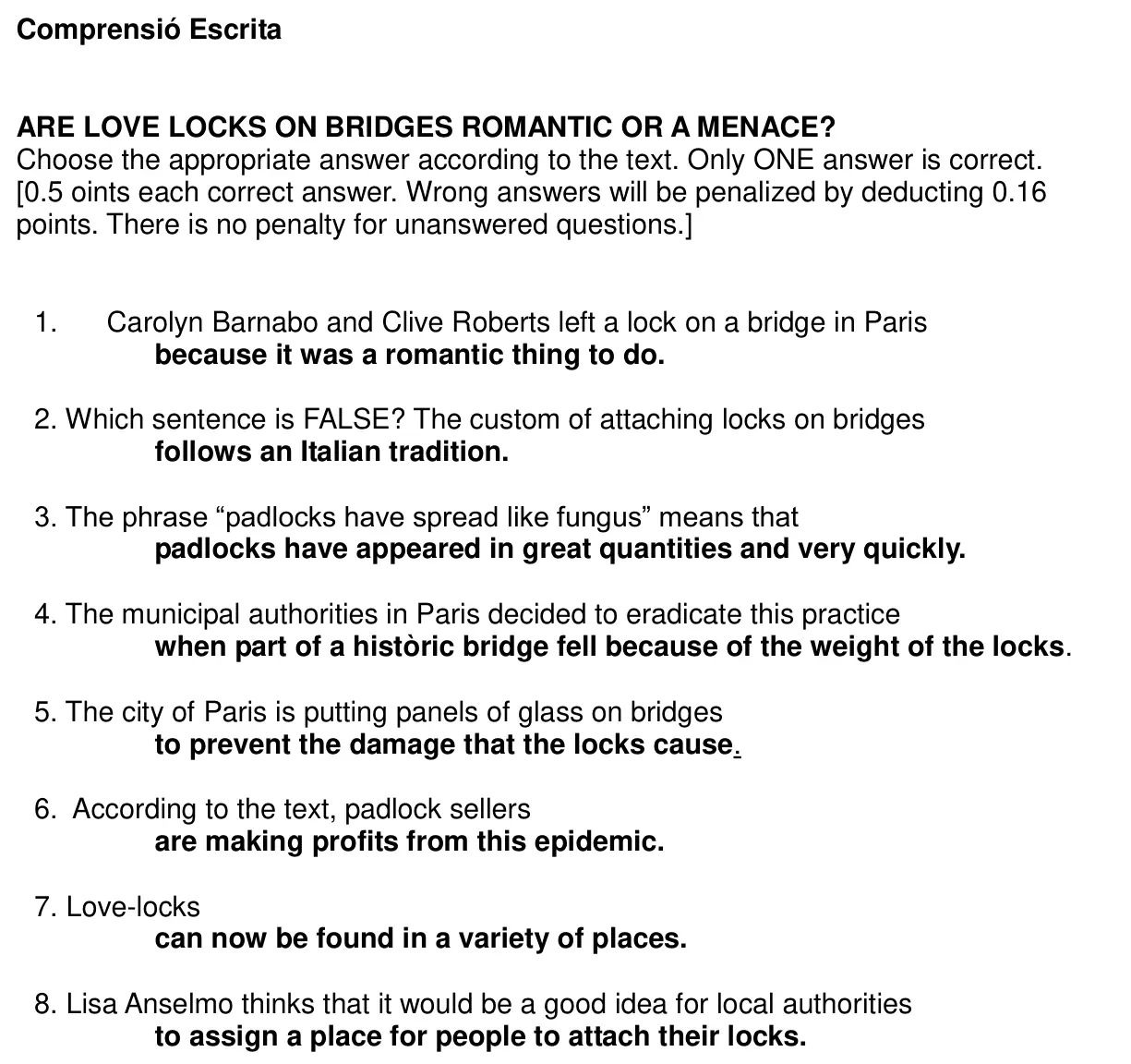
Text dels criteris (transcripció automàtica)
Comprensió Escrita
ARE LOVE LOCKS ON BRIDGES ROMANTIC OR A MENACE?
Choose the appropriate answer according to the text. Only ONE answer is correct.
[0.5 oints each correct answer. Wrong answers will be penalized by deducting 0.16
points. There is no penalty for unanswered questions.]
1. Carolyn Barnabo and Clive Roberts left a lock on a bridge in Paris
because it was a romantic thing to do.
2. Which sentence is FALSE? The custom of attaching locks on bridges
follows an Italian tradition.
3. The phrase “padlocks have spread like fungus” means that
padlocks have appeared in great quantities and very quickly.
4. The municipal authorities in Paris decided to eradicate this practice
when part of a històric bridge fell because of the weight of the locks.
5. The city of Paris is putting panels of glass on bridges
to prevent the damage that the locks cause.
6. According to the text, padlock sellers
are making profits from this epidemic.
7. Love-locks
can now be found in a variety of places.
8. […]
Resolució pas a pas
Encara no hi ha resolució pròpia verificada d'aquest exercici. Mentrestant, tens els criteris oficials de correcció a sobre. Si tens dubtes, pregunta'ls al xat de la Sala d'estudi.
Font: enunciat i criteris de correcció oficials de les PAU 2015 de Catalunya, publicats per la Generalitat de Catalunya (universitats.gencat.cat) i les universitats catalanes. La resolució pas a pas és pròpia de L'Acadèmia de Vic.
Altres exercicis d'aquest examen
- Part 2 · Writing Writing
- Part 3 · Listening comprehension Listening comprehension