
PAU Anglès 2015 · Setembre · Sèrie 5 · Part 3 · Listening comprehension
Enunciat
Text de l'enunciat (transcripció automàtica)
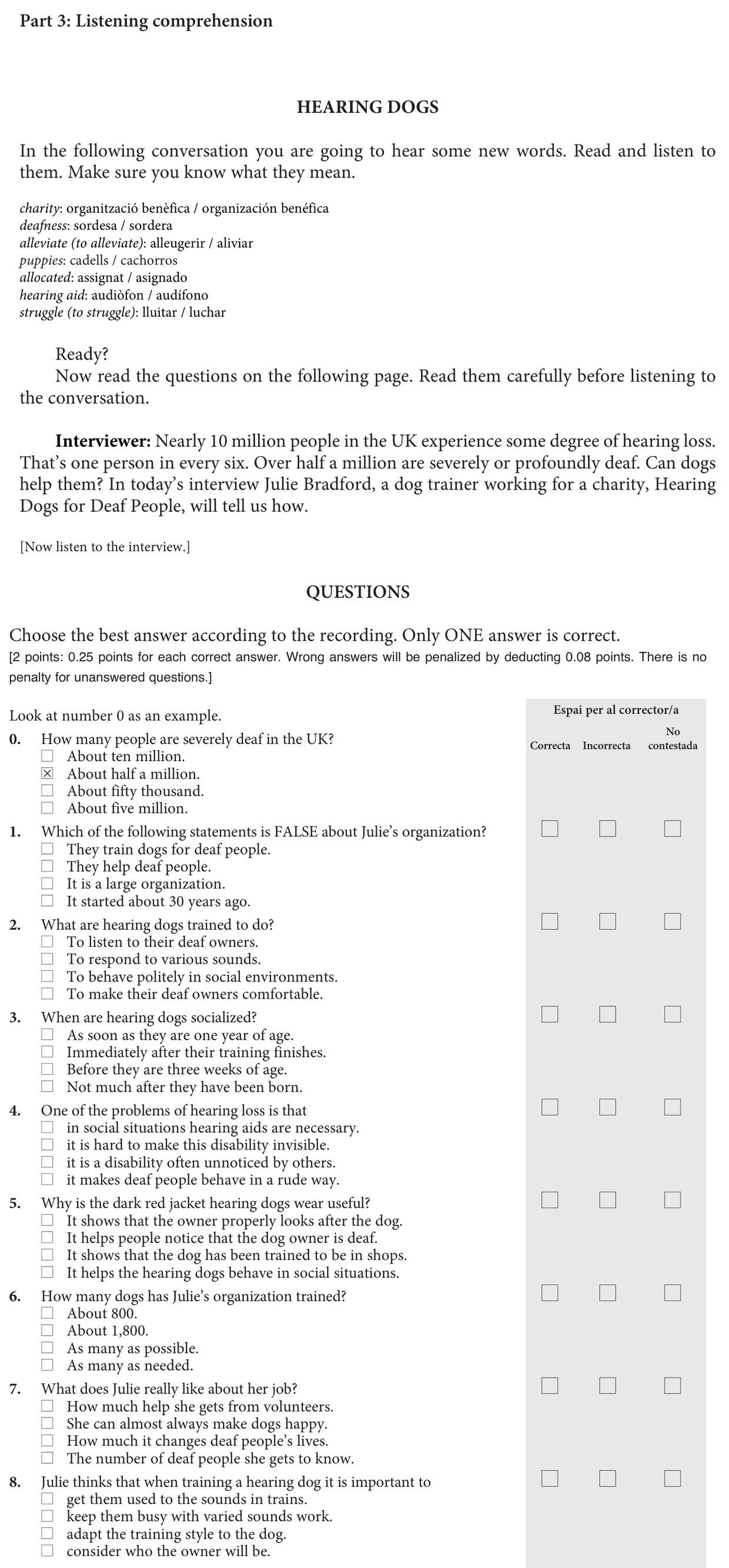
Part 3: Listening comprehension
HEARING DOGS
In the following conversation you are going to hear some new words. Read and listen to
them. Make sure you know what they mean.
charity: organització benèfica / organización benéfica
deafness: sordesa / sordera
alleviate (to alleviate): alleugerir / aliviar
puppies: cadells / cachorros
allocated: assignat / asignado
hearing aid: audiòfon / audífono
struggle (to struggle): lluitar / luchar
Ready?
Now read the questions on the following page. Read them carefully before listening to
the conversation.
Interviewer: Nearly 10 million people in the UK experience some degree of hearing loss.
That’s one person in every six. Over half a million are severely or profoundly deaf. Can dogs
help them? In today’s interview Julie Bradford, a dog trainer working for a charity, Hearing
Dogs for Deaf People, will tell us how.
[Now listen to the interview.]
QUESTIONS
Choose the best answer according to the recording. Only ONE answer is correct.
[2 points: 0.25 points for each correct answer. Wrong answers will be penalized by deducting 0.08 points. There is no
penalty for unanswered questions.]
Look at number 0 as an example.
0. How many people are severely deaf in the UK?
About ten million.
× About half a million.
About fifty thousand.
About five million.
1. Which of the following statements is FALSE about Julie’s organization?
They train dogs for deaf people.
They help deaf people.
It is a large organization.
It started about 30 years ago.
2. What are hearing dogs trained to do?
To listen to their deaf owners.
To respond to various sounds.
To behave politely in social environments.
To make their deaf owners comfortable.
3. When are hearing dogs socialized?
As soon as they are one year of age.
Immediately after their training finishes.
Before they are three weeks of age.
Not much after they have been born.
4. One of the problems of hearing loss is that
in social situations hearing aids are necessary.
it is hard to make this disability invisible.
it is a disability often unnoticed by others.
it makes deaf people behave in a rude way.
5. Why is the dark red jacket hearing dogs wear useful?
It shows that the owner properly looks after the dog.
It helps people notice that the dog owner is deaf.
It shows that the dog has been trained to be in shops.
It helps the hearing dogs behave in social situations.
6. How many dogs has Julie’s organization trained?
About 800.
About 1,800.
As many as possible.
As many as needed.
7. What does Julie really like about her job?
How much help she gets from volunteers.
She can almost always make dogs happy.
How much it changes deaf people’s lives.
The number of deaf people she gets to know.
8. Julie thinks that when training a hearing dog it is important to
get them used to the sounds in trains.
keep them busy with varied sounds work.
adapt the training style to the dog.
consider who the owner will be.
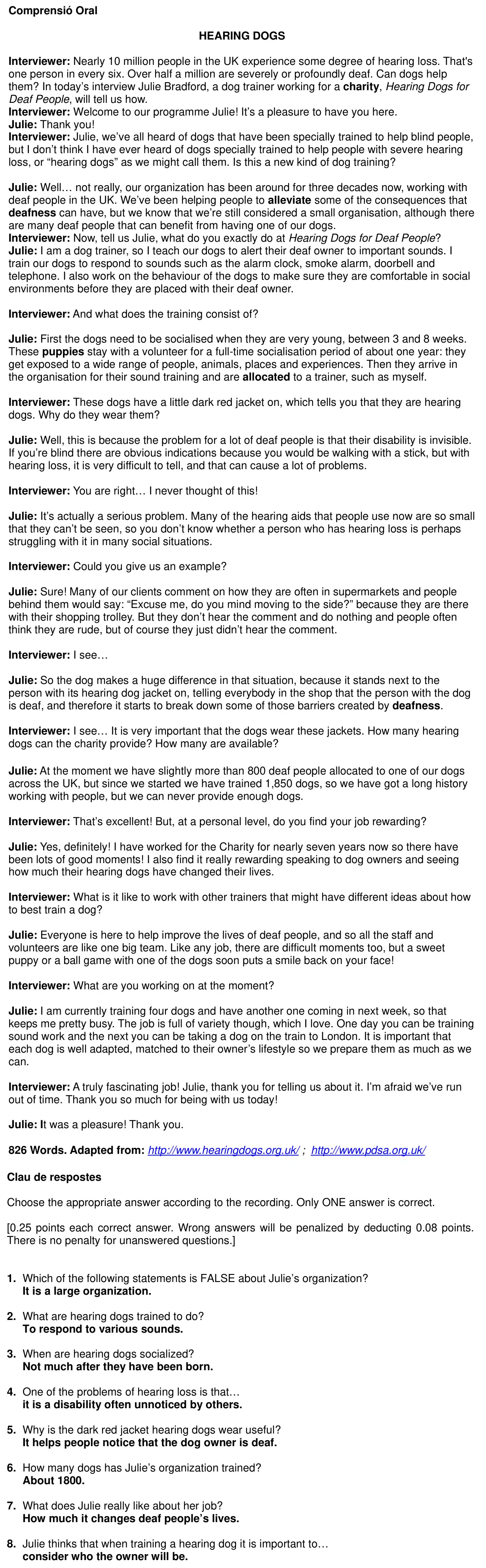
Criteris oficials de correcció
Resolució pas a pas
Aquest exercici no té una resolució escrita pas a pas (requereix l'àudio de la prova). Fes servir els criteris oficials de correcció.
Font: enunciat i criteris de correcció oficials de les PAU 2015 de Catalunya, publicats per la Generalitat de Catalunya (universitats.gencat.cat) i les universitats catalanes. La resolució pas a pas és pròpia de L'Acadèmia de Vic.
Altres exercicis d'aquest examen
- Part 1 · Reading comprehension Reading comprehension
- Part 2 · Writing Writing
Tots els exercicis de Listening comprehension · PAU de Anglès