
PAU Anglès 2014 · Juny · Sèrie 4 · Part 1 · Reading comprehension
Enunciat
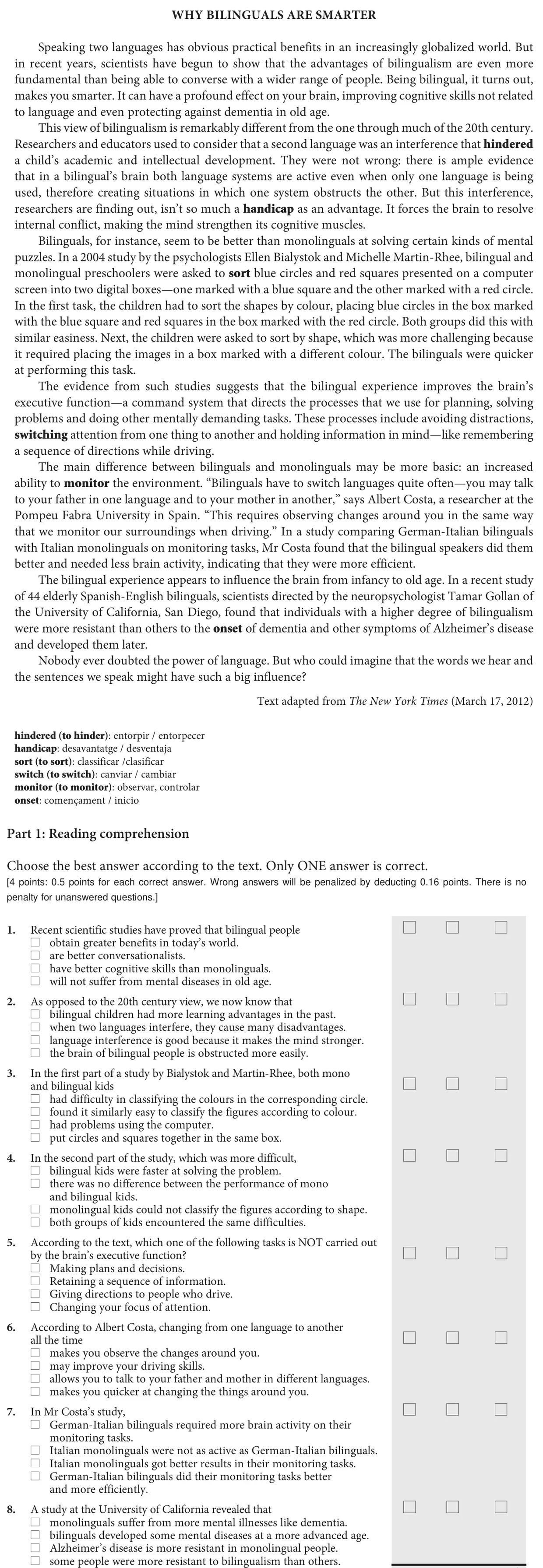
Text de l'enunciat (transcripció automàtica)
WHY BILINGUALS ARE SMARTER
Speaking two languages has obvious practical benefits in an increasingly globalized world. But
in recent years, scientists have begun to show that the advantages of bilingualism are even more
fundamental than being able to converse with a wider range of people. Being bilingual, it turns out,
makes you smarter. It can have a profound effect on your brain, improving cognitive skills not related
to language and even protecting against dementia in old age.
This view of bilingualism is remarkably different from the one through much of the 20th century.
Researchers and educators used to consider that a second language was an interference that hindered
a child’s academic and intellectual development. They were not wrong: there is ample evidence
that in a bilingual’s brain both language systems are active even when only one language is being
used, therefore creating situations in which one system obstructs the other. But this interference,
researchers are finding out, isn’t so much a handicap as an advantage. It forces the brain to resolve
internal conflict, making the mind strengthen its cognitive muscles.
Bilinguals, for instance, seem to be better than monolinguals at solving certain kinds of mental
puzzles. In a 2004 study by the psychologists Ellen Bialystok and Michelle Martin-Rhee, bilingual and
monolingual preschoolers were asked to sort blue circles and red squares presented on a computer
screen into two digital boxes—one marked with a blue square and the other marked with a red circle.
In the first task, the children had to sort the shapes by colour, placing blue circles in the box marked
with the blue square and red squares in the box marked with the red circle. Both groups did this with
similar easiness. Next, the children were asked to sort by shape, which was more challenging because
it required placing the images in a box marked with a different colour. The bilinguals were quicker
at performing this task.
The evidence from such studies suggests that the bilingual experience improves the brain’s
executive function—a command system that directs the processes that we use for planning, solving
problems and doing other mentally demanding tasks. These processes include avoiding distractions,
switching attention from one thing to another and holding information in mind—like remembering
a sequence of directions while driving.
The main difference between bilinguals and monolinguals may be more basic: an increased
ability to monitor the environment. “Bilinguals have to switch languages quite often—you may talk
to your father in one language and to your mother in another,” says Albert Costa, a researcher at the
Pompeu Fabra University in Spain. “This requires observing changes around you in the same way
that we monitor our surroundings when driving.” In a study comparing German-Italian bilinguals
with Italian monolinguals on monitoring tasks, Mr Costa found that the bilingual speakers did them
better and needed less brain activity, indicating that they were more efficient.
The bilingual experience appears to influence the brain from infancy to old age. In a recent study
of 44 elderly Spanish-English bilinguals, scientists directed by the neuropsychologist Tamar Gollan of
the University of California, San Diego, found that individuals with a higher degree of bilingualism
were more resistant than others to the onset of dementia and other symptoms of Alzheimer’s disease
and developed them later.
Nobody ever doubted the power of language. But who could imagine that the words we hear and
the sentences we speak might have such a big influence?
Text adapted from The New York Times (March 17, 2012)
hindered (to hinder): entorpir / entorpecer
handicap: desavantatge / desventaja
sort (to sort): classificar /clasificar
switch (to switch): canviar / cambiar
monitor (to monitor): observar, controlar
onset: començament / inicio
Part 1: Reading comprehension
Choose the best answer according to the text. Only ONE answer
Criteris oficials de correcció
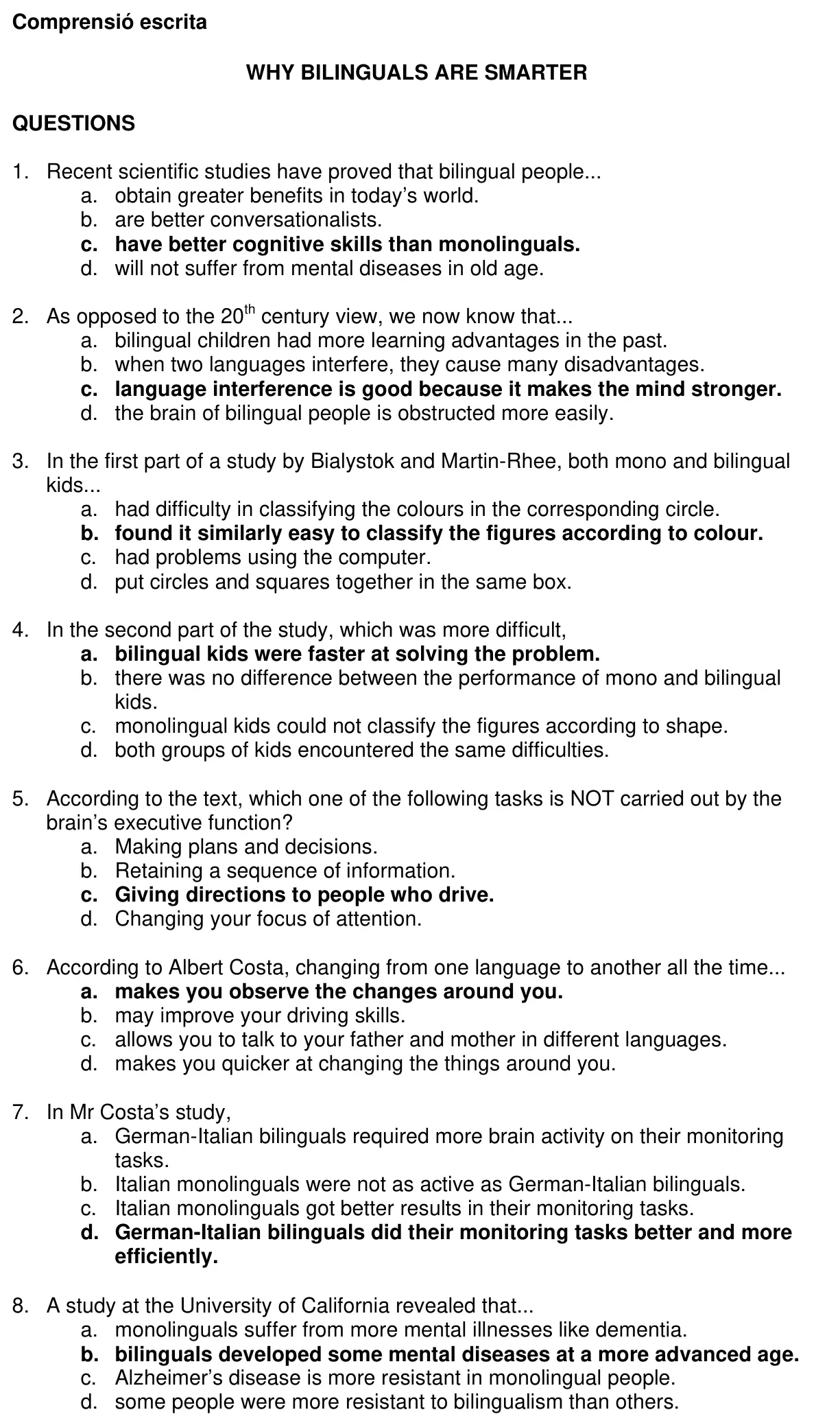
Text dels criteris (transcripció automàtica)
Comprensió escrita
WHY BILINGUALS ARE SMARTER
QUESTIONS
1. Recent scientific studies have proved that bilingual people...
a. obtain greater benefits in today’s world.
b. are better conversationalists.
c. have better cognitive skills than monolinguals.
d. will not suffer from mental diseases in old age.
2. As opposed to the 20th century view, we now know that...
a. bilingual children had more learning advantages in the past.
b. when two languages interfere, they cause many disadvantages.
c. language interference is good because it makes the mind stronger.
d. the brain of bilingual people is obstructed more easily.
3. In the first part of a study by Bialystok and Martin-Rhee, both mono and bilingual
kids...
a. had difficulty in classifying the colours in the corresponding circle.
b. found it similarly easy to classify the figures according to colour.
c. had problems using the computer.
d. put circles and squares together in the same box.
4. In the second part of the study, which was more […]
Resolució pas a pas
Encara no hi ha resolució pròpia verificada d'aquest exercici. Mentrestant, tens els criteris oficials de correcció a sobre. Si tens dubtes, pregunta'ls al xat de la Sala d'estudi.
Font: enunciat i criteris de correcció oficials de les PAU 2014 de Catalunya, publicats per la Generalitat de Catalunya (universitats.gencat.cat) i les universitats catalanes. La resolució pas a pas és pròpia de L'Acadèmia de Vic.
Altres exercicis d'aquest examen
- Part 2 · Writing Writing
- Part 3 · Listening comprehension Listening comprehension