
PAU Anglès 2014 · Juny · Sèrie 4 · Part 3 · Listening comprehension
Enunciat
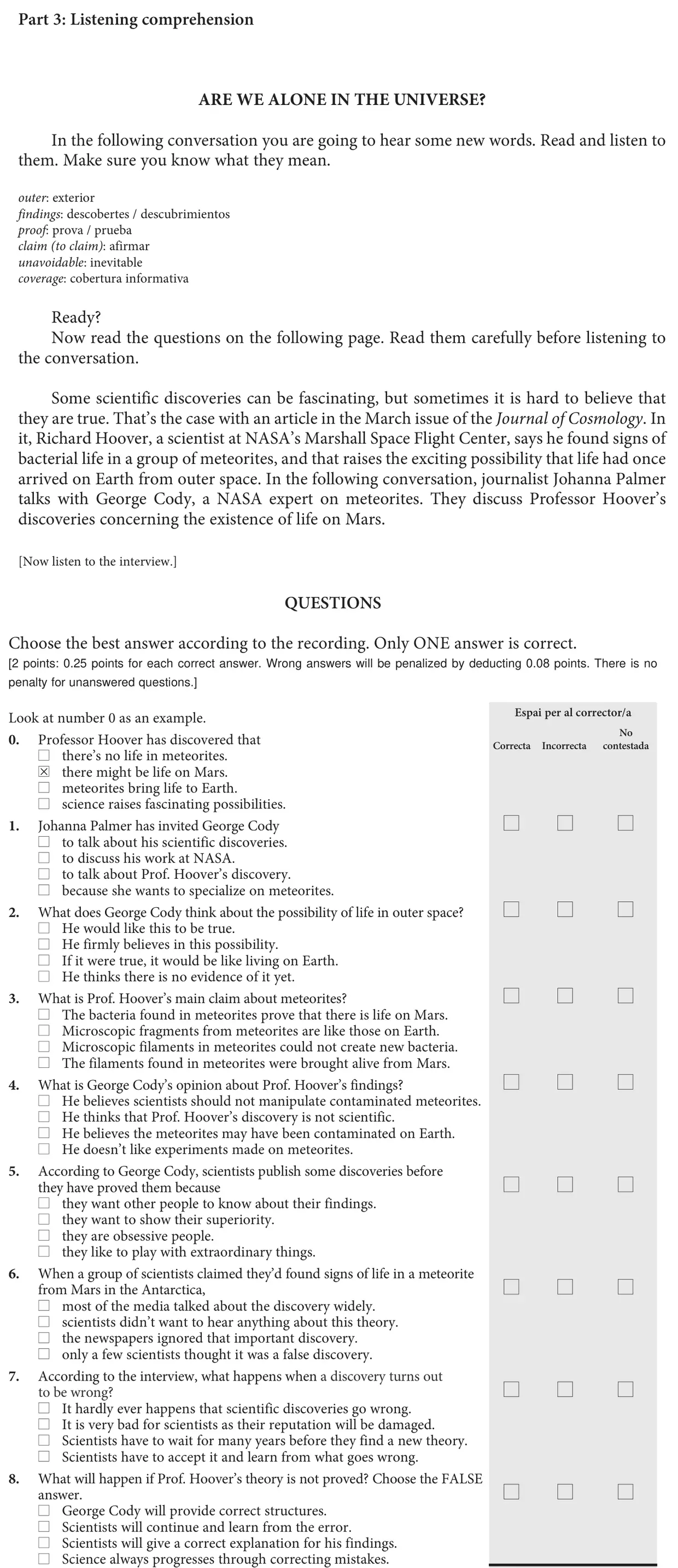
Text de l'enunciat (transcripció automàtica)
Part 3: Listening comprehension
ARE WE ALONE IN THE UNIVERSE?
In the following conversation you are going to hear some new words. Read and listen to
them. Make sure you know what they mean.
outer: exterior
findings: descobertes / descubrimientos
proof: prova / prueba
claim (to claim): afirmar
unavoidable: inevitable
coverage: cobertura informativa
Ready?
Now read the questions on the following page. Read them carefully before listening to
the conversation.
Some scientific discoveries can be fascinating, but sometimes it is hard to believe that
they are true. That’s the case with an article in the March issue of the Journal of Cosmology. In
it, Richard Hoover, a scientist at NASA’s Marshall Space Flight Center, says he found signs of
bacterial life in a group of meteorites, and that raises the exciting possibility that life had once
arrived on Earth from outer space. In the following conversation, journalist Johanna Palmer
talks with George Cody, a NASA expert on meteorites. They discuss Professor Hoover’s
discoveries concerning the existence of life on Mars.
[Now listen to the interview.]
QUESTIONS
Choose the best answer according to the recording. Only ONE answer is correct.
[2 points: 0.25 points for each correct answer. Wrong answers will be penalized by deducting 0.08 points. There is no
penalty for unanswered questions.]
Look at number 0 as an example.
0. Professor Hoover has discovered that
there’s no life in meteorites.
× there might be life on Mars.
meteorites bring life to Earth.
science raises fascinating possibilities.
1. Johanna Palmer has invited George Cody
to talk about his scientific discoveries.
to discuss his work at NASA.
to talk about Prof. Hoover’s discovery.
because she wants to specialize on meteorites.
2. What does George Cody think about the possibility of life in outer space?
He would like this to be true.
He firmly believes in this possibility.
If it were true, it would be like living on Earth.
He thinks there is no evidence of it yet.
3. What is Prof. Hoover’s main claim about meteorites?
The bacteria found in meteorites prove that there is life on Mars.
Microscopic fragments from meteorites are like those on Earth.
Microscopic filaments in meteorites could not create new bacteria.
The filaments found in meteorites were brought alive from Mars.
4. What is George Cody’s opinion about Prof. Hoover’s findings?
He believes scientists should not manipulate contaminated meteorites.
He thinks that Prof. Hoover’s discovery is not scientific.
He believes the meteorites may have been contaminated on Earth.
He doesn’t like experiments made on meteorites.
5. According to George Cody, scientists publish some discoveries before
they have proved them because
they want other people to know about their findings.
they want to show their superiority.
they are obsessive people.
they like to play with extraordinary things.
6. When a group of scientists claimed they’d found signs of life in a meteorite
from Mars in the Antarctica,
most of the media talked about the discovery widely.
scientists didn’t want to hear anything about this theory.
the newspapers ignored that important discovery.
only a few scientists thought it was a false discovery.
7. According to the interview, what happens when a discovery turns out
to be wrong?
It hardly ever happens that scientific discoveries go wrong.
It is very bad for scientists as their reputation will be damaged.
Scientists have to wait for many years before they find a new theory.
Scientists have to accept it and learn from what goes wrong.
8. What will happen if Prof. Hoover’s theory is not proved? Choose the FALSE
answer.
George Cody will provide correct structures.
Scientists will continue and learn from the error.
Scientists will give a correct explanation for his findings.
Science always progresses through correcting mistakes.
Correctes Incorrectes No contestades
Criteris oficials de correcció

Resolució pas a pas
Aquest exercici no té una resolució escrita pas a pas (requereix l'àudio de la prova). Fes servir els criteris oficials de correcció.
Font: enunciat i criteris de correcció oficials de les PAU 2014 de Catalunya, publicats per la Generalitat de Catalunya (universitats.gencat.cat) i les universitats catalanes. La resolució pas a pas és pròpia de L'Acadèmia de Vic.
Altres exercicis d'aquest examen
- Part 1 · Reading comprehension Reading comprehension
- Part 2 · Writing Writing
Tots els exercicis de Listening comprehension · PAU de Anglès