
PAU Anglès 2013 · Setembre · Sèrie 1 · Part 1 · Reading comprehension
Enunciat
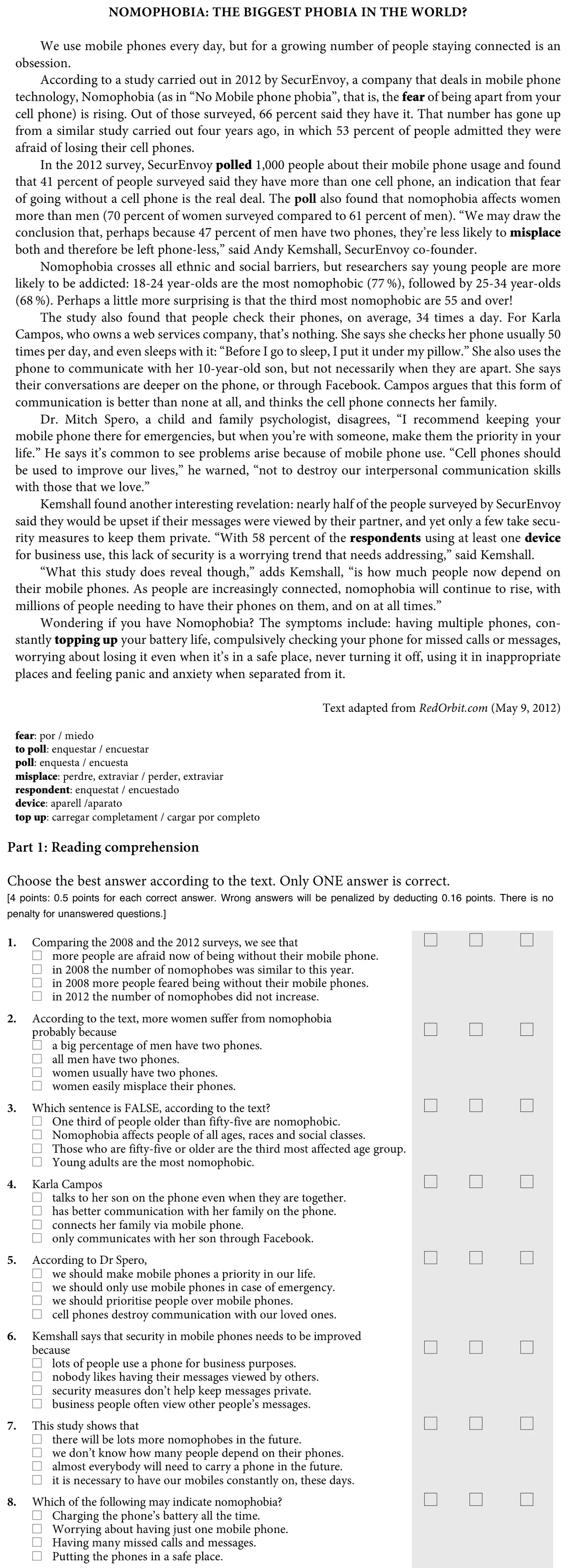
Text de l'enunciat (transcripció automàtica)
NOMOPHOBIA: THE BIGGEST PHOBIA IN THE WORLD?
We use mobile phones every day, but for a growing number of people staying connected is an
obsession.
According to a study carried out in 2012 by SecurEnvoy, a company that deals in mobile phone
technology, Nomophobia (as in “No Mobile phone phobia”, that is, the fear of being apart from your
cell phone) is rising. Out of those surveyed, 66 percent said they have it. That number has gone up
from a similar study carried out four years ago, in which 53 percent of people admitted they were
afraid of losing their cell phones.
In the 2012 survey, SecurEnvoy polled 1,000 people about their mobile phone usage and found
that 41 percent of people surveyed said they have more than one cell phone, an indication that fear
of going without a cell phone is the real deal. The poll also found that nomophobia affects women
more than men (70 percent of women surveyed compared to 61 percent of men). “We may draw the
conclusion that, perhaps because 47 percent of men have two phones, they’re less likely to misplace
both and therefore be left phone-less,” said Andy Kemshall, SecurEnvoy co-founder.
Nomophobia crosses all ethnic and social barriers, but researchers say young people are more
likely to be addicted: 18-24 year-olds are the most nomophobic (77 %), followed by 25-34 year-olds
(68 %). Perhaps a little more surprising is that the third most nomophobic are 55 and over!
The study also found that people check their phones, on average, 34 times a day. For Karla
Campos, who owns a web services company, that’s nothing. She says she checks her phone usually 50
times per day, and even sleeps with it: “Before I go to sleep, I put it under my pillow.” She also uses the
phone to communicate with her 10-year-old son, but not necessarily when they are apart. She says
their conversations are deeper on the phone, or through Facebook. Campos argues that this form of
communication is better than none at all, and thinks the cell phone connects her family.
Dr. Mitch Spero, a child and family psychologist, disagrees, “I recommend keeping your
mobile phone there for emergencies, but when you’re with someone, make them the priority in your
life.” He says it’s common to see problems arise because of mobile phone use. “Cell phones should
be used to improve our lives,” he warned, “not to destroy our interpersonal communication skills
with those that we love.”
Kemshall found another interesting revelation: nearly half of the people surveyed by SecurEnvoy
said they would be upset if their messages were viewed by their partner, and yet only a few take secu-
rity measures to keep them private. “With 58 percent of the respondents using at least one device
for business use, this lack of security is a worrying trend that needs addressing,” said Kemshall.
“What this study does reveal though,” adds Kemshall, “is how much people now depend on
their mobile phones. As people are increasingly connected, nomophobia will continue to rise, with
millions of people needing to have their phones on them, and on at all times.”
Wondering if you have Nomophobia? The symptoms include: having multiple phones, con-
stantly topping up your battery life, compulsively checking your phone for missed calls or messages,
worrying about losing it even when it’s in a safe place, never turning it off, using it in inappropriate
places and feeling panic and anxiety when separated from it.
Text adapted from RedOrbit.com (May 9, 2012)
fear: por / miedo
to poll: enquestar / encuestar
poll: enquesta / encuesta
misplace: perdre, extraviar / perder, extraviar
respondent: enquestat / encuestado
device: aparell /aparato
top up: carregar completament / cargar por completo
Part 1: Reading comprehension
Choose the best answer according to the text. Only ONE answer is correct.
[4 points: 0.5 points for each correct answer. Wrong answers will be penalized by deducting 0.16 points. There is no
penalty for unanswered questions.]
1. Comparing the 2008 and the 2012 surveys
Criteris oficials de correcció
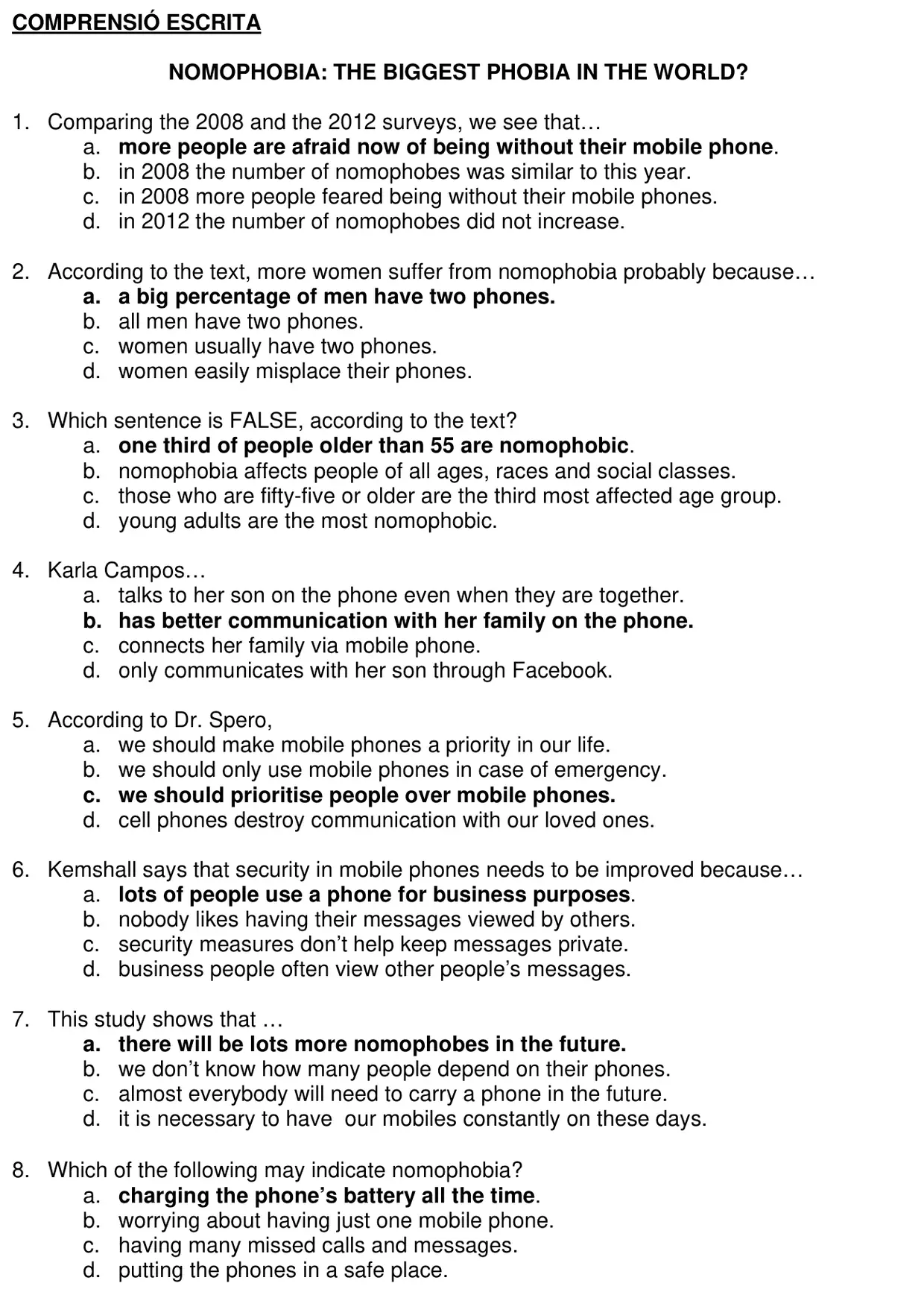
Text dels criteris (transcripció automàtica)
COMPRENSIÓ ESCRITA
NOMOPHOBIA: THE BIGGEST PHOBIA IN THE WORLD?
1. Comparing the 2008 and the 2012 surveys, we see that…
a. more people are afraid now of being without their mobile phone.
b. in 2008 the number of nomophobes was similar to this year.
c. in 2008 more people feared being without their mobile phones.
d. in 2012 the number of nomophobes did not increase.
2. According to the text, more women suffer from nomophobia probably because…
a. a big percentage of men have two phones.
b. all men have two phones.
c. women usually have two phones.
d. women easily misplace their phones.
3. Which sentence is FALSE, according to the text?
a. one third of people older than 55 are nomophobic.
b. nomophobia affects people of all ages, races and social classes.
c. those who are fifty-five or older are the third most affected age group.
d. young adults are the most nomophobic.
4. Karla Campos…
a. talks to her son on the phone even when they are together.
b. has better communication with her fam […]
Resolució pas a pas
Encara no hi ha resolució pròpia verificada d'aquest exercici. Mentrestant, tens els criteris oficials de correcció a sobre. Si tens dubtes, pregunta'ls al xat de la Sala d'estudi.
Font: enunciat i criteris de correcció oficials de les PAU 2013 de Catalunya, publicats per la Generalitat de Catalunya (universitats.gencat.cat) i les universitats catalanes. La resolució pas a pas és pròpia de L'Acadèmia de Vic.
Altres exercicis d'aquest examen
- Part 2 · Writing Writing
- Part 3 · Listening comprehension Listening comprehension