
PAU Anglès 2014 · Juny · Sèrie 3 · Part 1 · Reading comprehension
Enunciat
Text de l'enunciat (transcripció automàtica)
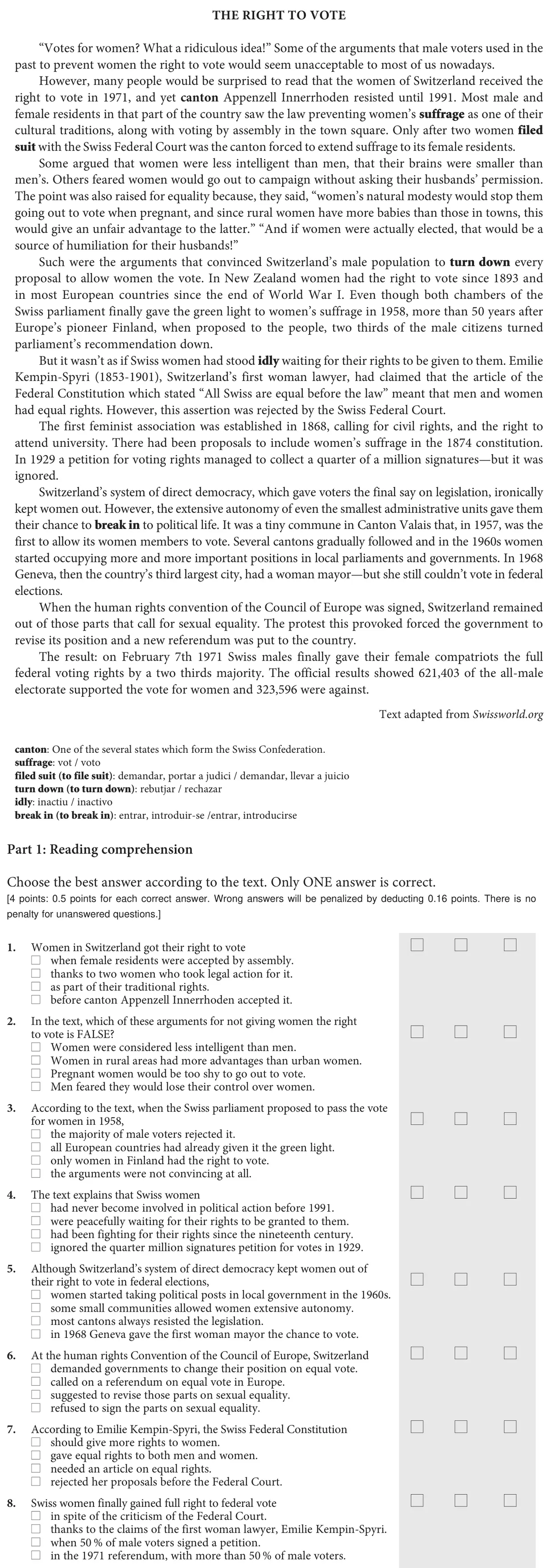
THE RIGHT TO VOTE
“Votes for women? What a ridiculous idea!” Some of the arguments that male voters used in the
past to prevent women the right to vote would seem unacceptable to most of us nowadays.
However, many people would be surprised to read that the women of Switzerland received the
right to vote in 1971, and yet canton Appenzell Innerrhoden resisted until 1991. Most male and
female residents in that part of the country saw the law preventing women’s suffrage as one of their
cultural traditions, along with voting by assembly in the town square. Only after two women filed
suit with the Swiss Federal Court was the canton forced to extend suffrage to its female residents.
Some argued that women were less intelligent than men, that their brains were smaller than
men’s. Others feared women would go out to campaign without asking their husbands’ permission.
The point was also raised for equality because, they said, “women’s natural modesty would stop them
going out to vote when pregnant, and since rural women have more babies than those in towns, this
would give an unfair advantage to the latter.” “And if women were actually elected, that would be a
source of humiliation for their husbands!”
Such were the arguments that convinced Switzerland’s male population to turn down every
proposal to allow women the vote. In New Zealand women had the right to vote since 1893 and
in most European countries since the end of World War I. Even though both chambers of the
Swiss parliament finally gave the green light to women’s suffrage in 1958, more than 50 years after
Europe’s pioneer Finland, when proposed to the people, two thirds of the male citizens turned
parliament’s recommendation down.
But it wasn’t as if Swiss women had stood idly waiting for their rights to be given to them. Emilie
Kempin-Spyri (1853-1901), Switzerland’s first woman lawyer, had claimed that the article of the
Federal Constitution which stated “All Swiss are equal before the law” meant that men and women
had equal rights. However, this assertion was rejected by the Swiss Federal Court.
The first feminist association was established in 1868, calling for civil rights, and the right to
attend university. There had been proposals to include women’s suffrage in the 1874 constitution.
In 1929 a petition for voting rights managed to collect a quarter of a million signatures—but it was
ignored.
Switzerland’s system of direct democracy, which gave voters the final say on legislation, ironically
kept women out. However, the extensive autonomy of even the smallest administrative units gave them
their chance to break in to political life. It was a tiny commune in Canton Valais that, in 1957, was the
first to allow its women members to vote. Several cantons gradually followed and in the 1960s women
started occupying more and more important positions in local parliaments and governments. In 1968
Geneva, then the country’s third largest city, had a woman mayor—but she still couldn’t vote in federal
elections.
When the human rights convention of the Council of Europe was signed, Switzerland remained
out of those parts that call for sexual equality. The protest this provoked forced the government to
revise its position and a new referendum was put to the country.
The result: on February 7th 1971 Swiss males finally gave their female compatriots the full
federal voting rights by a two thirds majority. The official results showed 621,403 of the all-male
electorate supported the vote for women and 323,596 were against.
Text adapted from Swissworld.org
canton: One of the several states which form the Swiss Confederation.
suffrage: vot / voto
filed suit (to file suit): demandar, portar a judici / demandar, llevar a juicio
turn down (to turn down): rebutjar / rechazar
idly: inactiu / inactivo
break in (to break in): entrar, introduir-se /entrar, introducirse
Part 1: Reading comprehension
Choose the best answer according to the text. Only ONE answer is correct.
[4 points: 0.5 points for
Criteris oficials de correcció
Text dels criteris (transcripció automàtica)
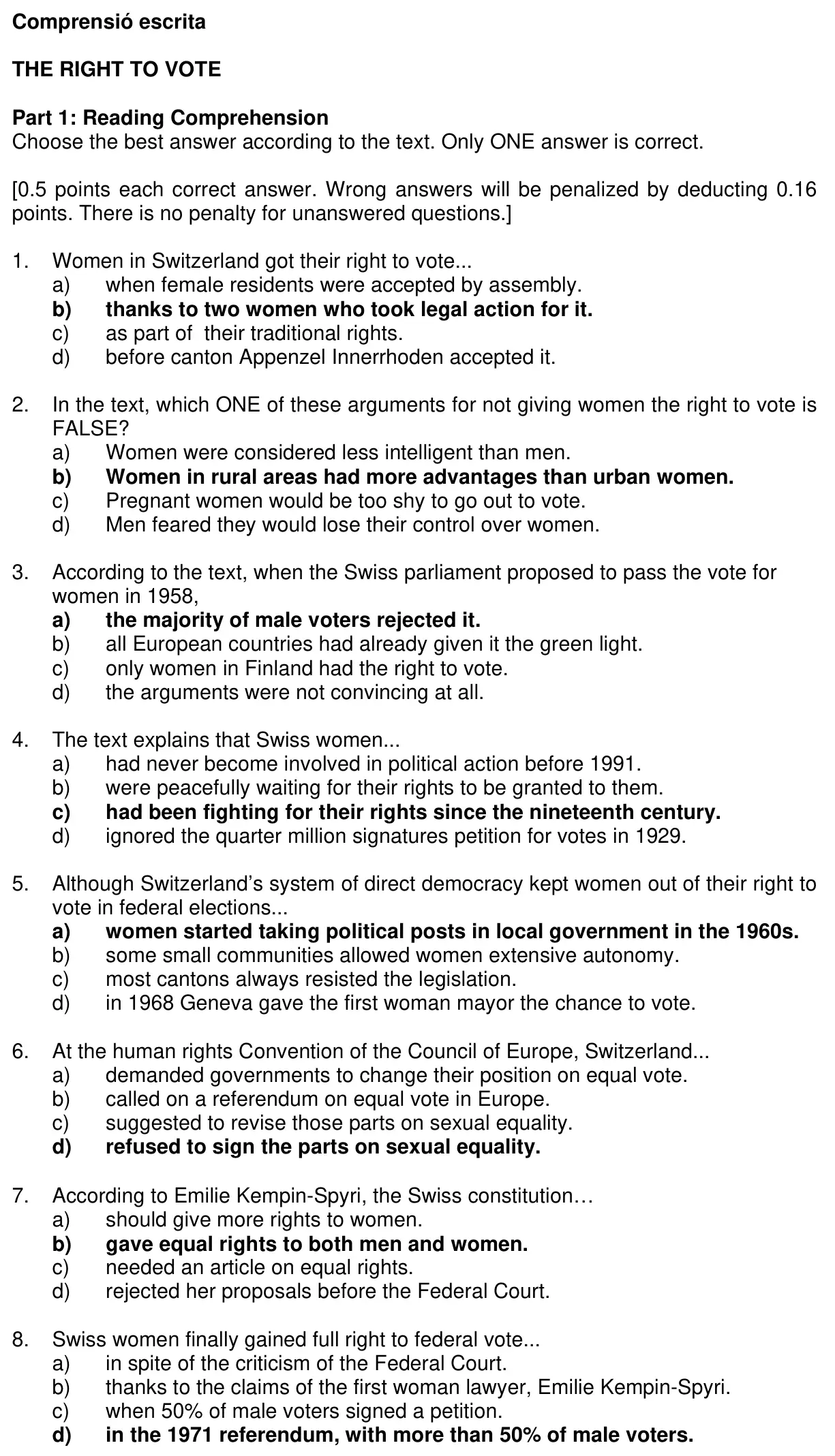
1. Women in Switzerland got their right to vote...
a) when female residents were accepted by assembly.
b) thanks to two women who took legal action for it.
c) as part of their traditional rights.
d) before canton Appenzel Innerrhoden accepted it.
2. In the text, which ONE of these arguments for not giving women the right to vote is
FALSE?
a) Women were considered less intelligent than men.
b) Women in rural areas had more advantages than urban women.
c) Pregnant women would be too shy to go out to vote.
d) Men feared they would lose their control over women.
3. According to the text, when the Swiss parliament proposed to pass the vote for
women in 1958,
a) the majority of male voters rejected it.
b) all European countries had already given it the green light.
c) only women in Finland had the right to vote.
d) the arguments were not convincing at all.
4. The text explains that Swiss women...
a) had never become involved in political action before 1991.
b) were peacefully waiting for the […]
Resolució pas a pas
Encara no hi ha resolució pròpia verificada d'aquest exercici. Mentrestant, tens els criteris oficials de correcció a sobre. Si tens dubtes, pregunta'ls al xat de la Sala d'estudi.
Font: enunciat i criteris de correcció oficials de les PAU 2014 de Catalunya, publicats per la Generalitat de Catalunya (universitats.gencat.cat) i les universitats catalanes. La resolució pas a pas és pròpia de L'Acadèmia de Vic.
Altres exercicis d'aquest examen
- Part 2 · Writing Writing
- Part 3 · Listening comprehension Listening comprehension