
PAU Anglès 2013 · Juny · Sèrie 5 · Part 1 · Reading comprehension
Enunciat
Text de l'enunciat (transcripció automàtica)
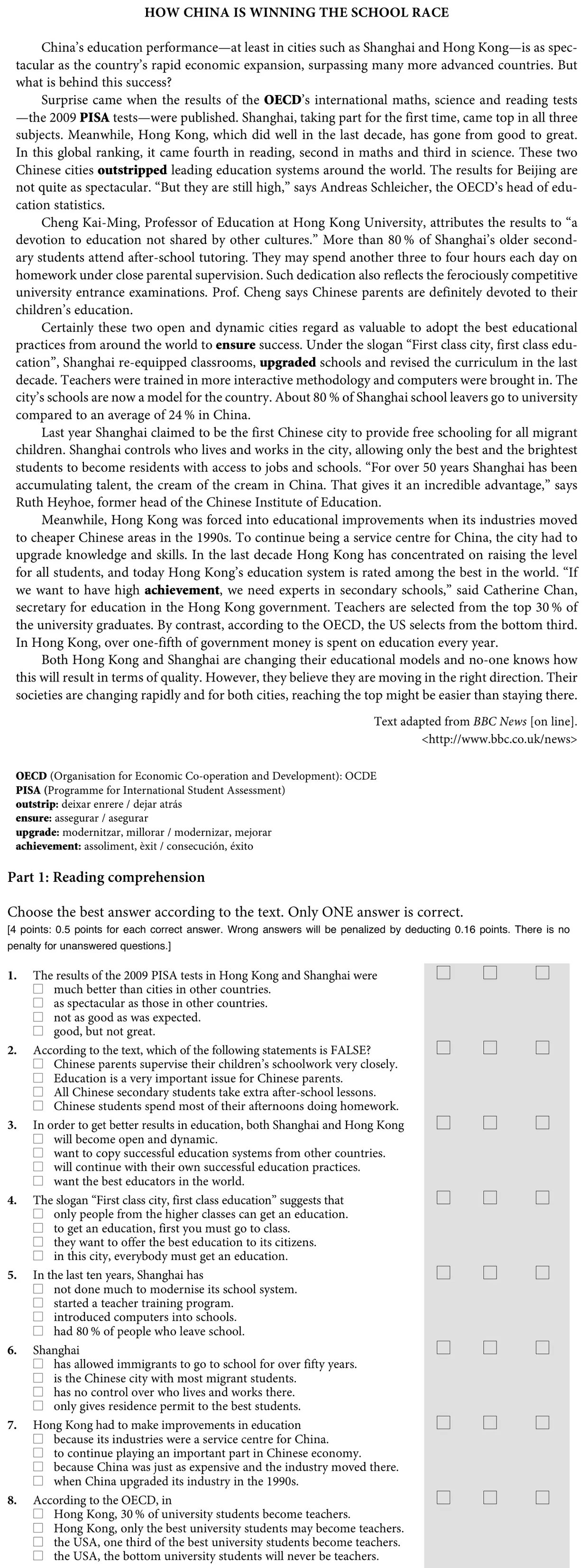
HOW CHINA IS WINNING THE SCHOOL RACE
China’s education performance—at least in cities such as Shanghai and Hong Kong—is as spec-
tacular as the country’s rapid economic expansion, surpassing many more advanced countries. But
what is behind this success?
Surprise came when the results of the OECD’s international maths, science and reading tests
—the 2009 PISA tests—were published. Shanghai, taking part for the first time, came top in all three
subjects. Meanwhile, Hong Kong, which did well in the last decade, has gone from good to great.
In this global ranking, it came fourth in reading, second in maths and third in science. These two
Chinese cities outstripped leading education systems around the world. The results for Beijing are
not quite as spectacular. “But they are still high,” says Andreas Schleicher, the OECD’s head of edu-
cation statistics.
Cheng Kai-Ming, Professor of Education at Hong Kong University, attributes the results to “a
devotion to education not shared by other cultures.” More than 80 % of Shanghai’s older second-
ary students attend after-school tutoring. They may spend another three to four hours each day on
homework under close parental supervision. Such dedication also reflects the ferociously competitive
university entrance examinations. Prof. Cheng says Chinese parents are definitely devoted to their
children’s education.
Certainly these two open and dynamic cities regard as valuable to adopt the best educational
practices from around the world to ensure success. Under the slogan “First class city, first class edu-
cation”, Shanghai re-equipped classrooms, upgraded schools and revised the curriculum in the last
decade. Teachers were trained in more interactive methodology and computers were brought in. The
city’s schools are now a model for the country. About 80 % of Shanghai school leavers go to university
compared to an average of 24 % in China.
Last year Shanghai claimed to be the first Chinese city to provide free schooling for all migrant
children. Shanghai controls who lives and works in the city, allowing only the best and the brightest
students to become residents with access to jobs and schools. “For over 50 years Shanghai has been
accumulating talent, the cream of the cream in China. That gives it an incredible advantage,” says
Ruth Heyhoe, former head of the Chinese Institute of Education.
Meanwhile, Hong Kong was forced into educational improvements when its industries moved
to cheaper Chinese areas in the 1990s. To continue being a service centre for China, the city had to
upgrade knowledge and skills. In the last decade Hong Kong has concentrated on raising the level
for all students, and today Hong Kong’s education system is rated among the best in the world. “If
we want to have high achievement, we need experts in secondary schools,” said Catherine Chan,
secretary for education in the Hong Kong government. Teachers are selected from the top 30 % of
the university graduates. By contrast, according to the OECD, the US selects from the bottom third.
In Hong Kong, over one-fifth of government money is spent on education every year.
Both Hong Kong and Shanghai are changing their educational models and no-one knows how
this will result in terms of quality. However, they believe they are moving in the right direction. Their
societies are changing rapidly and for both cities, reaching the top might be easier than staying there.
Text adapted from BBC News [on line].
<http://www.bbc.co.uk/news>
OECD (Organisation for Economic Co-operation and Development): OCDE
PISA (Programme for International Student Assessment)
outstrip: deixar enrere / dejar atrás
ensure: assegurar / asegurar
upgrade: modernitzar, millorar / modernizar, mejorar
achievement: assoliment, èxit / consecución, éxito
Part 1: Reading comprehension
Choose the best answer according to the text. Only ONE answer is correct.
[4 points: 0.5 points for each correct answer. Wrong answers will be penalized by deducting 0.16 points. There i
Criteris oficials de correcció
Text dels criteris (transcripció automàtica)
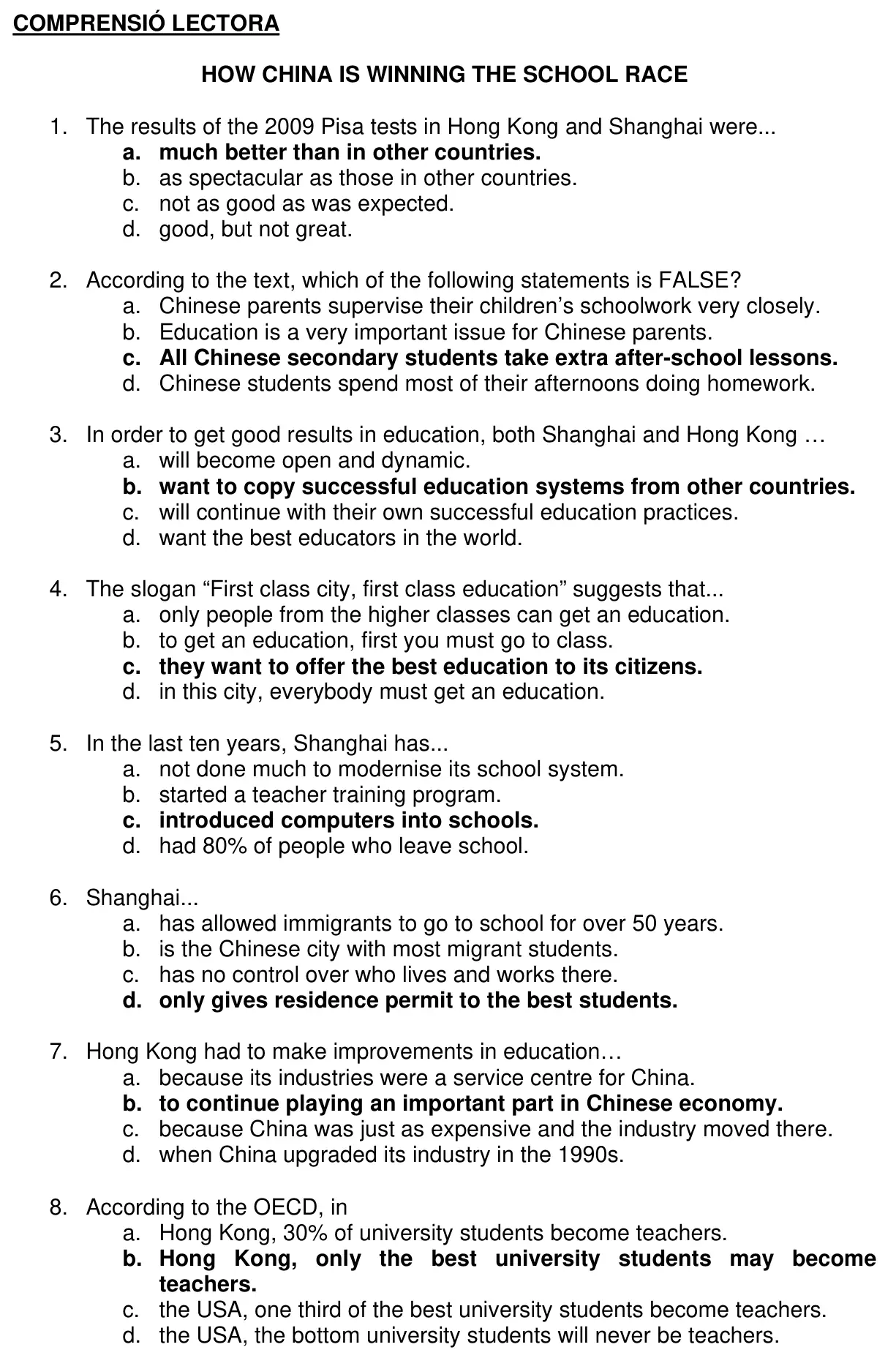
COMPRENSIÓ LECTORA
HOW CHINA IS WINNING THE SCHOOL RACE
1. The results of the 2009 Pisa tests in Hong Kong and Shanghai were...
a. much better than in other countries.
b. as spectacular as those in other countries.
c. not as good as was expected.
d. good, but not great.
2. According to the text, which of the following statements is FALSE?
a. Chinese parents supervise their children’s schoolwork very closely.
b. Education is a very important issue for Chinese parents.
c. All Chinese secondary students take extra after-school lessons.
d. Chinese students spend most of their afternoons doing homework.
3. In order to get good results in education, both Shanghai and Hong Kong …
a. will become open and dynamic.
b. want to copy successful education systems from other countries.
c. will continue with their own successful education practices.
d. want the best educators in the world.
4. The slogan “First class city, first class education” suggests that...
a. only people from the higher classes c […]
Resolució pas a pas
Encara no hi ha resolució pròpia verificada d'aquest exercici. Mentrestant, tens els criteris oficials de correcció a sobre. Si tens dubtes, pregunta'ls al xat de la Sala d'estudi.
Font: enunciat i criteris de correcció oficials de les PAU 2013 de Catalunya, publicats per la Generalitat de Catalunya (universitats.gencat.cat) i les universitats catalanes. La resolució pas a pas és pròpia de L'Acadèmia de Vic.
Altres exercicis d'aquest examen
- Part 2 · Writing Writing
- Part 3 · Listening comprehension Listening comprehension