
PAU Anglès 2012 · Setembre · Sèrie 4 · Part 1 · Reading comprehension
Enunciat
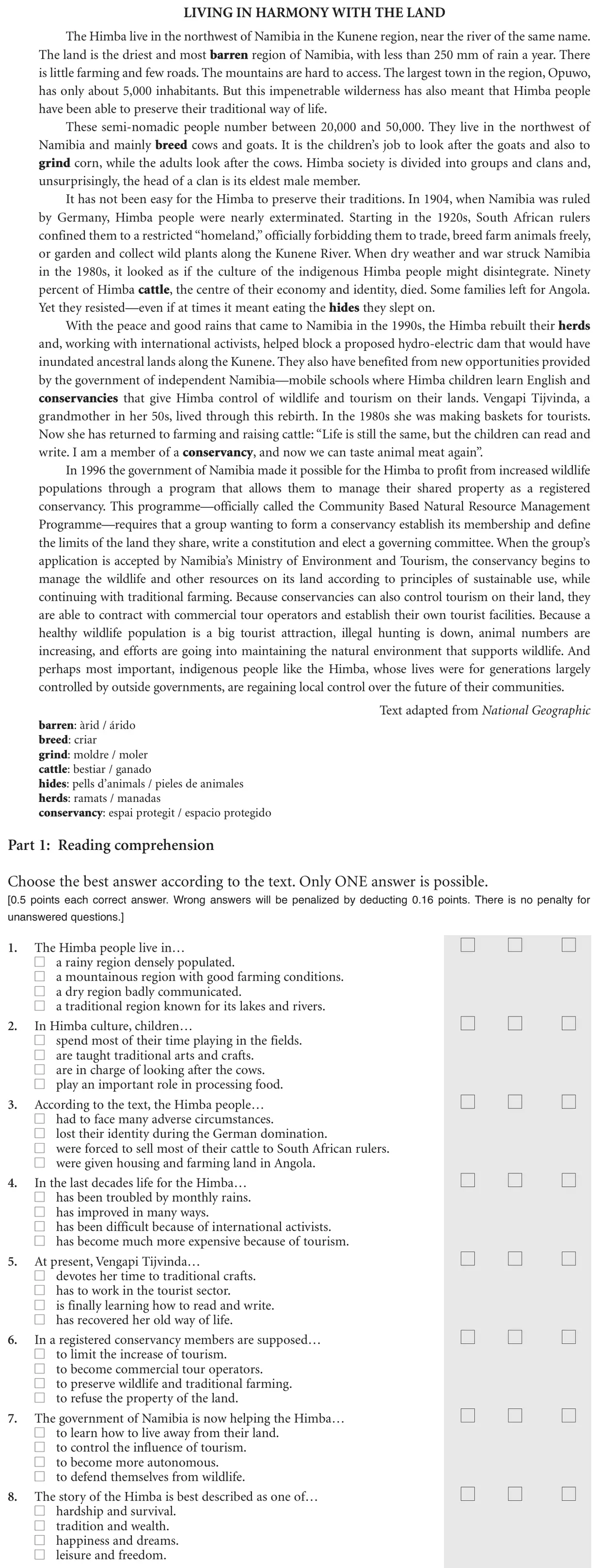
Text de l'enunciat (transcripció automàtica)
LIVING IN HARMONY WITH THE LAND
The Himba live in the northwest of Namibia in the Kunene region, near the river of the same name.
The land is the driest and most barren region of Namibia, with less than 250 mm of rain a year. There
is little farming and few roads. The mountains are hard to access. The largest town in the region, Opuwo,
has only about 5,000 inhabitants. But this impenetrable wilderness has also meant that Himba people
have been able to preserve their traditional way of life.
These semi-nomadic people number between 20,000 and 50,000. They live in the northwest of
Namibia and mainly breed cows and goats. It is the children’s job to look after the goats and also to
grind corn, while the adults look after the cows. Himba society is divided into groups and clans and,
unsurprisingly, the head of a clan is its eldest male member.
It has not been easy for the Himba to preserve their traditions. In 1904, when Namibia was ruled
by Germany, Himba people were nearly exterminated. Starting in the 1920s, South African rulers
confined them to a restricted “homeland,” officially forbidding them to trade, breed farm animals freely,
or garden and collect wild plants along the Kunene River. When dry weather and war struck Namibia
in the 1980s, it looked as if the culture of the indigenous Himba people might disintegrate. Ninety
percent of Himba cattle, the centre of their economy and identity, died. Some families left for Angola.
Yet they resisted—even if at times it meant eating the hides they slept on.
With the peace and good rains that came to Namibia in the 1990s, the Himba rebuilt their herds
and, working with international activists, helped block a proposed hydro-electric dam that would have
inundated ancestral lands along the Kunene. They also have benefited from new opportunities provided
by the government of independent Namibia—mobile schools where Himba children learn English and
conservancies that give Himba control of wildlife and tourism on their lands. Vengapi Tijvinda, a
grandmother in her 50s, lived through this rebirth. In the 1980s she was making baskets for tourists.
Now she has returned to farming and raising cattle: “Life is still the same, but the children can read and
write. I am a member of a conservancy, and now we can taste animal meat again”.
In 1996 the government of Namibia made it possible for the Himba to profit from increased wildlife
populations through a program that allows them to manage their shared property as a registered
conservancy. This programme—officially called the Community Based Natural Resource Management
Programme—requires that a group wanting to form a conservancy establish its membership and define
the limits of the land they share, write a constitution and elect a governing committee. When the group’s
application is accepted by Namibia’s Ministry of Environment and Tourism, the conservancy begins to
manage the wildlife and other resources on its land according to principles of sustainable use, while
continuing with traditional farming. Because conservancies can also control tourism on their land, they
are able to contract with commercial tour operators and establish their own tourist facilities. Because a
healthy wildlife population is a big tourist attraction, illegal hunting is down, animal numbers are
increasing, and efforts are going into maintaining the natural environment that supports wildlife. And
perhaps most important, indigenous people like the Himba, whose lives were for generations largely
controlled by outside governments, are regaining local control over the future of their communities.
Text adapted from National Geographic
barren: àrid / árido
breed: criar
grind: moldre / moler
cattle: bestiar / ganado
hides: pells d’animals / pieles de animales
herds: ramats / manadas
conservancy: espai protegit / espacio protegido
Part 1: Reading comprehension
Choose the best answer according to the text. Only ONE answer is possible.
[0.5 points each correct answer. Wrong ans
Criteris oficials de correcció
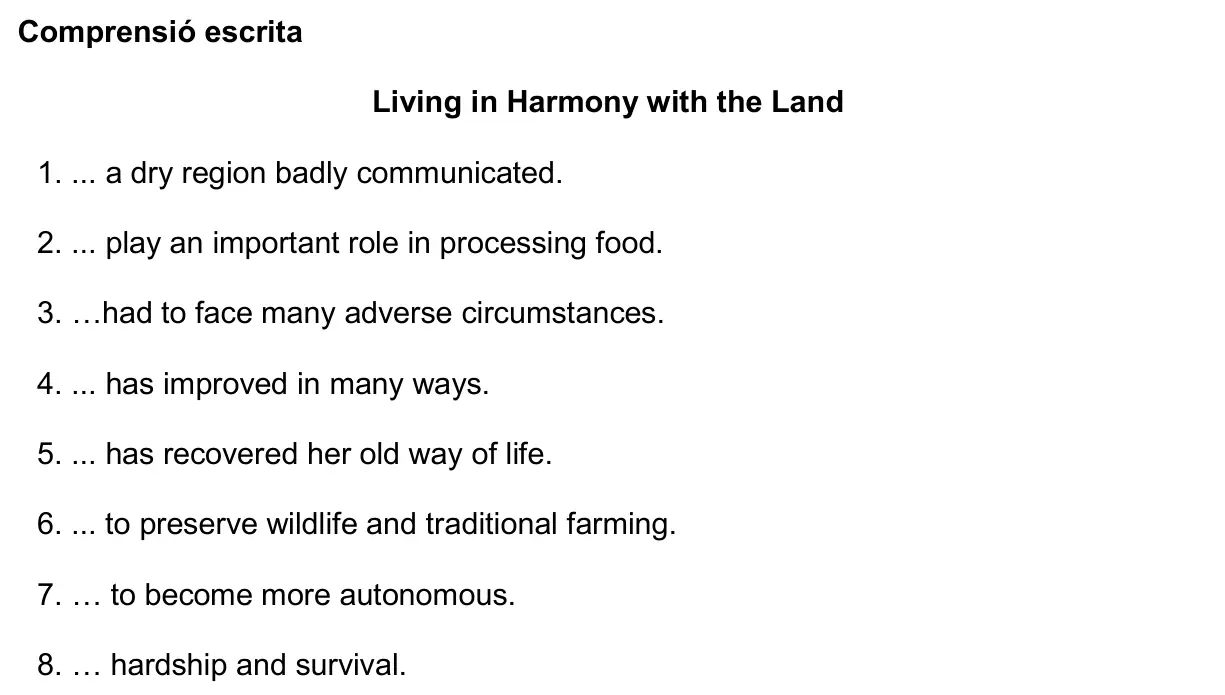
Text dels criteris (transcripció automàtica)
1. ... a dry region badly communicated.
2. ... play an important role in processing food.
3. …had to face many adverse circumstances.
4. ... has improved in many ways.
5. ... has recovered her old way of life.
6. ... to preserve wildlife and traditional farming.
7. … to become more autonomous.
8. … hardship and survival.
Prova auditiva
Interview with Steven Spencer (Detective David Jones)
Stephen Spencer made his acting debut at age 16 in BBC 2's television action film Life
or Death and playing the role of detective David Jones at the age of 23, Jones has
starred in five David Jones’ films since 2001, with the final one being released in July
2011.
From a BBC Radio Interview. Adapted.
Mary: Welcome to our radio show Celebrities, today we have a very special guest. I'm
very pleased to welcome onto the show now, um, oh, what do I call you? Do I call you
Stephen, or Steve, or David?
Steve: Steve. Please call me Steve.
Mary: It's Steve Spencer, or David Jones. Star of detective David Jones […]
Resolució pas a pas
Encara no hi ha resolució pròpia verificada d'aquest exercici. Mentrestant, tens els criteris oficials de correcció a sobre. Si tens dubtes, pregunta'ls al xat de la Sala d'estudi.
Font: enunciat i criteris de correcció oficials de les PAU 2012 de Catalunya, publicats per la Generalitat de Catalunya (universitats.gencat.cat) i les universitats catalanes. La resolució pas a pas és pròpia de L'Acadèmia de Vic.
Altres exercicis d'aquest examen
- Part 2 · Writing Writing
- Part 3 · Listening comprehension Listening comprehension