
PAU Anglès 2013 · Juny · Sèrie 5 · Part 3 · Listening comprehension
Enunciat
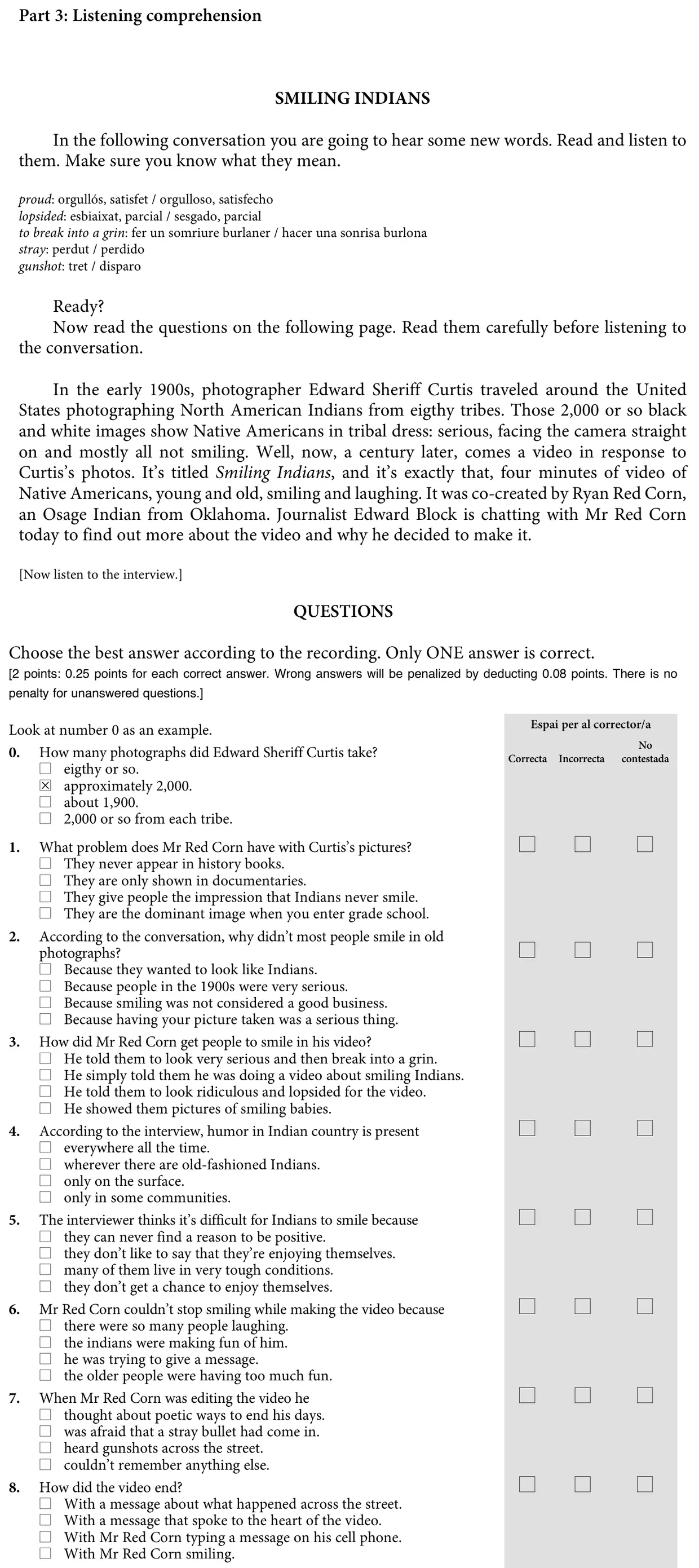
Text de l'enunciat (transcripció automàtica)
Part 3: Listening comprehension
SMILING INDIANS
In the following conversation you are going to hear some new words. Read and listen to
them. Make sure you know what they mean.
proud: orgullós, satisfet / orgulloso, satisfecho
lopsided: esbiaixat, parcial / sesgado, parcial
to break into a grin: fer un somriure burlaner / hacer una sonrisa burlona
stray: perdut / perdido
gunshot: tret / disparo
Ready?
Now read the questions on the following page. Read them carefully before listening to
the conversation.
In the early 1900s, photographer Edward Sheriff Curtis traveled around the United
States photographing North American Indians from eigthy tribes. Those 2,000 or so black
and white images show Native Americans in tribal dress: serious, facing the camera straight
on and mostly all not smiling. Well, now, a century later, comes a video in response to
Curtis’s photos. It’s titled Smiling Indians, and it’s exactly that, four minutes of video of
Native Americans, young and old, smiling and laughing. It was co-created by Ryan Red Corn,
an Osage Indian from Oklahoma. Journalist Edward Block is chatting with Mr Red Corn
today to find out more about the video and why he decided to make it.
[Now listen to the interview.]
QUESTIONS
Choose the best answer according to the recording. Only ONE answer is correct.
[2 points: 0.25 points for each correct answer. Wrong answers will be penalized by deducting 0.08 points. There is no
penalty for unanswered questions.]
Look at number 0 as an example.
0. How many photographs did Edward Sheriff Curtis take?
■ eigthy or so.
■× approximately 2,000.
■ about 1,900.
■ 2,000 or so from each tribe.
1. What problem does Mr Red Corn have with Curtis’s pictures?
■ They never appear in history books.
■ They are only shown in documentaries.
■ They give people the impression that Indians never smile.
■ They are the dominant image when you enter grade school.
2. According to the conversation, why didn’t most people smile in old
photographs?
■ Because they wanted to look like Indians.
■ Because people in the 1900s were very serious.
■ Because smiling was not considered a good business.
■ Because having your picture taken was a serious thing.
3. How did Mr Red Corn get people to smile in his video?
■ He told them to look very serious and then break into a grin.
■ He simply told them he was doing a video about smiling Indians.
■ He told them to look ridiculous and lopsided for the video.
■ He showed them pictures of smiling babies.
4. According to the interview, humor in Indian country is present
■ everywhere all the time.
■ wherever there are old-fashioned Indians.
■ only on the surface.
■ only in some communities.
5. The interviewer thinks it’s difficult for Indians to smile because
■ they can never find a reason to be positive.
■ they don’t like to say that they’re enjoying themselves.
■ many of them live in very tough conditions.
■ they don’t get a chance to enjoy themselves.
6. Mr Red Corn couldn’t stop smiling while making the video because
■ there were so many people laughing.
■ the indians were making fun of him.
■ he was trying to give a message.
■ the older people were having too much fun.
7. When Mr Red Corn was editing the video he
■ thought about poetic ways to end his days.
■ was afraid that a stray bullet had come in.
■ heard gunshots across the street.
■ couldn’t remember anything else.
8. How did the video end?
■ With a message about what happened across the street.
■ With a message that spoke to the heart of the video.
■ With Mr Red Corn typing a message on his cell phone.
■ With Mr Red Corn smiling.
Criteris oficials de correcció

Resolució pas a pas
Aquest exercici no té una resolució escrita pas a pas (requereix l'àudio de la prova). Fes servir els criteris oficials de correcció.
Font: enunciat i criteris de correcció oficials de les PAU 2013 de Catalunya, publicats per la Generalitat de Catalunya (universitats.gencat.cat) i les universitats catalanes. La resolució pas a pas és pròpia de L'Acadèmia de Vic.
Altres exercicis d'aquest examen
- Part 1 · Reading comprehension Reading comprehension
- Part 2 · Writing Writing
Tots els exercicis de Listening comprehension · PAU de Anglès