
PAU Anglès 2013 · Juny · Sèrie 3 · Part 1 · Reading comprehension
Enunciat
Text de l'enunciat (transcripció automàtica)
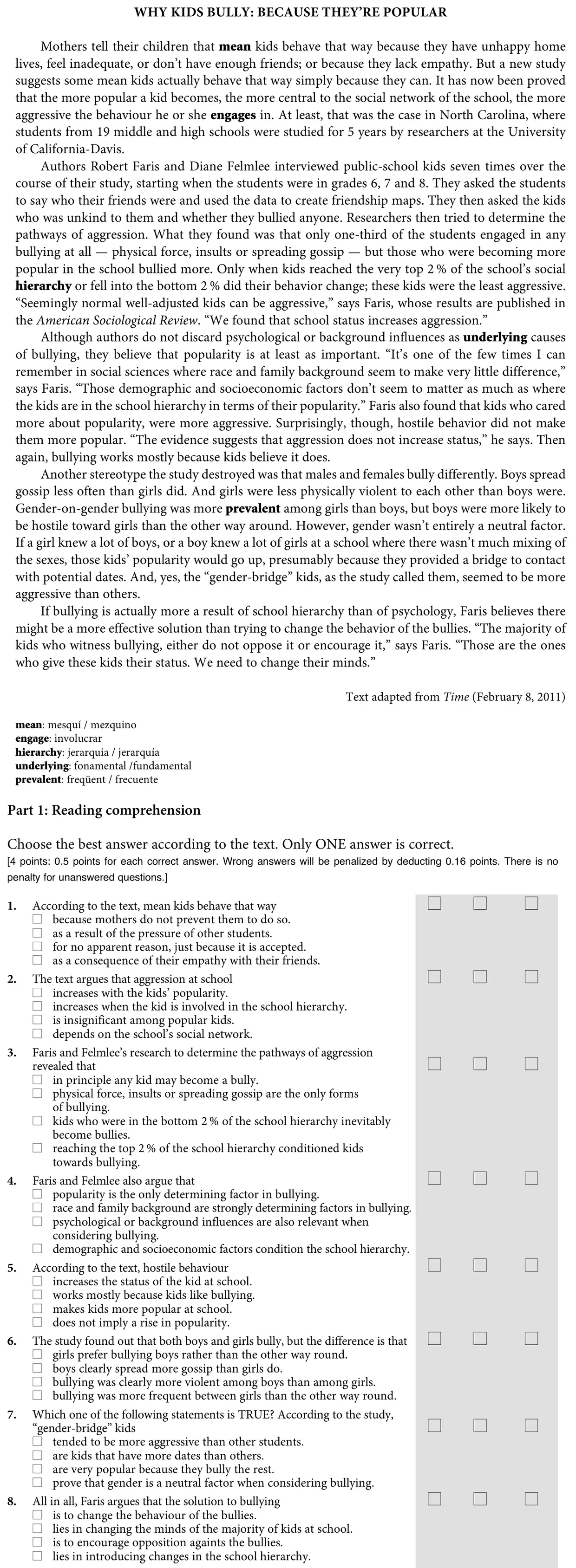
WHY KIDS BULLY: BECAUSE THEY’RE POPULAR
Mothers tell their children that mean kids behave that way because they have unhappy home
lives, feel inadequate, or don’t have enough friends; or because they lack empathy. But a new study
suggests some mean kids actually behave that way simply because they can. It has now been proved
that the more popular a kid becomes, the more central to the social network of the school, the more
aggressive the behaviour he or she engages in. At least, that was the case in North Carolina, where
students from 19 middle and high schools were studied for 5 years by researchers at the University
of California-Davis.
Authors Robert Faris and Diane Felmlee interviewed public-school kids seven times over the
course of their study, starting when the students were in grades 6, 7 and 8. They asked the students
to say who their friends were and used the data to create friendship maps. They then asked the kids
who was unkind to them and whether they bullied anyone. Researchers then tried to determine the
pathways of aggression. What they found was that only one-third of the students engaged in any
bullying at all — physical force, insults or spreading gossip — but those who were becoming more
popular in the school bullied more. Only when kids reached the very top 2 % of the school’s social
hierarchy or fell into the bottom 2 % did their behavior change; these kids were the least aggressive.
“Seemingly normal well-adjusted kids can be aggressive,” says Faris, whose results are published in
the American Sociological Review. “We found that school status increases aggression.”
Although authors do not discard psychological or background influences as underlying causes
of bullying, they believe that popularity is at least as important. “It’s one of the few times I can
remember in social sciences where race and family background seem to make very little difference,”
says Faris. “Those demographic and socioeconomic factors don’t seem to matter as much as where
the kids are in the school hierarchy in terms of their popularity.” Faris also found that kids who cared
more about popularity, were more aggressive. Surprisingly, though, hostile behavior did not make
them more popular. “The evidence suggests that aggression does not increase status,” he says. Then
again, bullying works mostly because kids believe it does.
Another stereotype the study destroyed was that males and females bully differently. Boys spread
gossip less often than girls did. And girls were less physically violent to each other than boys were.
Gender-on-gender bullying was more prevalent among girls than boys, but boys were more likely to
be hostile toward girls than the other way around. However, gender wasn’t entirely a neutral factor.
If a girl knew a lot of boys, or a boy knew a lot of girls at a school where there wasn’t much mixing of
the sexes, those kids’ popularity would go up, presumably because they provided a bridge to contact
with potential dates. And, yes, the “gender-bridge” kids, as the study called them, seemed to be more
aggressive than others.
If bullying is actually more a result of school hierarchy than of psychology, Faris believes there
might be a more effective solution than trying to change the behavior of the bullies. “The majority of
kids who witness bullying, either do not oppose it or encourage it,” says Faris. “Those are the ones
who give these kids their status. We need to change their minds.”
Text adapted from Time (February 8, 2011)
mean: mesquí / mezquino
engage: involucrar
hierarchy: jerarquia / jerarquía
underlying: fonamental /fundamental
prevalent: freqüent / frecuente
Part 1: Reading comprehension
Choose the best answer according to the text. Only ONE answer is correct.
[4 points: 0.5 points for each correct answer. Wrong answers will be penalized by deducting 0.16 points. There is no
penalty for unanswered questions.]
1. According to the text, mean kids behave that way
■ because mothers do not prevent them to do s
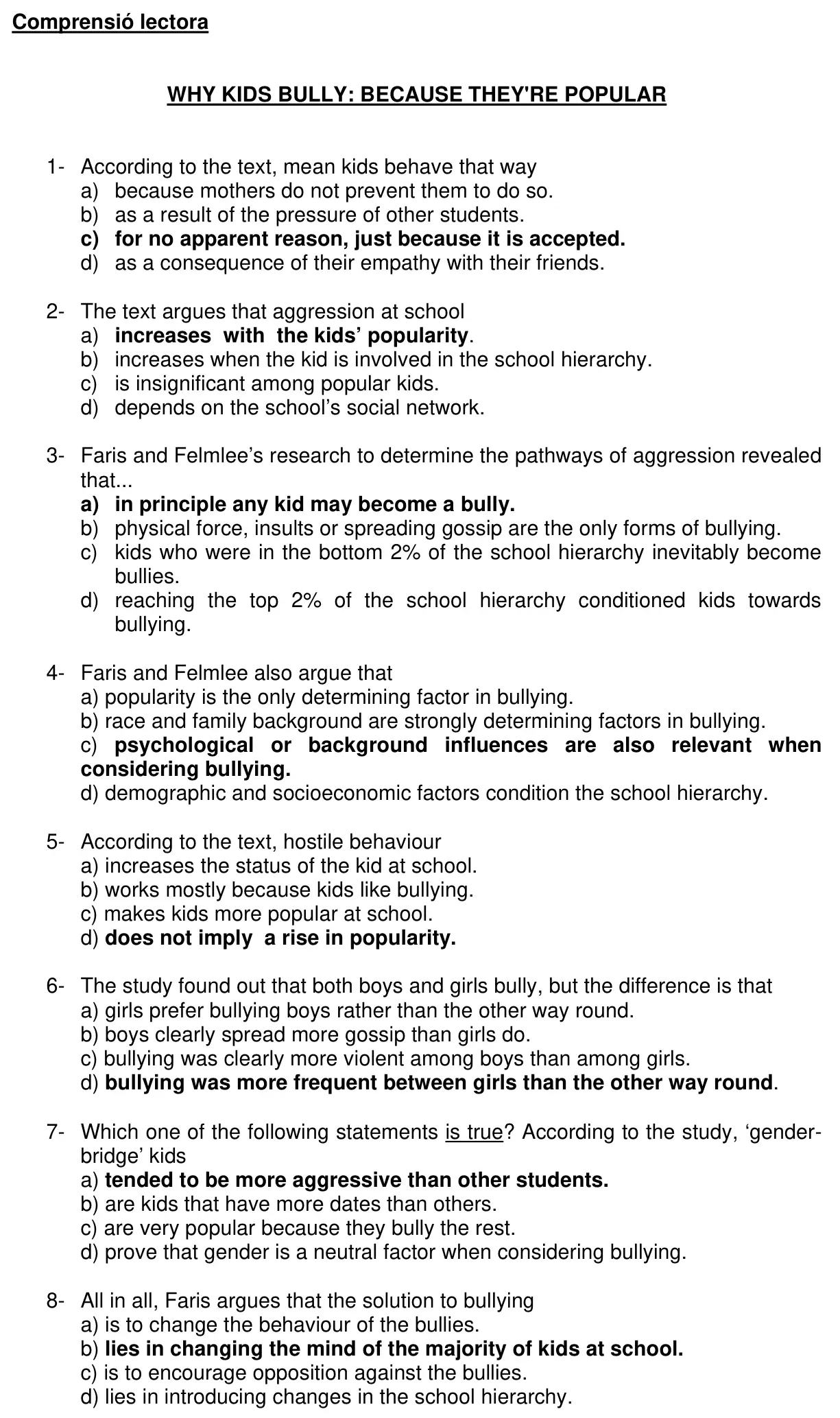
Criteris oficials de correcció
Text dels criteris (transcripció automàtica)
1. When did Mr. Johnston decide to run for Norwich mayor?
Approximately 10 years ago.
Three years ago.
Since he started working for the Labour party.
Since he organized city events.
2. Which of the following statements about Mr. Johnston is FALSE?
He has a degree in law.
He studied at Harvard University.
He lived away from Norwich for seven years.
He was a Member of Parliament.
3. When was Norwich the second largest city in England?
From the Industrial Revolution to the present day.
Only in the Medieval Age.
From the 11th century till the Industrial Revolution.
Only in the 11th century.
4. Norwich Castle
keeps a model tower full of computers.
used to be a palace for the Norman kings.
was destroyed by the Normans.
is now an archeological site.
5. Norwich Cathedral is
surrounded by a cemetery.
the tallest in England.
Romanesque and has a tall spire.
beautiful but has no cloister.
6. How long did the celebrations for the Olympic Torch relay last?
[…]
Resolució pas a pas
Encara no hi ha resolució pròpia verificada d'aquest exercici. Mentrestant, tens els criteris oficials de correcció a sobre. Si tens dubtes, pregunta'ls al xat de la Sala d'estudi.
Font: enunciat i criteris de correcció oficials de les PAU 2013 de Catalunya, publicats per la Generalitat de Catalunya (universitats.gencat.cat) i les universitats catalanes. La resolució pas a pas és pròpia de L'Acadèmia de Vic.
Altres exercicis d'aquest examen
- Part 2 · Writing Writing
- Part 3 · Listening comprehension Listening comprehension