
PAU Anglès 2008 · Juny · Sèrie 5 · Part 1 · Reading comprehension
Enunciat
Text de l'enunciat (transcripció automàtica)
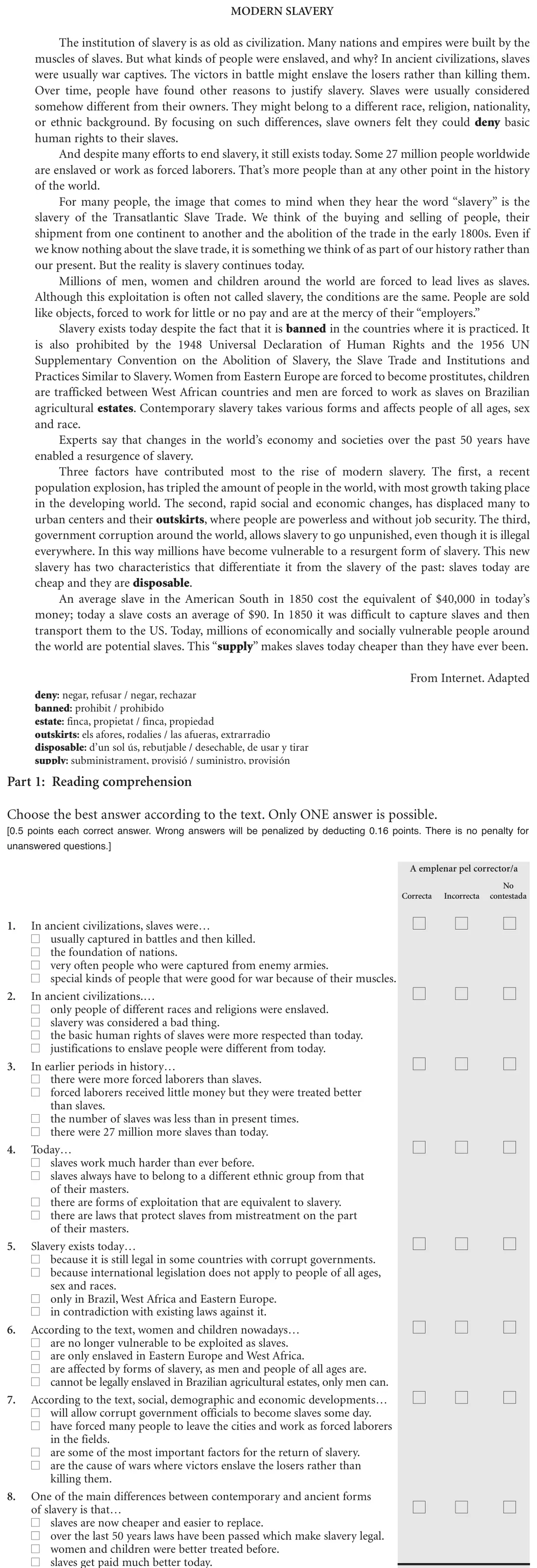
MODERN SLAVERY
The institution of slavery is as old as civilization. Many nations and empires were built by the
muscles of slaves. But what kinds of people were enslaved, and why? In ancient civilizations, slaves
were usually war captives. The victors in battle might enslave the losers rather than killing them.
Over time, people have found other reasons to justify slavery. Slaves were usually considered
somehow different from their owners. They might belong to a different race, religion, nationality,
or ethnic background. By focusing on such differences, slave owners felt they could deny basic
human rights to their slaves.
And despite many efforts to end slavery, it still exists today. Some 27 million people worldwide
are enslaved or work as forced laborers. That’s more people than at any other point in the history
of the world.
For many people, the image that comes to mind when they hear the word “slavery” is the
slavery of the Transatlantic Slave Trade. We think of the buying and selling of people, their
shipment from one continent to another and the abolition of the trade in the early 1800s. Even if
we know nothing about the slave trade, it is something we think of as part of our history rather than
our present. But the reality is slavery continues today.
Millions of men, women and children around the world are forced to lead lives as slaves.
Although this exploitation is often not called slavery, the conditions are the same. People are sold
like objects, forced to work for little or no pay and are at the mercy of their “employers.”
Slavery exists today despite the fact that it is banned in the countries where it is practiced. It
is also prohibited by the 1948 Universal Declaration of Human Rights and the 1956 UN
Supplementary Convention on the Abolition of Slavery, the Slave Trade and Institutions and
Practices Similar to Slavery. Women from Eastern Europe are forced to become prostitutes, children
are trafficked between West African countries and men are forced to work as slaves on Brazilian
agricultural estates. Contemporary slavery takes various forms and affects people of all ages, sex
and race.
Experts say that changes in the world’s economy and societies over the past 50 years have
enabled a resurgence of slavery.
Three factors have contributed most to the rise of modern slavery. The first, a recent
population explosion, has tripled the amount of people in the world, with most growth taking place
in the developing world. The second, rapid social and economic changes, has displaced many to
urban centers and their outskirts, where people are powerless and without job security. The third,
government corruption around the world, allows slavery to go unpunished, even though it is illegal
everywhere. In this way millions have become vulnerable to a resurgent form of slavery. This new
slavery has two characteristics that differentiate it from the slavery of the past: slaves today are
cheap and they are disposable.
An average slave in the American South in 1850 cost the equivalent of $40,000 in today’s
money; today a slave costs an average of $90. In 1850 it was difficult to capture slaves and then
transport them to the US. Today, millions of economically and socially vulnerable people around
the world are potential slaves. This “supply” makes slaves today cheaper than they have ever been.
From Internet. Adapted
deny: negar, refusar / negar, rechazar
banned: prohibit / prohibido
estate: finca, propietat / finca, propiedad
outskirts: els afores, rodalies / las afueras, extrarradio
disposable: d’un sol ús, rebutjable / desechable, de usar y tirar
supply: subministrament, provisió / suministro, provisión
Part 1: Reading comprehension
Choose the best answer according to the text. Only ONE answer is possible.
[0.5 points each correct answer. Wrong answers will be penalized by deducting 0.16 points. There is no penalty for
unanswered questions.]
A emplenar pel corrector/a
No
Correcta Incorrecta contestada
1. In ancient civilizat
Criteris oficials de correcció
Text dels criteris (transcripció automàtica)
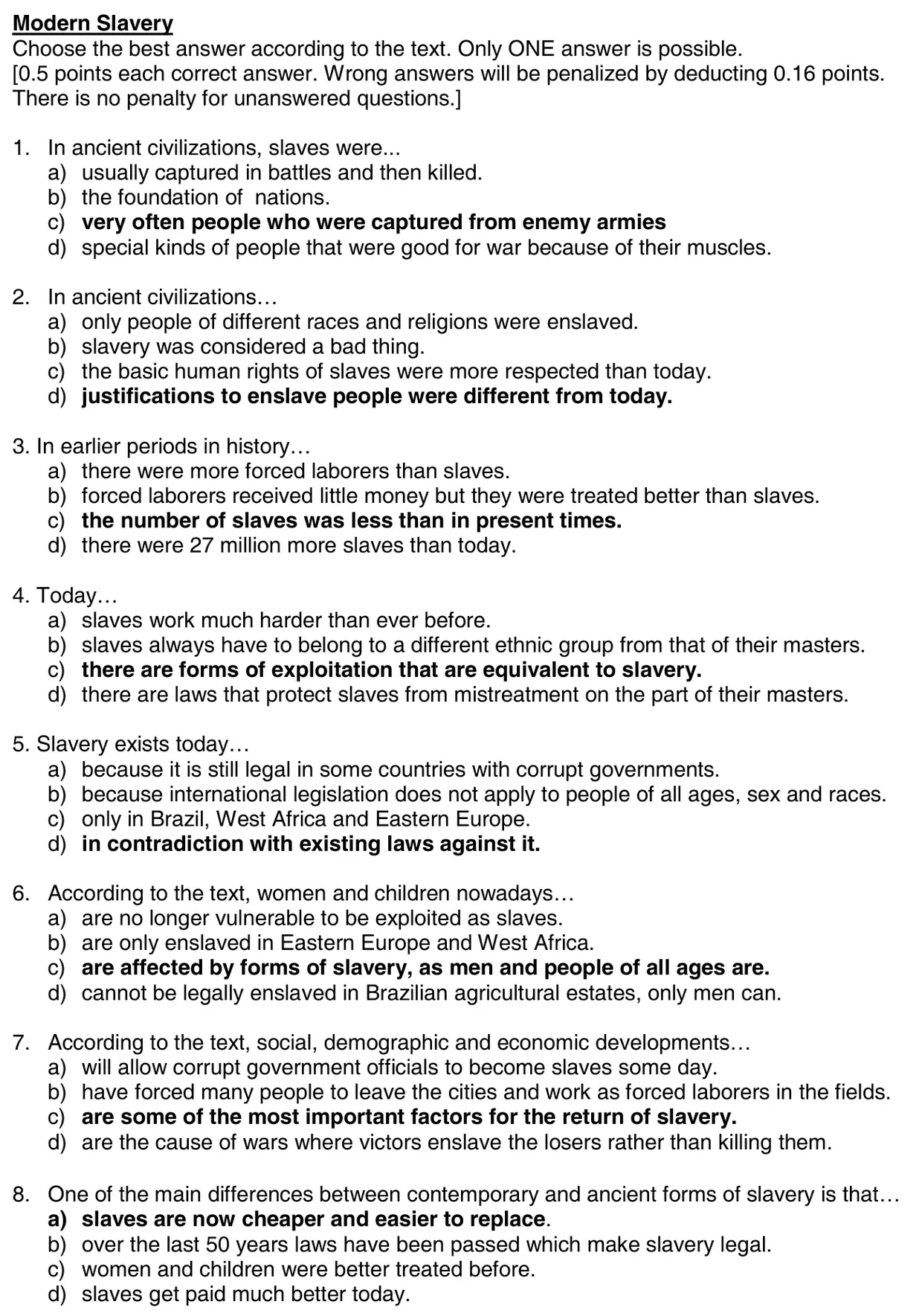
1. In ancient civilizations, slaves were...
a) usually captured in battles and then killed.
b) the foundation of nations.
c) very often people who were captured from enemy armies
d) special kinds of people that were good for war because of their muscles.
2. In ancient civilizations…
a) only people of different races and religions were enslaved.
b) slavery was considered a bad thing.
c) the basic human rights of slaves were more respected than today.
d) justifications to enslave people were different from today.
3. In earlier periods in history…
a) there were more forced laborers than slaves.
b) forced laborers received little money but they were treated better than slaves.
c) the number of slaves was less than in present times.
d) there were 27 million more slaves than today.
4. Today…
a) slaves work much harder than ever before.
b) slaves always have to belong to a different ethnic group from that of their masters.
c) there are forms of exploitation that are equivalent to slavery.
d) […]
Resolució pas a pas
Encara no hi ha resolució pròpia verificada d'aquest exercici. Mentrestant, tens els criteris oficials de correcció a sobre. Si tens dubtes, pregunta'ls al xat de la Sala d'estudi.
Font: enunciat i criteris de correcció oficials de les PAU 2008 de Catalunya, publicats per la Generalitat de Catalunya (universitats.gencat.cat) i les universitats catalanes. La resolució pas a pas és pròpia de L'Acadèmia de Vic.
Altres exercicis d'aquest examen
- Part 2 · Writing Writing
- Part 3 · Listening comprehension Listening comprehension