
PAU Anglès 2007 · Setembre · Sèrie 3 · Part 1 · Reading comprehension
Enunciat
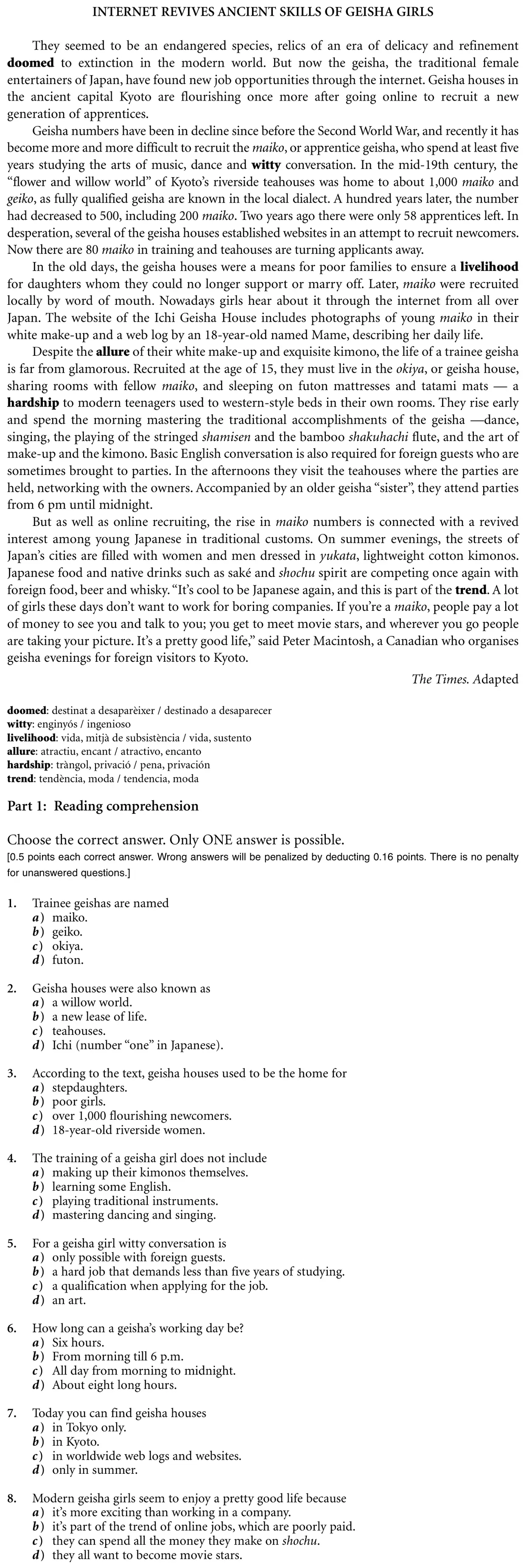
Text de l'enunciat (transcripció automàtica)
INTERNET REVIVES ANCIENT SKILLS OF GEISHA GIRLS
They seemed to be an endangered species, relics of an era of delicacy and refinement
doomed to extinction in the modern world. But now the geisha, the traditional female
entertainers of Japan, have found new job opportunities through the internet. Geisha houses in
the ancient capital Kyoto are flourishing once more after going online to recruit a new
generation of apprentices.
Geisha numbers have been in decline since before the Second World War, and recently it has
become more and more difficult to recruit the maiko, or apprentice geisha, who spend at least five
years studying the arts of music, dance and witty conversation. In the mid-19th century, the
“flower and willow world” of Kyoto’s riverside teahouses was home to about 1,000 maiko and
geiko, as fully qualified geisha are known in the local dialect. A hundred years later, the number
had decreased to 500, including 200 maiko. Two years ago there were only 58 apprentices left. In
desperation, several of the geisha houses established websites in an attempt to recruit newcomers.
Now there are 80 maiko in training and teahouses are turning applicants away.
In the old days, the geisha houses were a means for poor families to ensure a livelihood
for daughters whom they could no longer support or marry off. Later, maiko were recruited
locally by word of mouth. Nowadays girls hear about it through the internet from all over
Japan. The website of the Ichi Geisha House includes photographs of young maiko in their
white make-up and a web log by an 18-year-old named Mame, describing her daily life.
Despite the allure of their white make-up and exquisite kimono, the life of a trainee geisha
is far from glamorous. Recruited at the age of 15, they must live in the okiya, or geisha house,
sharing rooms with fellow maiko, and sleeping on futon mattresses and tatami mats — a
hardship to modern teenagers used to western-style beds in their own rooms. They rise early
and spend the morning mastering the traditional accomplishments of the geisha —dance,
singing, the playing of the stringed shamisen and the bamboo shakuhachi flute, and the art of
make-up and the kimono. Basic English conversation is also required for foreign guests who are
sometimes brought to parties. In the afternoons they visit the teahouses where the parties are
held, networking with the owners. Accompanied by an older geisha “sister”, they attend parties
from 6 pm until midnight.
But as well as online recruiting, the rise in maiko numbers is connected with a revived
interest among young Japanese in traditional customs. On summer evenings, the streets of
Japan’s cities are filled with women and men dressed in yukata, lightweight cotton kimonos.
Japanese food and native drinks such as saké and shochu spirit are competing once again with
foreign food, beer and whisky.“It’s cool to be Japanese again, and this is part of the trend. A lot
of girls these days don’t want to work for boring companies. If you’re a maiko, people pay a lot
of money to see you and talk to you; you get to meet movie stars, and wherever you go people
are taking your picture. It’s a pretty good life,” said Peter Macintosh, a Canadian who organises
geisha evenings for foreign visitors to Kyoto.
The Times. Adapted
doomed: destinat a desaparèixer / destinado a desaparecer
witty: enginyós / ingenioso
livelihood: vida, mitjà de subsistència / vida, sustento
allure: atractiu, encant / atractivo, encanto
hardship: tràngol, privació / pena, privación
trend: tendència, moda / tendencia, moda
Part 1: Reading comprehension
Choose the correct answer. Only ONE answer is possible.
[0.5 points each correct answer. Wrong answers will be penalized by deducting 0.16 points. There is no penalty
for unanswered questions.]
1. Trainee geishas are named
a) maiko.
b) geiko.
c) okiya.
d) futon.
2. Geisha houses were also known as
a) a willow world.
b) a new lease of life.
c) teahouses.
d) Ichi (number “one” in Japanese).
3. Accord
Criteris oficials de correcció
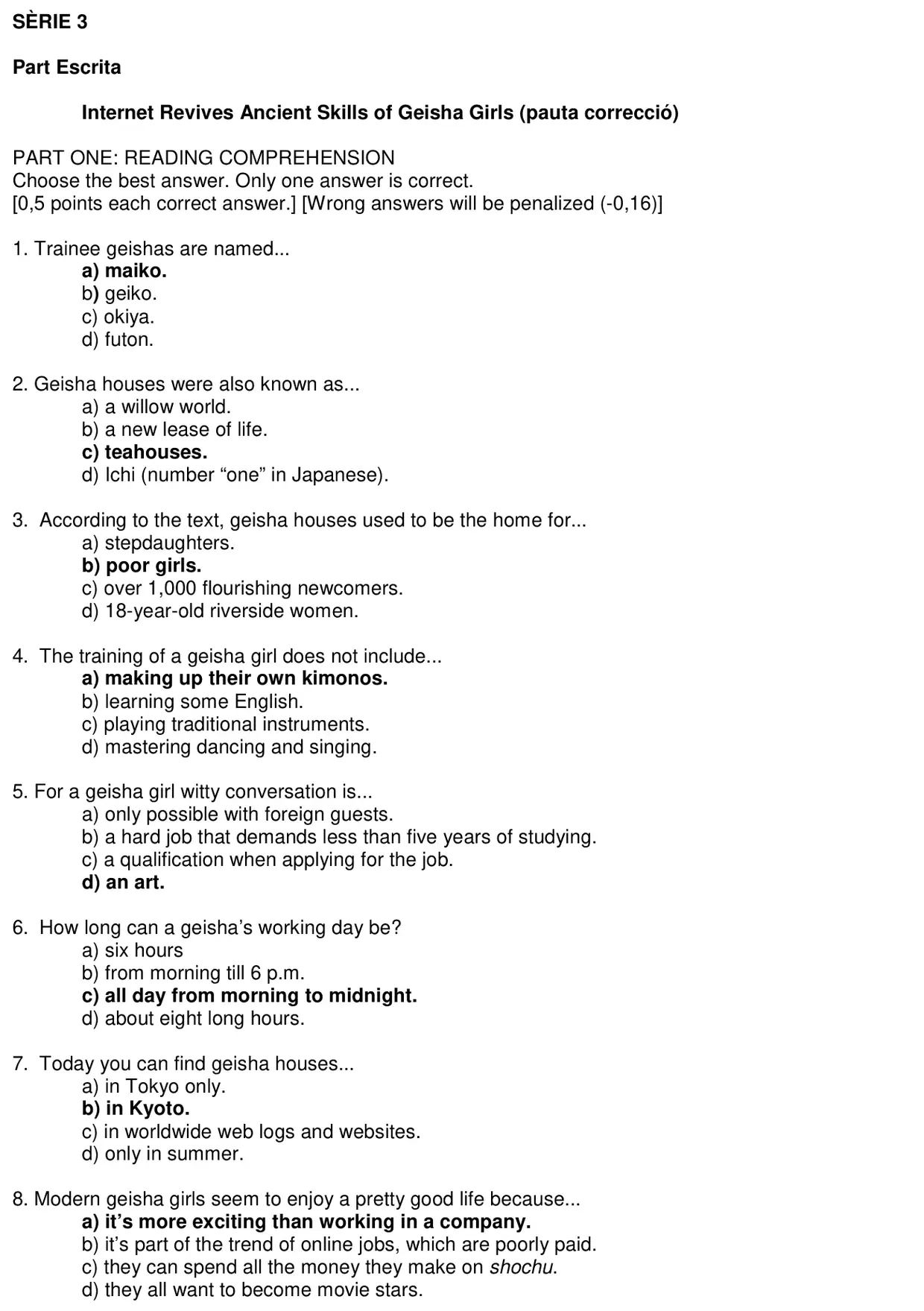
Text dels criteris (transcripció automàtica)
1. Trainee geishas are named...
a) maiko.
b) geiko.
c) okiya.
d) futon.
2. Geisha houses were also known as...
a) a willow world.
b) a new lease of life.
c) teahouses.
d) Ichi (number “one” in Japanese).
3. According to the text, geisha houses used to be the home for...
a) stepdaughters.
b) poor girls.
c) over 1,000 flourishing newcomers.
d) 18-year-old riverside women.
4. The training of a geisha girl does not include...
a) making up their own kimonos.
b) learning some English.
c) playing traditional instruments.
d) mastering dancing and singing.
5. For a geisha girl witty conversation is...
a) only possible with foreign guests.
b) a hard job that demands less than five years of studying.
c) a qualification when applying for the job.
d) an art.
6. How long can a geisha’s working day be?
a) six hours
b) from morning till 6 p.m.
c) all day from morning to midnight.
d) about eight long hours.
7. Today you can find geisha houses...
a) in Tokyo only.
b) in Kyoto.
c) in worldwide web logs a […]
Resolució pas a pas
Encara no hi ha resolució pròpia verificada d'aquest exercici. Mentrestant, tens els criteris oficials de correcció a sobre. Si tens dubtes, pregunta'ls al xat de la Sala d'estudi.
Font: enunciat i criteris de correcció oficials de les PAU 2007 de Catalunya, publicats per la Generalitat de Catalunya (universitats.gencat.cat) i les universitats catalanes. La resolució pas a pas és pròpia de L'Acadèmia de Vic.
Altres exercicis d'aquest examen
- Part 2 · Writing Writing
- Part 3 · Listening comprehension Listening comprehension