
PAU Anglès 2008 · Juny · Sèrie 2 · Part 1 · Reading comprehension
Enunciat
Text de l'enunciat (transcripció automàtica)
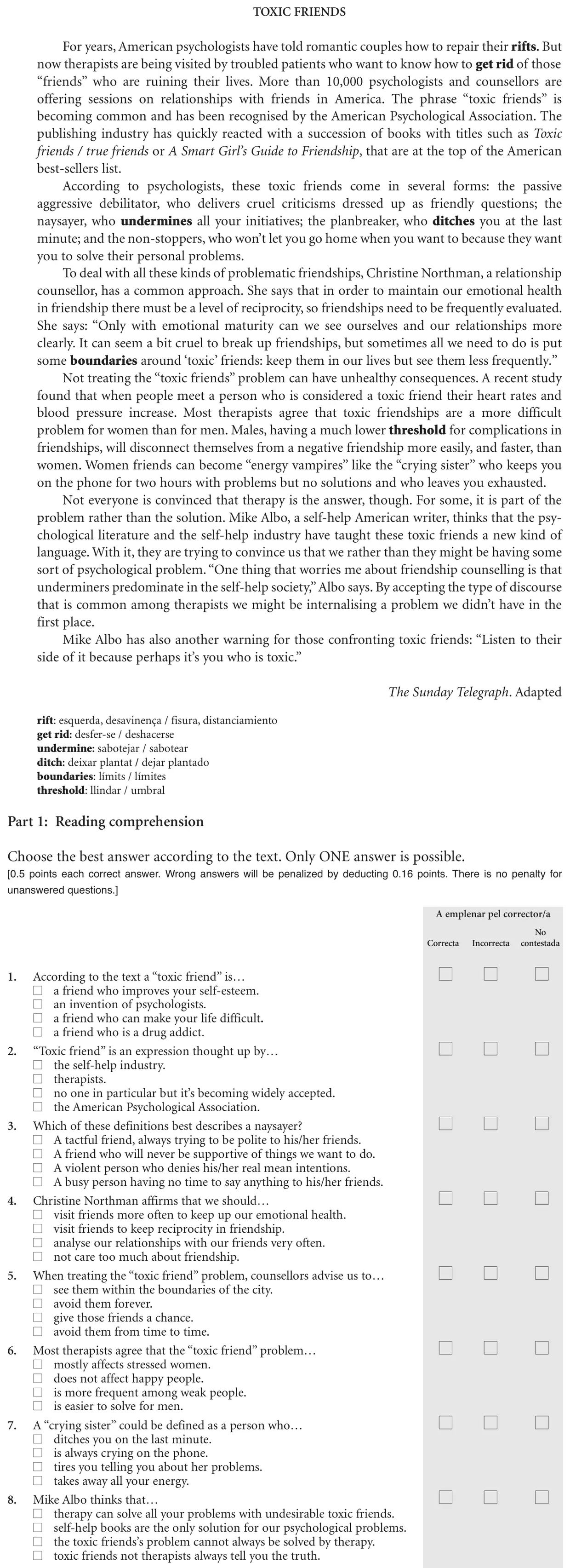
TOXIC FRIENDS
For years, American psychologists have told romantic couples how to repair their rifts. But
now therapists are being visited by troubled patients who want to know how to get rid of those
“friends” who are ruining their lives. More than 10,000 psychologists and counsellors are
offering sessions on relationships with friends in America. The phrase “toxic friends” is
becoming common and has been recognised by the American Psychological Association. The
publishing industry has quickly reacted with a succession of books with titles such as Toxic
friends / true friends or A Smart Girl’s Guide to Friendship, that are at the top of the American
best-sellers list.
According to psychologists, these toxic friends come in several forms: the passive
aggressive debilitator, who delivers cruel criticisms dressed up as friendly questions; the
naysayer, who undermines all your initiatives; the planbreaker, who ditches you at the last
minute; and the non-stoppers, who won’t let you go home when you want to because they want
you to solve their personal problems.
To deal with all these kinds of problematic friendships, Christine Northman, a relationship
counsellor, has a common approach. She says that in order to maintain our emotional health
in friendship there must be a level of reciprocity, so friendships need to be frequently evaluated.
She says: “Only with emotional maturity can we see ourselves and our relationships more
clearly. It can seem a bit cruel to break up friendships, but sometimes all we need to do is put
some boundaries around ‘toxic’ friends: keep them in our lives but see them less frequently.”
Not treating the “toxic friends” problem can have unhealthy consequences. A recent study
found that when people meet a person who is considered a toxic friend their heart rates and
blood pressure increase. Most therapists agree that toxic friendships are a more difficult
problem for women than for men. Males, having a much lower threshold for complications in
friendships, will disconnect themselves from a negative friendship more easily, and faster, than
women. Women friends can become “energy vampires” like the “crying sister” who keeps you
on the phone for two hours with problems but no solutions and who leaves you exhausted.
Not everyone is convinced that therapy is the answer, though. For some, it is part of the
problem rather than the solution. Mike Albo, a self-help American writer, thinks that the psy-
chological literature and the self-help industry have taught these toxic friends a new kind of
language. With it, they are trying to convince us that we rather than they might be having some
sort of psychological problem. “One thing that worries me about friendship counselling is that
underminers predominate in the self-help society,” Albo says. By accepting the type of discourse
that is common among therapists we might be internalising a problem we didn’t have in the
first place.
Mike Albo has also another warning for those confronting toxic friends: “Listen to their
side of it because perhaps it’s you who is toxic.”
The Sunday Telegraph. Adapted
rift: esquerda, desavinença / fisura, distanciamiento
get rid: desfer-se / deshacerse
undermine: sabotejar / sabotear
ditch: deixar plantat / dejar plantado
boundaries: límits / límites
threshold: llindar / umbral
Part 1: Reading comprehension
Choose the best answer according to the text. Only ONE answer is possible.
[0.5 points each correct answer. Wrong answers will be penalized by deducting 0.16 points. There is no penalty for
unanswered questions.]
A emplenar pel corrector/a
No
Correcta Incorrecta contestada
1. According to the text a “toxic friend” is…
I a friend who improves your self-esteem.
I an invention of psychologists.
I a friend who can make your life difficult.
I a friend who is a drug addict.
2. “Toxic friend” is an expression thought up by…
I the self-help industry.
I therapists.
I no one in particular but it’s becoming widely accepted.
I the American Psycho
Criteris oficials de correcció
Text dels criteris (transcripció automàtica)
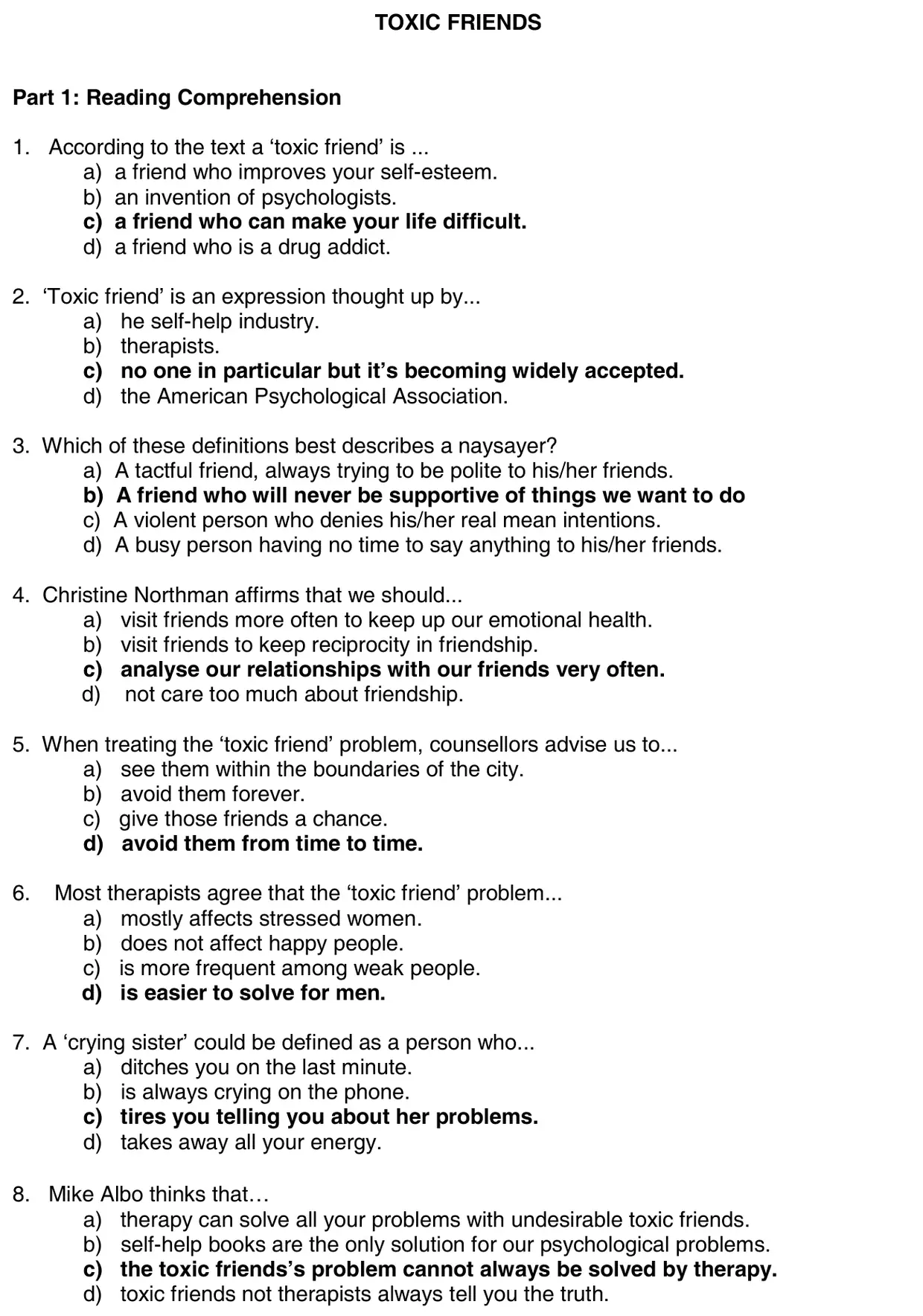
Part 1: Reading Comprehension
1. According to the text a ‘toxic friend’ is ...
a) a friend who improves your self-esteem.
b) an invention of psychologists.
c) a friend who can make your life difficult.
d) a friend who is a drug addict.
2. ‘Toxic friend’ is an expression thought up by...
a) he self-help industry.
b) therapists.
c) no one in particular but it’s becoming widely accepted.
d) the American Psychological Association.
3. Which of these definitions best describes a naysayer?
a) A tactful friend, always trying to be polite to his/her friends.
b) A friend who will never be supportive of things we want to do
c) A violent person who denies his/her real mean intentions.
d) A busy person having no time to say anything to his/her friends.
4. Christine Northman affirms that we should...
a) visit friends more often to keep up our emotional health.
b) visit friends to keep reciprocity in friendship.
c) analyse our relationships with our friends very often.
d) not care too much about frie […]
Resolució pas a pas
Encara no hi ha resolució pròpia verificada d'aquest exercici. Mentrestant, tens els criteris oficials de correcció a sobre. Si tens dubtes, pregunta'ls al xat de la Sala d'estudi.
Font: enunciat i criteris de correcció oficials de les PAU 2008 de Catalunya, publicats per la Generalitat de Catalunya (universitats.gencat.cat) i les universitats catalanes. La resolució pas a pas és pròpia de L'Acadèmia de Vic.
Altres exercicis d'aquest examen
- Part 2 · Writing Writing
- Part 3 · Listening comprehension Listening comprehension