
PAU Anglès 2008 · Juny · Sèrie 5 · Part 3 · Listening comprehension
Enunciat
Text de l'enunciat (transcripció automàtica)
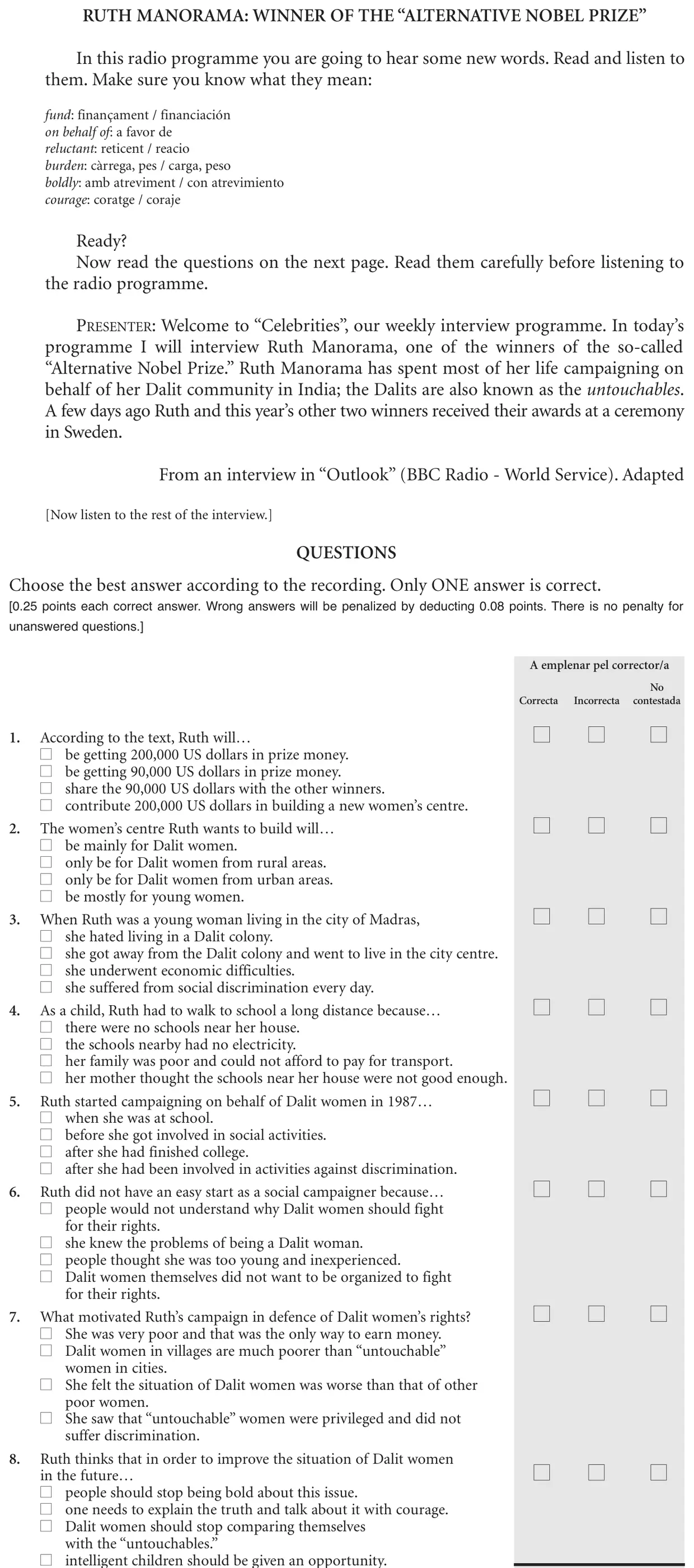
RUTH MANORAMA: WINNER OF THE “ALTERNATIVE NOBEL PRIZE”
In this radio programme you are going to hear some new words. Read and listen to
them. Make sure you know what they mean:
fund: finançament / financiación
on behalf of: a favor de
reluctant: reticent / reacio
burden: càrrega, pes / carga, peso
boldly: amb atreviment / con atrevimiento
courage: coratge / coraje
Ready?
Now read the questions on the next page. Read them carefully before listening to
the radio programme.
PRESENTER: Welcome to “Celebrities”, our weekly interview programme. In today’s
programme I will interview Ruth Manorama, one of the winners of the so-called
“Alternative Nobel Prize.” Ruth Manorama has spent most of her life campaigning on
behalf of her Dalit community in India; the Dalits are also known as the untouchables.
A few days ago Ruth and this year’s other two winners received their awards at a ceremony
in Sweden.
From an interview in “Outlook” (BBC Radio - World Service). Adapted
[Now listen to the rest of the interview.]
QUESTIONS
Choose the best answer according to the recording. Only ONE answer is correct.
[0.25 points each correct answer. Wrong answers will be penalized by deducting 0.08 points. There is no penalty for
unanswered questions.]
A emplenar pel corrector/a
No
Correcta Incorrecta contestada
1. According to the text, Ruth will…
I be getting 200,000 US dollars in prize money.
I be getting 90,000 US dollars in prize money.
I share the 90,000 US dollars with the other winners.
I contribute 200,000 US dollars in building a new women’s centre.
2. The women’s centre Ruth wants to build will…
I be mainly for Dalit women.
I only be for Dalit women from rural areas.
I only be for Dalit women from urban areas.
I be mostly for young women.
3. When Ruth was a young woman living in the city of Madras,
I she hated living in a Dalit colony.
I she got away from the Dalit colony and went to live in the city centre.
I she underwent economic difficulties.
I she suffered from social discrimination every day.
4. As a child, Ruth had to walk to school a long distance because…
I there were no schools near her house.
I the schools nearby had no electricity.
I her family was poor and could not afford to pay for transport.
I her mother thought the schools near her house were not good enough.
5. Ruth started campaigning on behalf of Dalit women in 1987…
I when she was at school.
I before she got involved in social activities.
I after she had finished college.
I after she had been involved in activities against discrimination.
6. Ruth did not have an easy start as a social campaigner because…
I people would not understand why Dalit women should fight
for their rights.
I she knew the problems of being a Dalit woman.
I people thought she was too young and inexperienced.
I Dalit women themselves did not want to be organized to fight
for their rights.
7. What motivated Ruth’s campaign in defence of Dalit women’s rights?
I She was very poor and that was the only way to earn money.
I Dalit women in villages are much poorer than “untouchable”
women in cities.
I She felt the situation of Dalit women was worse than that of other
poor women.
I She saw that “untouchable” women were privileged and did not
suffer discrimination.
8. Ruth thinks that in order to improve the situation of Dalit women
in the future…
I people should stop being bold about this issue.
I one needs to explain the truth and talk about it with courage.
I Dalit women should stop comparing themselves
with the “untouchables.”
I intelligent children should be given an opportunity.
Correctes Incorrectes No contestades
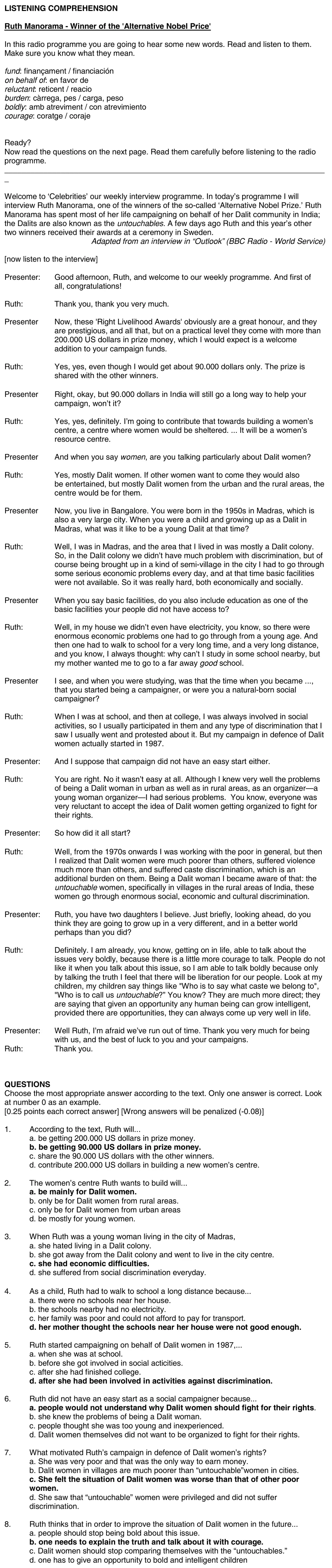
Criteris oficials de correcció
Resolució pas a pas
Aquest exercici no té una resolució escrita pas a pas (requereix l'àudio de la prova). Fes servir els criteris oficials de correcció.
Font: enunciat i criteris de correcció oficials de les PAU 2008 de Catalunya, publicats per la Generalitat de Catalunya (universitats.gencat.cat) i les universitats catalanes. La resolució pas a pas és pròpia de L'Acadèmia de Vic.
Altres exercicis d'aquest examen
- Part 1 · Reading comprehension Reading comprehension
- Part 2 · Writing Writing
Tots els exercicis de Listening comprehension · PAU de Anglès