
PAU Anglès 2005 · Setembre · Sèrie 3 · Part 1 · Reading comprehension
Enunciat
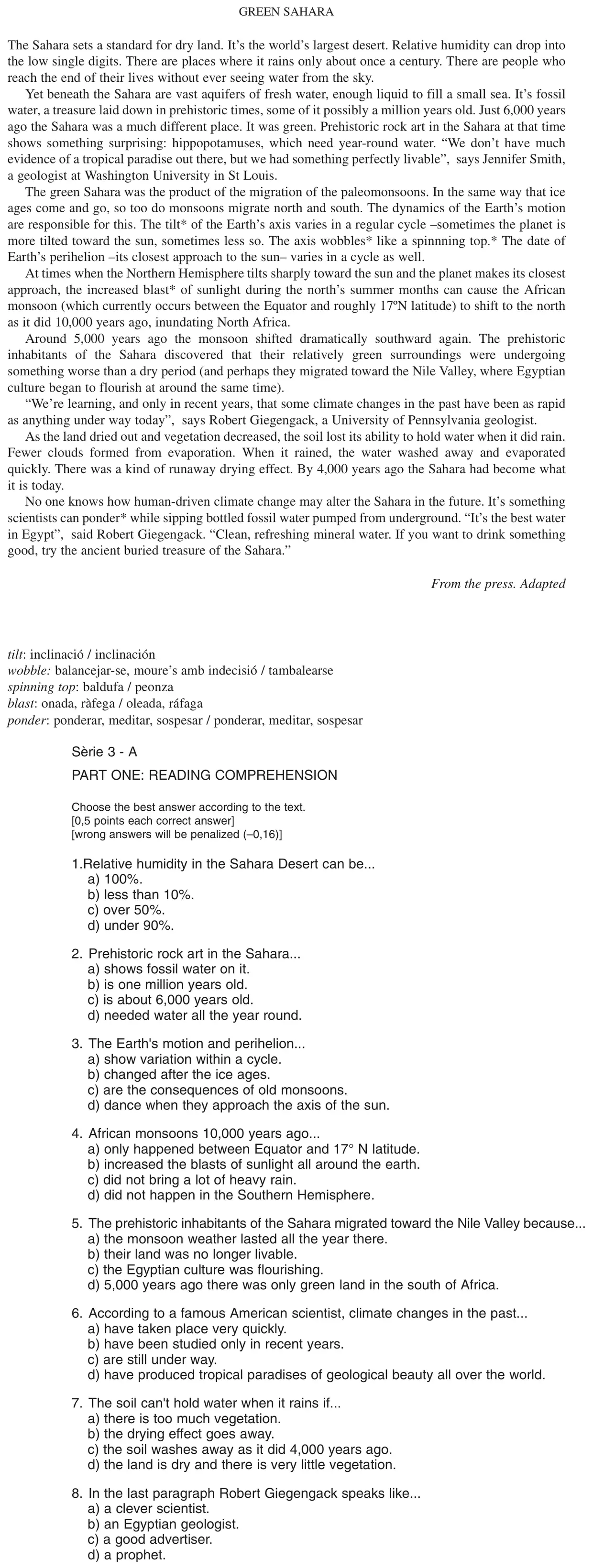
Text de l'enunciat (transcripció automàtica)
GREEN SAHARA
The Sahara sets a standard for dry land. It’s the world’s largest desert. Relative humidity can drop into
the low single digits. There are places where it rains only about once a century. There are people who
reach the end of their lives without ever seeing water from the sky.
Yet beneath the Sahara are vast aquifers of fresh water, enough liquid to fill a small sea. It’s fossil
water, a treasure laid down in prehistoric times, some of it possibly a million years old. Just 6,000 years
ago the Sahara was a much different place. It was green. Prehistoric rock art in the Sahara at that time
shows something surprising: hippopotamuses, which need year-round water. “We don’t have much
evidence of a tropical paradise out there, but we had something perfectly livable”, says Jennifer Smith,
a geologist at Washington University in St Louis.
The green Sahara was the product of the migration of the paleomonsoons. In the same way that ice
ages come and go, so too do monsoons migrate north and south. The dynamics of the Earth’s motion
are responsible for this. The tilt* of the Earth’s axis varies in a regular cycle –sometimes the planet is
more tilted toward the sun, sometimes less so. The axis wobbles* like a spinnning top.* The date of
Earth’s perihelion –its closest approach to the sun– varies in a cycle as well.
At times when the Northern Hemisphere tilts sharply toward the sun and the planet makes its closest
approach, the increased blast* of sunlight during the north’s summer months can cause the African
monsoon (which currently occurs between the Equator and roughly 17ºN latitude) to shift to the north
as it did 10,000 years ago, inundating North Africa.
Around 5,000 years ago the monsoon shifted dramatically southward again. The prehistoric
inhabitants of the Sahara discovered that their relatively green surroundings were undergoing
something worse than a dry period (and perhaps they migrated toward the Nile Valley, where Egyptian
culture began to flourish at around the same time).
“We’re learning, and only in recent years, that some climate changes in the past have been as rapid
as anything under way today”, says Robert Giegengack, a University of Pennsylvania geologist.
As the land dried out and vegetation decreased, the soil lost its ability to hold water when it did rain.
Fewer clouds formed from evaporation. When it rained, the water washed away and evaporated
quickly. There was a kind of runaway drying effect. By 4,000 years ago the Sahara had become what
it is today.
No one knows how human-driven climate change may alter the Sahara in the future. It’s something
scientists can ponder* while sipping bottled fossil water pumped from underground. “It’s the best water
in Egypt”, said Robert Giegengack. “Clean, refreshing mineral water. If you want to drink something
good, try the ancient buried treasure of the Sahara.”
From the press. Adapted
tilt: inclinació / inclinación
wobble: balancejar-se, moure’s amb indecisió / tambalearse
spinning top: baldufa / peonza
blast: onada, ràfega / oleada, ráfaga
ponder: ponderar, meditar, sospesar / ponderar, meditar, sospesar
Sèrie 3 - A
PART ONE: READING COMPREHENSION
Choose the best answer according to the text.
[0,5 points each correct answer]
[wrong answers will be penalized (–0,16)]
1.Relative humidity in the Sahara Desert can be...
a) 100%.
b) less than 10%.
c) over 50%.
d) under 90%.
2. Prehistoric rock art in the Sahara...
a) shows fossil water on it.
b) is one million years old.
c) is about 6,000 years old.
d) needed water all the year round.
3. The Earth's motion and perihelion...
a) show variation within a cycle.
b) changed after the ice ages.
c) are the consequences of old monsoons.
d) dance when they approach the axis of the sun.
4. African monsoons 10,000 years ago...
a) only happened between Equator and 17° N latitude.
b) increased the blasts of sunlight all around the earth.
c) did not bring a lot of heavy rain.
d) did not happen in the Southern Hemisphere.
5. T
Criteris oficials de correcció
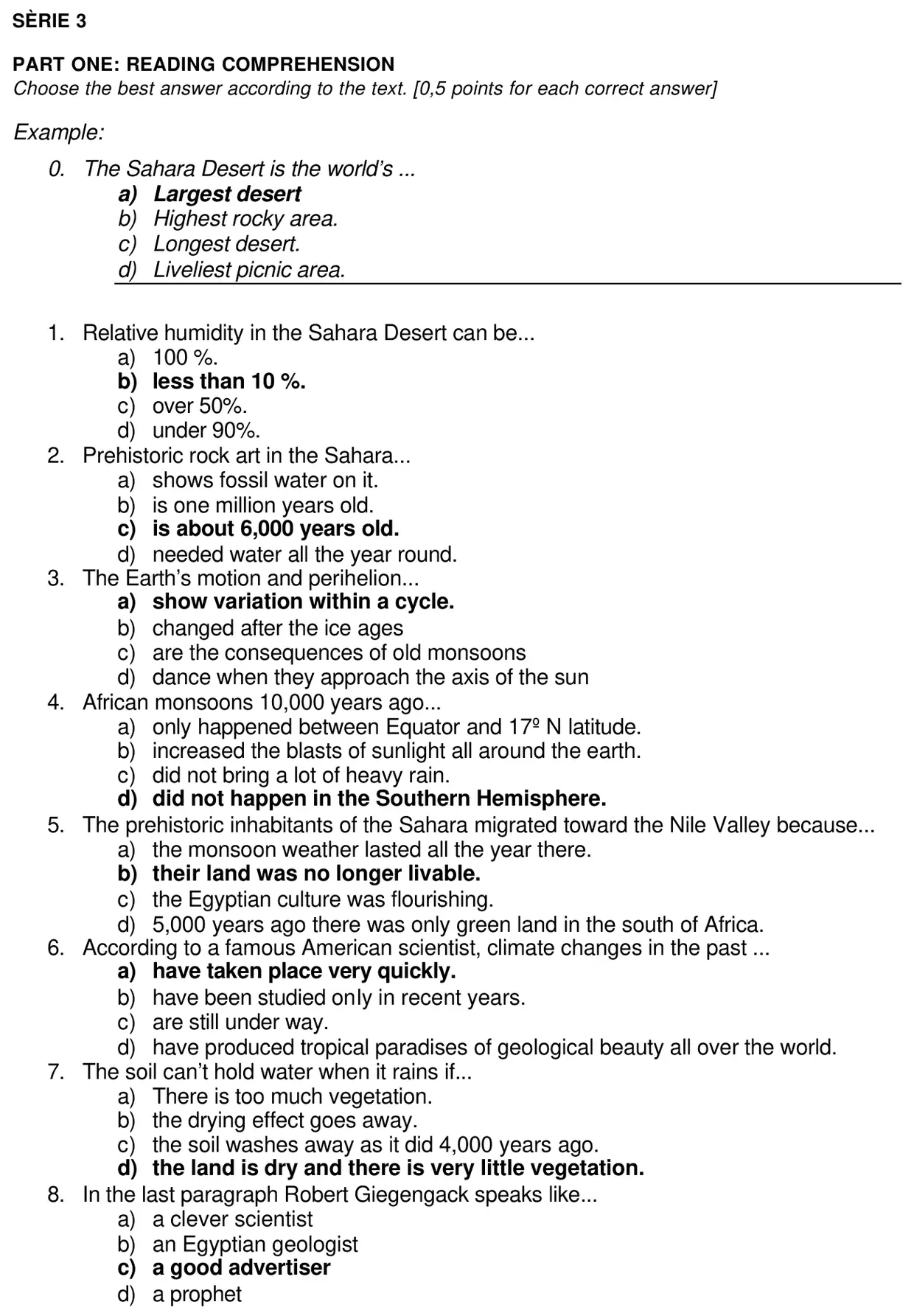
Text dels criteris (transcripció automàtica)
PART ONE: READING COMPREHENSION
Choose the best answer according to the text. [0,5 points for each correct answer]
Example:
0. The Sahara Desert is the world’s ...
a) Largest desert
b) Highest rocky area.
c) Longest desert.
d) Liveliest picnic area.
1. Relative humidity in the Sahara Desert can be...
a) 100 %.
b) less than 10 %.
c) over 50%.
d) under 90%.
2. Prehistoric rock art in the Sahara...
a) shows fossil water on it.
b) is one million years old.
c) is about 6,000 years old.
d) needed water all the year round.
3. The Earth’s motion and perihelion...
a) show variation within a cycle.
b) changed after the ice ages
c) are the consequences of old monsoons
d) dance when they approach the axis of the sun
4. African monsoons 10,000 years ago...
a) only happened between Equator and 17º N latitude.
b) increased the blasts of sunlight all around the earth.
c) did not bring a lot of heavy rain.
d) did not happen in the Southern Hemisphere.
5. The prehistoric inhabitants of the Sahara migrat […]
Resolució pas a pas
Encara no hi ha resolució pròpia verificada d'aquest exercici. Mentrestant, tens els criteris oficials de correcció a sobre. Si tens dubtes, pregunta'ls al xat de la Sala d'estudi.
Font: enunciat i criteris de correcció oficials de les PAU 2005 de Catalunya, publicats per la Generalitat de Catalunya (universitats.gencat.cat) i les universitats catalanes. La resolució pas a pas és pròpia de L'Acadèmia de Vic.
Altres exercicis d'aquest examen
- Part 2 · Writing Writing
- Part 3 · Listening comprehension Listening comprehension