
PAU Anglès 2005 · Juny · Sèrie 1 · Part 1 · Reading comprehension
Enunciat
Text de l'enunciat (transcripció automàtica)
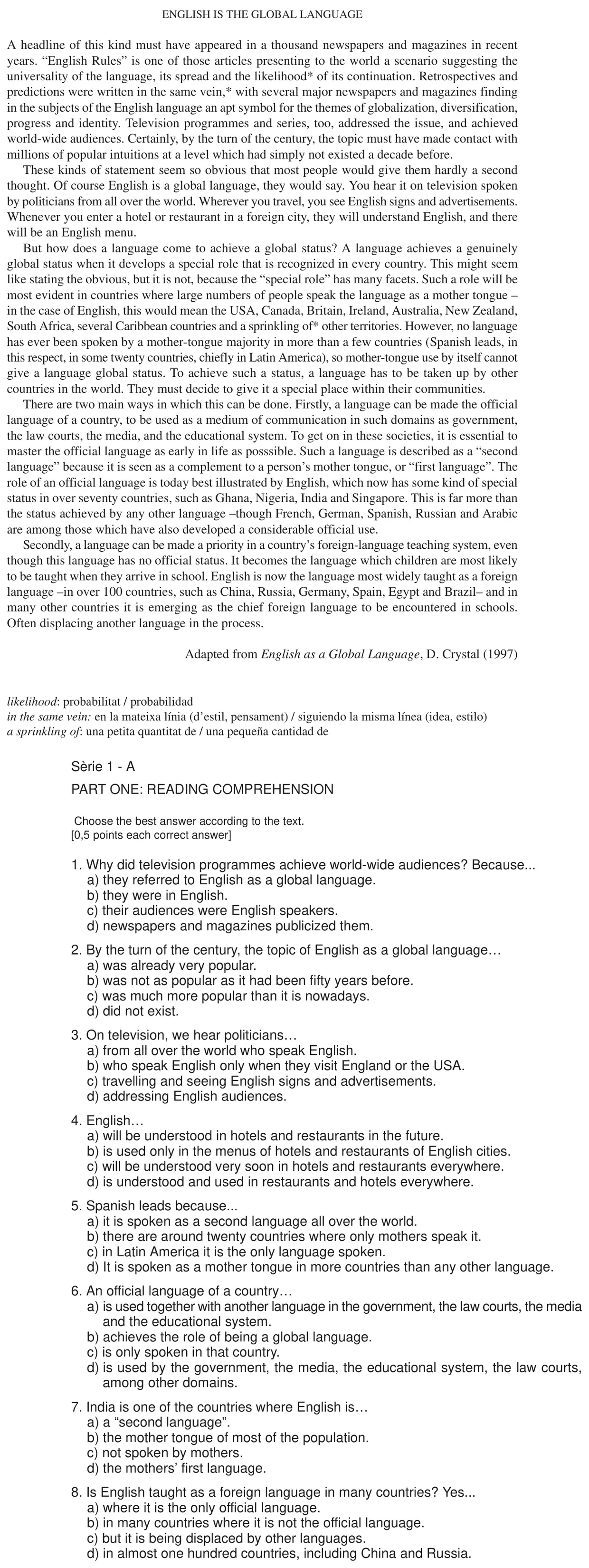
ENGLISH IS THE GLOBAL LANGUAGE
A headline of this kind must have appeared in a thousand newspapers and magazines in recent
years. “English Rules” is one of those articles presenting to the world a scenario suggesting the
universality of the language, its spread and the likelihood* of its continuation. Retrospectives and
predictions were written in the same vein,* with several major newspapers and magazines finding
in the subjects of the English language an apt symbol for the themes of globalization, diversification,
progress and identity. Television programmes and series, too, addressed the issue, and achieved
world-wide audiences. Certainly, by the turn of the century, the topic must have made contact with
millions of popular intuitions at a level which had simply not existed a decade before.
These kinds of statement seem so obvious that most people would give them hardly a second
thought. Of course English is a global language, they would say. You hear it on television spoken
by politicians from all over the world. Wherever you travel, you see English signs and advertisements.
Whenever you enter a hotel or restaurant in a foreign city, they will understand English, and there
will be an English menu.
But how does a language come to achieve a global status? A language achieves a genuinely
global status when it develops a special role that is recognized in every country. This might seem
like stating the obvious, but it is not, because the “special role” has many facets. Such a role will be
most evident in countries where large numbers of people speak the language as a mother tongue –
in the case of English, this would mean the USA, Canada, Britain, Ireland, Australia, New Zealand,
South Africa, several Caribbean countries and a sprinkling of* other territories. However, no language
has ever been spoken by a mother-tongue majority in more than a few countries (Spanish leads, in
this respect, in some twenty countries, chiefly in Latin America), so mother-tongue use by itself cannot
give a language global status. To achieve such a status, a language has to be taken up by other
countries in the world. They must decide to give it a special place within their communities.
There are two main ways in which this can be done. Firstly, a language can be made the official
language of a country, to be used as a medium of communication in such domains as government,
the law courts, the media, and the educational system. To get on in these societies, it is essential to
master the official language as early in life as posssible. Such a language is described as a “second
language” because it is seen as a complement to a person’s mother tongue, or “first language”. The
role of an official language is today best illustrated by English, which now has some kind of special
status in over seventy countries, such as Ghana, Nigeria, India and Singapore. This is far more than
the status achieved by any other language –though French, German, Spanish, Russian and Arabic
are among those which have also developed a considerable official use.
Secondly, a language can be made a priority in a country’s foreign-language teaching system, even
though this language has no official status. It becomes the language which children are most likely
to be taught when they arrive in school. English is now the language most widely taught as a foreign
language –in over 100 countries, such as China, Russia, Germany, Spain, Egypt and Brazil– and in
many other countries it is emerging as the chief foreign language to be encountered in schools.
Often displacing another language in the process.
Adapted from English as a Global Language, D. Crystal (1997)
likelihood: probabilitat / probabilidad
in the same vein: en la mateixa línia (d’estil, pensament) / siguiendo la misma línea (idea, estilo)
a sprinkling of: una petita quantitat de / una pequeña cantidad de
Sèrie 1 - A
PART ONE: READING COMPREHENSION
Choose the best answer according to the text.
[0,5 points each correct answer]
Criteris oficials de correcció
Text dels criteris (transcripció automàtica)
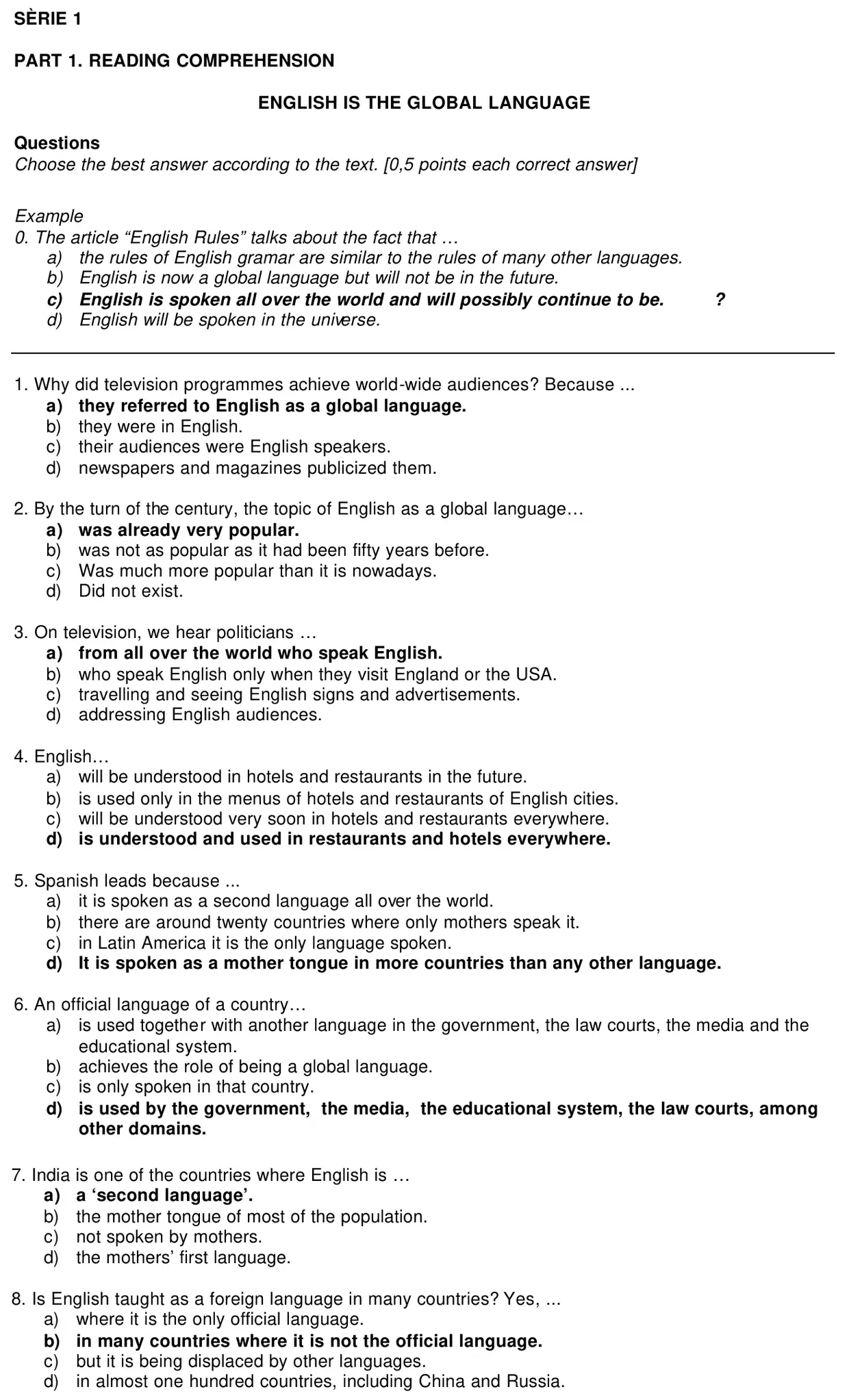
PART 1. READING COMPREHENSION
ENGLISH IS THE GLOBAL LANGUAGE
Questions
Choose the best answer according to the text. [0,5 points each correct answer]
Example
0. The article “English Rules” talks about the fact that …
a) the rules of English gramar are similar to the rules of many other languages.
b) English is now a global language but will not be in the future.
c) English is spoken all over the world and will possibly continue to be. ?
d) English will be spoken in the universe.
1. Why did television programmes achieve world-wide audiences? Because ...
a) they referred to English as a global language.
b) they were in English.
c) their audiences were English speakers.
d) newspapers and magazines publicized them.
2. By the turn of the century, the topic of English as a global language…
a) was already very popular.
b) was not as popular as it had been fifty years before.
c) Was much more popular than it is nowadays.
d) Did not exist.
3. On television, we hear politicians …
a) from all ove […]
Resolució pas a pas
Encara no hi ha resolució pròpia verificada d'aquest exercici. Mentrestant, tens els criteris oficials de correcció a sobre. Si tens dubtes, pregunta'ls al xat de la Sala d'estudi.
Font: enunciat i criteris de correcció oficials de les PAU 2005 de Catalunya, publicats per la Generalitat de Catalunya (universitats.gencat.cat) i les universitats catalanes. La resolució pas a pas és pròpia de L'Acadèmia de Vic.
Altres exercicis d'aquest examen
- Part 2 · Writing Writing
- Part 3 · Listening comprehension Listening comprehension