
PAU Anglès 2005 · Setembre · Sèrie 3 · Part 3 · Listening comprehension
Enunciat
Text de l'enunciat (transcripció automàtica)
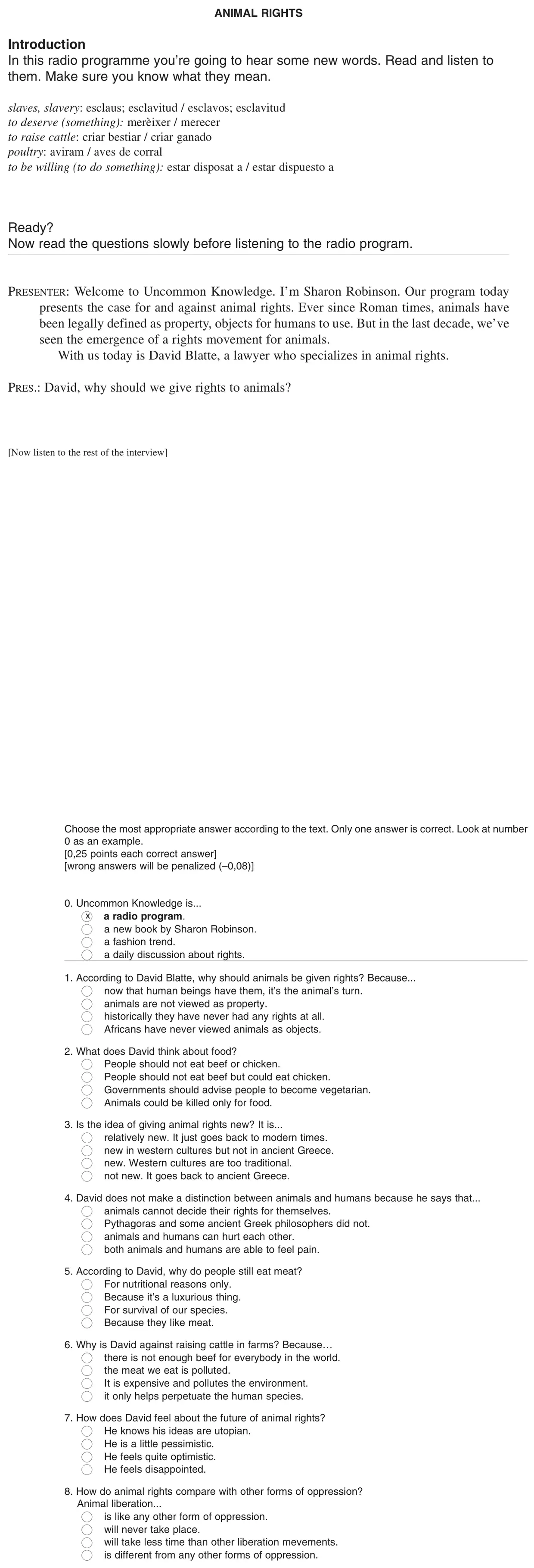
ANIMAL RIGHTS
Introduction
In this radio programme you’re going to hear some new words. Read and listen to
them. Make sure you know what they mean.
slaves, slavery: esclaus; esclavitud / esclavos; esclavitud
to deserve (something): merèixer / merecer
to raise cattle: criar bestiar / criar ganado
poultry: aviram / aves de corral
to be willing (to do something): estar disposat a / estar dispuesto a
Ready?
Now read the questions slowly before listening to the radio program.
PRESENTER: Welcome to Uncommon Knowledge. I’m Sharon Robinson. Our program today
presents the case for and against animal rights. Ever since Roman times, animals have
been legally defined as property, objects for humans to use. But in the last decade, we’ve
seen the emergence of a rights movement for animals.
With us today is David Blatte, a lawyer who specializes in animal rights.
PRES.: David, why should we give rights to animals?
[Now listen to the rest of the interview]
Choose the most appropriate answer according to the text. Only one answer is correct. Look at number
0 as an example.
[0,25 points each correct answer]
[wrong answers will be penalized (–0,08)]
0. Uncommon Knowledge is...
nx
a radio program.
n a new book by Sharon Robinson.
n a fashion trend.
n a daily discussion about rights.
1. According to David Blatte, why should animals be given rights? Because...
n now that human beings have them, it’s the animal’s turn.
n animals are not viewed as property.
n historically they have never had any rights at all.
n Africans have never viewed animals as objects.
2. What does David think about food?
n People should not eat beef or chicken.
n People should not eat beef but could eat chicken.
n Governments should advise people to become vegetarian.
n Animals could be killed only for food.
3. Is the idea of giving animal rights new? It is...
n relatively new. It just goes back to modern times.
n new in western cultures but not in ancient Greece.
n new. Western cultures are too traditional.
n not new. It goes back to ancient Greece.
4. David does not make a distinction between animals and humans because he says that...
n animals cannot decide their rights for themselves.
n Pythagoras and some ancient Greek philosophers did not.
n animals and humans can hurt each other.
n both animals and humans are able to feel pain.
5. According to David, why do people still eat meat?
n For nutritional reasons only.
n Because it’s a luxurious thing.
n For survival of our species.
n Because they like meat.
6. Why is David against raising cattle in farms? Because…
n there is not enough beef for everybody in the world.
n the meat we eat is polluted.
n It is expensive and pollutes the environment.
n it only helps perpetuate the human species.
7. How does David feel about the future of animal rights?
n He knows his ideas are utopian.
n He is a little pessimistic.
n He feels quite optimistic.
n He feels disappointed.
8. How do animal rights compare with other forms of oppression?
Animal liberation...
n is like any other form of oppression.
n will never take place.
n will take less time than other liberation mevements.
n is different from any other forms of oppression.
Criteris oficials de correcció
Text dels criteris (transcripció automàtica)
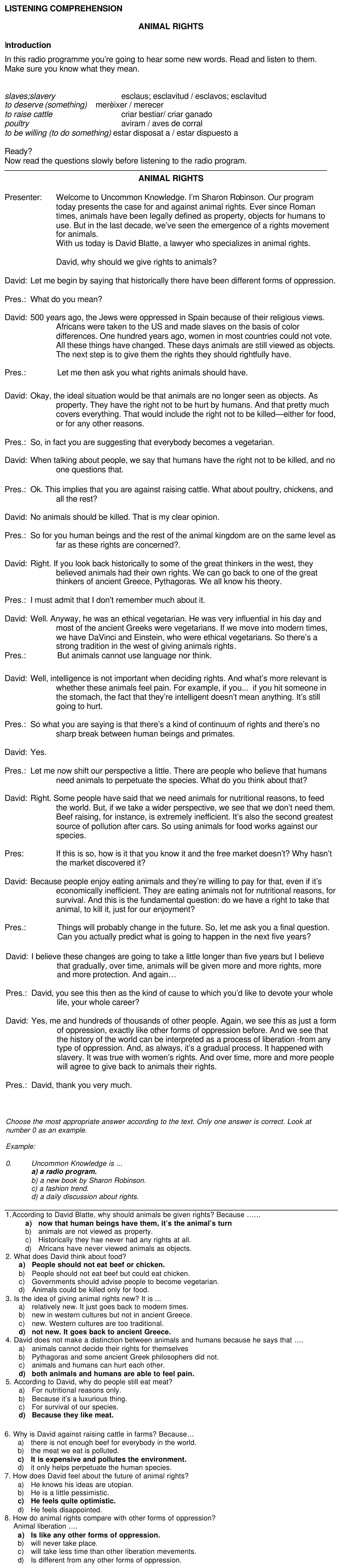
LISTENING COMPREHENSION
ANIMAL RIGHTS
Introduction
In this radio programme you’re going to hear some new words. Read and listen to them.
Make sure you know what they mean.
slaves;slavery esclaus; esclavitud / esclavos; esclavitud
to deserve (something) merèixer / merecer
to raise cattle criar bestiar/ criar ganado
poultry aviram / aves de corral
to be willing (to do something) estar disposat a / estar dispuesto a
Ready?
Now read the questions slowly before listening to the radio program.
ANIMAL RIGHTS
Presenter: Welcome to Uncommon Knowledge. I’m Sharon Robinson. Our program
today presents the case for and against animal rights. Ever since Roman
times, animals have been legally defined as property, objects for humans to
use. But in the last decade, we’ve seen the emergence of a rights movement
for animals.
With us today is David Blatte, a lawyer who specializes in animal rights.
David, why should we give rights to animals?
David: Let me begin by saying that historically there have been […]
Resolució pas a pas
Aquest exercici no té una resolució escrita pas a pas (requereix l'àudio de la prova). Fes servir els criteris oficials de correcció.
Font: enunciat i criteris de correcció oficials de les PAU 2005 de Catalunya, publicats per la Generalitat de Catalunya (universitats.gencat.cat) i les universitats catalanes. La resolució pas a pas és pròpia de L'Acadèmia de Vic.
Altres exercicis d'aquest examen
- Part 1 · Reading comprehension Reading comprehension
- Part 2 · Writing Writing
Tots els exercicis de Listening comprehension · PAU de Anglès