
PAU Anglès 2006 · Juny · Sèrie 3 · Part 1 · Reading comprehension
Enunciat
Text de l'enunciat (transcripció automàtica)
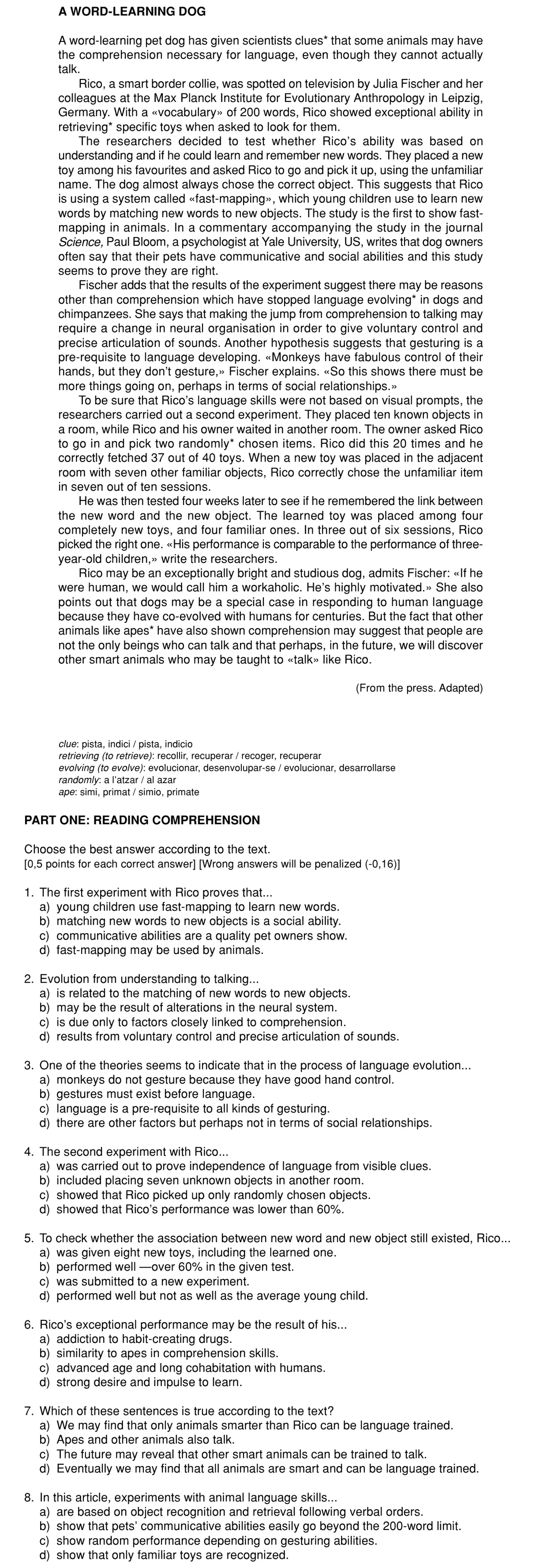
A WORD-LEARNING DOG
A word-learning pet dog has given scientists clues* that some animals may have
the comprehension necessary for language, even though they cannot actually
talk.
Rico, a smart border collie, was spotted on television by Julia Fischer and her
colleagues at the Max Planck Institute for Evolutionary Anthropology in Leipzig,
Germany. With a «vocabulary» of 200 words, Rico showed exceptional ability in
retrieving* specific toys when asked to look for them.
The researchers decided to test whether Rico’s ability was based on
understanding and if he could learn and remember new words. They placed a new
toy among his favourites and asked Rico to go and pick it up, using the unfamiliar
name. The dog almost always chose the correct object. This suggests that Rico
is using a system called «fast-mapping», which young children use to learn new
words by matching new words to new objects. The study is the first to show fast-
mapping in animals. In a commentary accompanying the study in the journal
Science, Paul Bloom, a psychologist at Yale University, US, writes that dog owners
often say that their pets have communicative and social abilities and this study
seems to prove they are right.
Fischer adds that the results of the experiment suggest there may be reasons
other than comprehension which have stopped language evolving* in dogs and
chimpanzees. She says that making the jump from comprehension to talking may
require a change in neural organisation in order to give voluntary control and
precise articulation of sounds. Another hypothesis suggests that gesturing is a
pre-requisite to language developing. «Monkeys have fabulous control of their
hands, but they don’t gesture,» Fischer explains. «So this shows there must be
more things going on, perhaps in terms of social relationships.»
To be sure that Rico’s language skills were not based on visual prompts, the
researchers carried out a second experiment. They placed ten known objects in
a room, while Rico and his owner waited in another room. The owner asked Rico
to go in and pick two randomly* chosen items. Rico did this 20 times and he
correctly fetched 37 out of 40 toys. When a new toy was placed in the adjacent
room with seven other familiar objects, Rico correctly chose the unfamiliar item
in seven out of ten sessions.
He was then tested four weeks later to see if he remembered the link between
the new word and the new object. The learned toy was placed among four
completely new toys, and four familiar ones. In three out of six sessions, Rico
picked the right one. «His performance is comparable to the performance of three-
year-old children,» write the researchers.
Rico may be an exceptionally bright and studious dog, admits Fischer: «If he
were human, we would call him a workaholic. He’s highly motivated.» She also
points out that dogs may be a special case in responding to human language
because they have co-evolved with humans for centuries. But the fact that other
animals like apes* have also shown comprehension may suggest that people are
not the only beings who can talk and that perhaps, in the future, we will discover
other smart animals who may be taught to «talk» like Rico.
(From the press. Adapted)
clue: pista, indici / pista, indicio
retrieving (to retrieve): recollir, recuperar / recoger, recuperar
evolving (to evolve): evolucionar, desenvolupar-se / evolucionar, desarrollarse
randomly: a l’atzar / al azar
ape: simi, primat / simio, primate
PART ONE: READING COMPREHENSION
Choose the best answer according to the text.
[0,5 points for each correct answer] [Wrong answers will be penalized (-0,16)]
1. The first experiment with Rico proves that...
a) young children use fast-mapping to learn new words.
b) matching new words to new objects is a social ability.
c) communicative abilities are a quality pet owners show.
d) fast-mapping may be used by animals.
2. Evolution from understanding to talking...
a) is related to the matching of new words to new objects.
b)
Criteris oficials de correcció
Text dels criteris (transcripció automàtica)
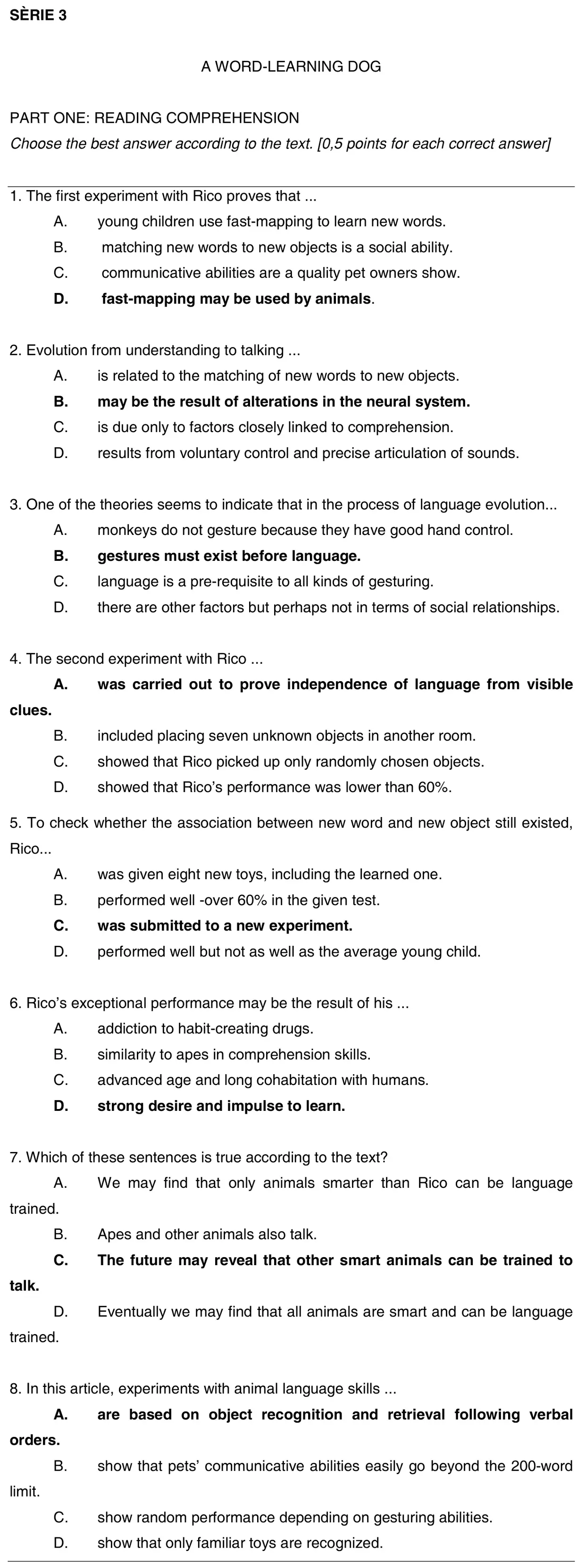
PART ONE: READING COMPREHENSION
Choose the best answer according to the text. [0,5 points for each correct answer]
1. The first experiment with Rico proves that ...
A. young children use fast-mapping to learn new words.
B. matching new words to new objects is a social ability.
C. communicative abilities are a quality pet owners show.
D. fast-mapping may be used by animals.
2. Evolution from understanding to talking ...
A. is related to the matching of new words to new objects.
B. may be the result of alterations in the neural system.
C. is due only to factors closely linked to comprehension.
D. results from voluntary control and precise articulation of sounds.
3. One of the theories seems to indicate that in the process of language evolution...
A. monkeys do not gesture because they have good hand control.
B. gestures must exist before language.
C. language is a pre-requisite to all kinds of gesturing.
D. there are other factors but perhaps not in terms of social relationships.
4. The […]
Resolució pas a pas
Encara no hi ha resolució pròpia verificada d'aquest exercici. Mentrestant, tens els criteris oficials de correcció a sobre. Si tens dubtes, pregunta'ls al xat de la Sala d'estudi.
Font: enunciat i criteris de correcció oficials de les PAU 2006 de Catalunya, publicats per la Generalitat de Catalunya (universitats.gencat.cat) i les universitats catalanes. La resolució pas a pas és pròpia de L'Acadèmia de Vic.
Altres exercicis d'aquest examen
- Part 2 · Writing Writing
- Part 3 · Listening comprehension Listening comprehension