
PAU Anglès 2005 · Juny · Sèrie 4 · Part 1 · Reading comprehension
Enunciat
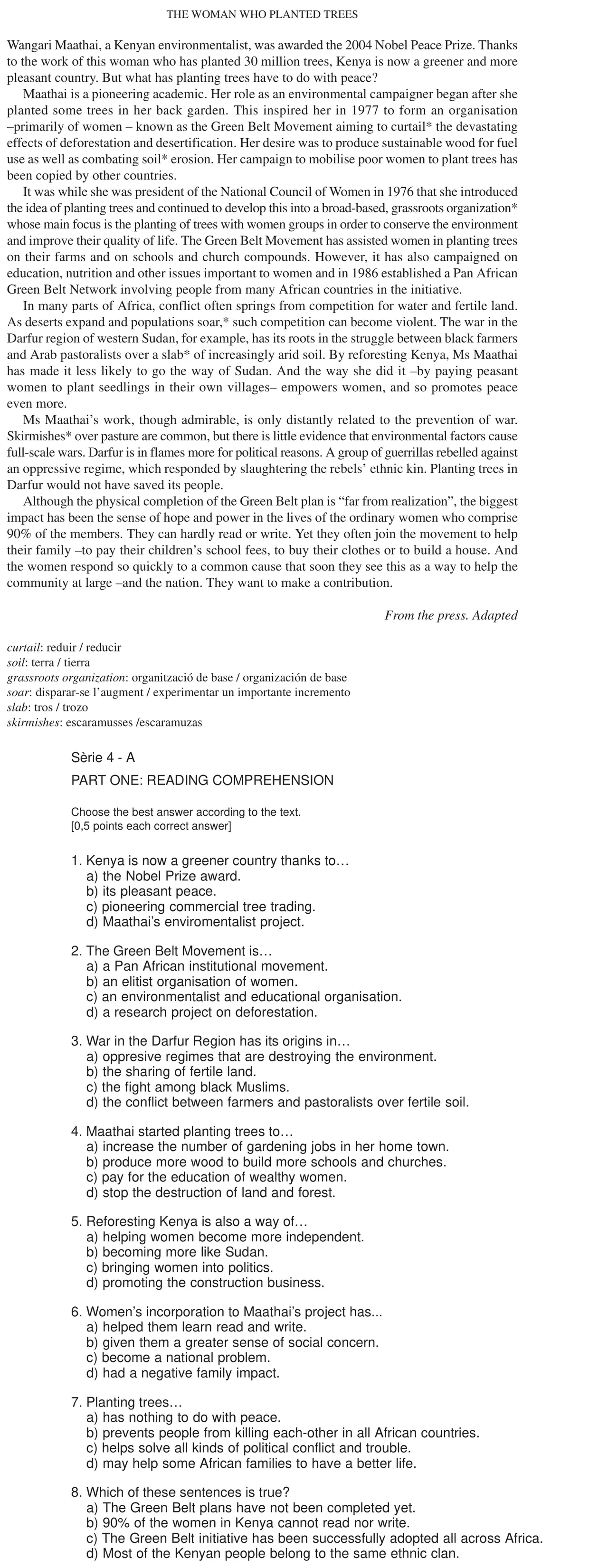
Text de l'enunciat (transcripció automàtica)
THE WOMAN WHO PLANTED TREES
Wangari Maathai, a Kenyan environmentalist, was awarded the 2004 Nobel Peace Prize. Thanks
to the work of this woman who has planted 30 million trees, Kenya is now a greener and more
pleasant country. But what has planting trees have to do with peace?
Maathai is a pioneering academic. Her role as an environmental campaigner began after she
planted some trees in her back garden. This inspired her in 1977 to form an organisation
–primarily of women – known as the Green Belt Movement aiming to curtail* the devastating
effects of deforestation and desertification. Her desire was to produce sustainable wood for fuel
use as well as combating soil* erosion. Her campaign to mobilise poor women to plant trees has
been copied by other countries.
It was while she was president of the National Council of Women in 1976 that she introduced
the idea of planting trees and continued to develop this into a broad-based, grassroots organization*
whose main focus is the planting of trees with women groups in order to conserve the environment
and improve their quality of life. The Green Belt Movement has assisted women in planting trees
on their farms and on schools and church compounds. However, it has also campaigned on
education, nutrition and other issues important to women and in 1986 established a Pan African
Green Belt Network involving people from many African countries in the initiative.
In many parts of Africa, conflict often springs from competition for water and fertile land.
As deserts expand and populations soar,* such competition can become violent. The war in the
Darfur region of western Sudan, for example, has its roots in the struggle between black farmers
and Arab pastoralists over a slab* of increasingly arid soil. By reforesting Kenya, Ms Maathai
has made it less likely to go the way of Sudan. And the way she did it –by paying peasant
women to plant seedlings in their own villages– empowers women, and so promotes peace
even more.
Ms Maathai’s work, though admirable, is only distantly related to the prevention of war.
Skirmishes* over pasture are common, but there is little evidence that environmental factors cause
full-scale wars. Darfur is in flames more for political reasons. A group of guerrillas rebelled against
an oppressive regime, which responded by slaughtering the rebels’ ethnic kin. Planting trees in
Darfur would not have saved its people.
Although the physical completion of the Green Belt plan is “far from realization”, the biggest
impact has been the sense of hope and power in the lives of the ordinary women who comprise
90% of the members. They can hardly read or write. Yet they often join the movement to help
their family –to pay their children’s school fees, to buy their clothes or to build a house. And
the women respond so quickly to a common cause that soon they see this as a way to help the
community at large –and the nation. They want to make a contribution.
From the press. Adapted
curtail: reduir / reducir
soil: terra / tierra
grassroots organization: organització de base / organización de base
soar: disparar-se l’augment / experimentar un importante incremento
slab: tros / trozo
skirmishes: escaramusses /escaramuzas
Sèrie 4 - A
PART ONE: READING COMPREHENSION
Choose the best answer according to the text.
[0,5 points each correct answer]
1. Kenya is now a greener country thanks to…
a) the Nobel Prize award.
b) its pleasant peace.
c) pioneering commercial tree trading.
d) Maathai’s enviromentalist project.
2. The Green Belt Movement is…
a) a Pan African institutional movement.
b) an elitist organisation of women.
c) an environmentalist and educational organisation.
d) a research project on deforestation.
3. War in the Darfur Region has its origins in…
a) oppresive regimes that are destroying the environment.
b) the sharing of fertile land.
c) the fight among black Muslims.
d) the conflict between farmers and pastoralists over fertile soil.
4. Maathai started planting trees to…
a) i
Criteris oficials de correcció
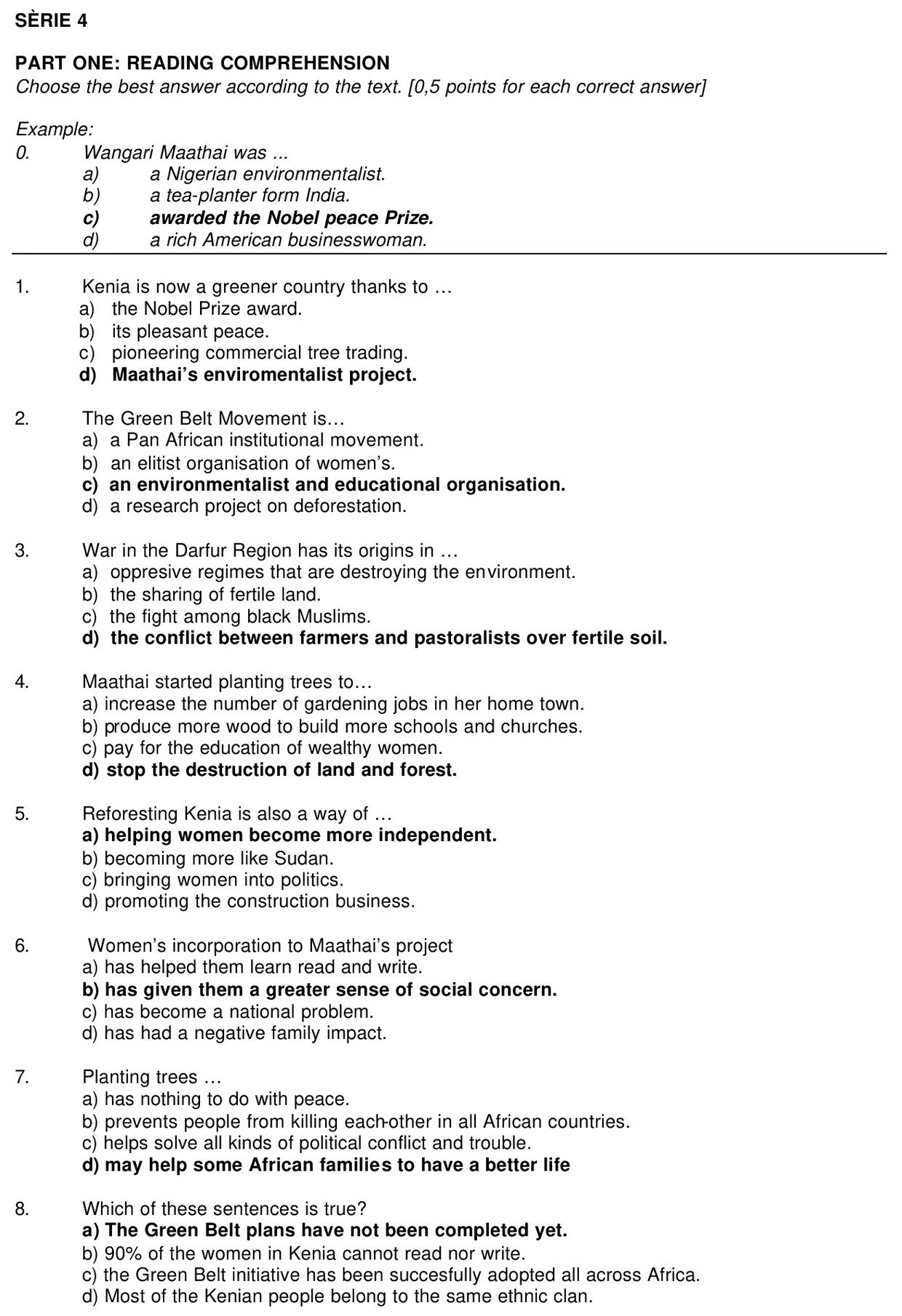
Text dels criteris (transcripció automàtica)
PART ONE: READING COMPREHENSION
Choose the best answer according to the text. [0,5 points for each correct answer]
Example:
0. Wangari Maathai was ...
a) a Nigerian environmentalist.
b) a tea-planter form India.
c) awarded the Nobel peace Prize.
d) a rich American businesswoman.
1. Kenia is now a greener country thanks to …
a) the Nobel Prize award.
b) its pleasant peace.
c) pioneering commercial tree trading.
d) Maathai’s enviromentalist project.
2. The Green Belt Movement is…
a) a Pan African institutional movement.
b) an elitist organisation of women’s.
c) an environmentalist and educational organisation.
d) a research project on deforestation.
3. War in the Darfur Region has its origins in …
a) oppresive regimes that are destroying the environment.
b) the sharing of fertile land.
c) the fight among black Muslims.
d) the conflict between farmers and pastoralists over fertile soil.
4. Maathai started planting trees to…
a) increase the number of gardening jobs in her home town.
b) pro […]
Resolució pas a pas
Encara no hi ha resolució pròpia verificada d'aquest exercici. Mentrestant, tens els criteris oficials de correcció a sobre. Si tens dubtes, pregunta'ls al xat de la Sala d'estudi.
Font: enunciat i criteris de correcció oficials de les PAU 2005 de Catalunya, publicats per la Generalitat de Catalunya (universitats.gencat.cat) i les universitats catalanes. La resolució pas a pas és pròpia de L'Acadèmia de Vic.
Altres exercicis d'aquest examen
- Part 2 · Writing Writing
- Part 3 · Listening comprehension Listening comprehension