
PAU Anglès 2004 · Setembre · Sèrie 5 · Part 1 · Reading comprehension
Enunciat
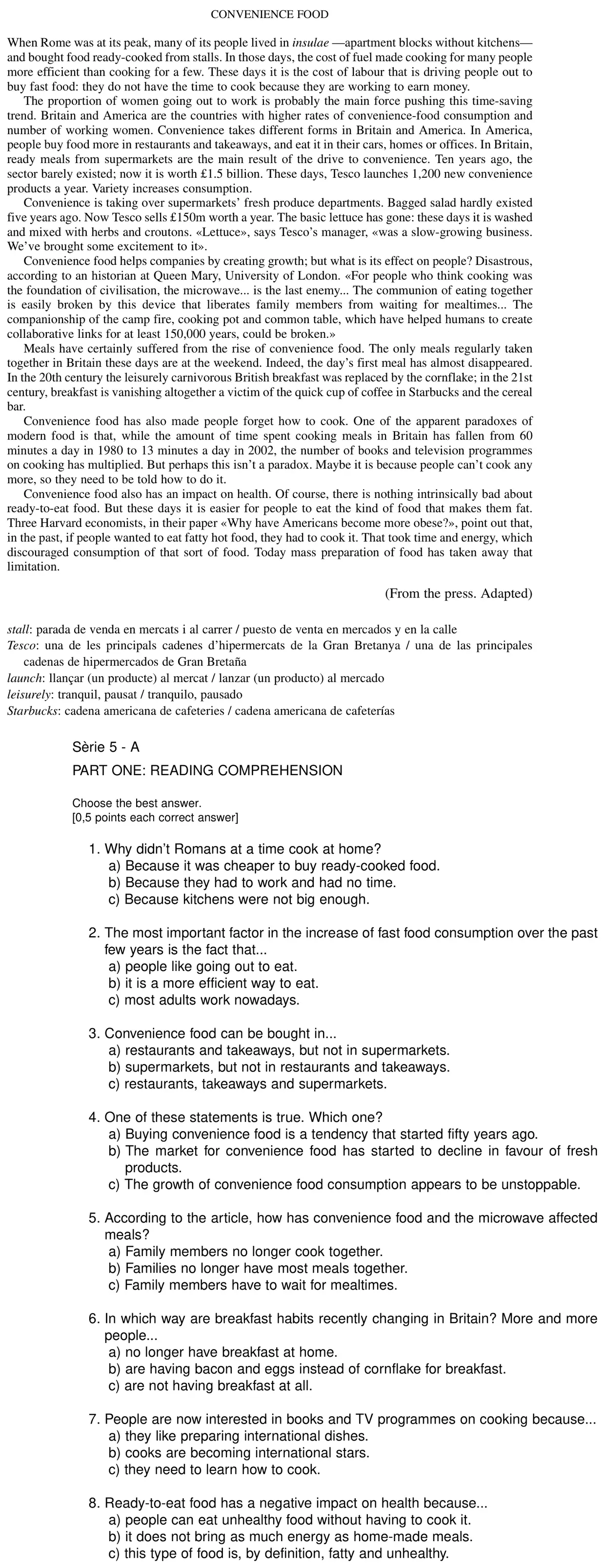
Text de l'enunciat (transcripció automàtica)
CONVENIENCE FOOD
When Rome was at its peak, many of its people lived in insulae —apartment blocks without kitchens—
and bought food ready-cooked from stalls. In those days, the cost of fuel made cooking for many people
more efficient than cooking for a few. These days it is the cost of labour that is driving people out to
buy fast food: they do not have the time to cook because they are working to earn money.
The proportion of women going out to work is probably the main force pushing this time-saving
trend. Britain and America are the countries with higher rates of convenience-food consumption and
number of working women. Convenience takes different forms in Britain and America. In America,
people buy food more in restaurants and takeaways, and eat it in their cars, homes or offices. In Britain,
ready meals from supermarkets are the main result of the drive to convenience. Ten years ago, the
sector barely existed; now it is worth £1.5 billion. These days, Tesco launches 1,200 new convenience
products a year. Variety increases consumption.
Convenience is taking over supermarkets’ fresh produce departments. Bagged salad hardly existed
five years ago. Now Tesco sells £150m worth a year. The basic lettuce has gone: these days it is washed
and mixed with herbs and croutons. «Lettuce», says Tesco’s manager, «was a slow-growing business.
We’ve brought some excitement to it».
Convenience food helps companies by creating growth; but what is its effect on people? Disastrous,
according to an historian at Queen Mary, University of London. «For people who think cooking was
the foundation of civilisation, the microwave... is the last enemy... The communion of eating together
is easily broken by this device that liberates family members from waiting for mealtimes... The
companionship of the camp fire, cooking pot and common table, which have helped humans to create
collaborative links for at least 150,000 years, could be broken.»
Meals have certainly suffered from the rise of convenience food. The only meals regularly taken
together in Britain these days are at the weekend. Indeed, the day’s first meal has almost disappeared.
In the 20th century the leisurely carnivorous British breakfast was replaced by the cornflake; in the 21st
century, breakfast is vanishing altogether a victim of the quick cup of coffee in Starbucks and the cereal
bar.
Convenience food has also made people forget how to cook. One of the apparent paradoxes of
modern food is that, while the amount of time spent cooking meals in Britain has fallen from 60
minutes a day in 1980 to 13 minutes a day in 2002, the number of books and television programmes
on cooking has multiplied. But perhaps this isn’t a paradox. Maybe it is because people can’t cook any
more, so they need to be told how to do it.
Convenience food also has an impact on health. Of course, there is nothing intrinsically bad about
ready-to-eat food. But these days it is easier for people to eat the kind of food that makes them fat.
Three Harvard economists, in their paper «Why have Americans become more obese?», point out that,
in the past, if people wanted to eat fatty hot food, they had to cook it. That took time and energy, which
discouraged consumption of that sort of food. Today mass preparation of food has taken away that
limitation.
(From the press. Adapted)
stall: parada de venda en mercats i al carrer / puesto de venta en mercados y en la calle
Tesco: una de les principals cadenes d’hipermercats de la Gran Bretanya / una de las principales
cadenas de hipermercados de Gran Bretaña
launch: llançar (un producte) al mercat / lanzar (un producto) al mercado
leisurely: tranquil, pausat / tranquilo, pausado
Starbucks: cadena americana de cafeteries / cadena americana de cafeterías
Sèrie 5 - A
PART ONE: READING COMPREHENSION
Choose the best answer.
[0,5 points each correct answer]
1. Why didn’t Romans at a time cook at home?
a) Because it was cheaper to buy ready-cooked food.
b) Because they had to work and ha
Criteris oficials de correcció
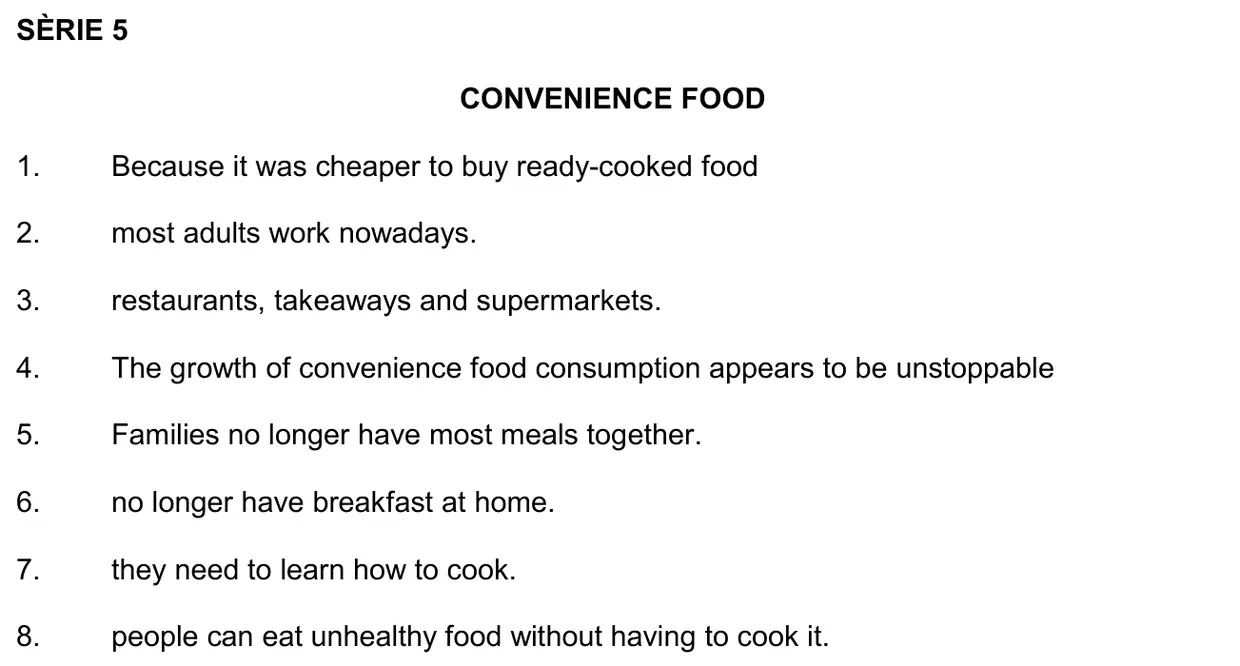
Text dels criteris (transcripció automàtica)
1. Because it was cheaper to buy ready-cooked food
2. most adults work nowadays.
3. restaurants, takeaways and supermarkets.
4. The growth of convenience food consumption appears to be unstoppable
5. Families no longer have most meals together.
6. no longer have breakfast at home.
7. they need to learn how to cook.
8. people can eat unhealthy food without having to cook it.
PROVA AUDITIVA
Are all twins alike?
Script
Introduction
Hi!
In this radio programme your are going to hear some new words. Read and listen to them. Make sure
you know what they mean.
cuddles abraçades / abrazos
jealousy gelosia / celos
share compartir / compartir
allocation assignació, asignación
Ready?
Now read the questions on the next page. Read them carefully before listening to this interview.
Are all twins alike?
An interview with Dr. Smith
Presenter: You are listening to Radio Europe International. And after this song by Phil Collins, we turn
to our next guest, Dr. Kerry Smith from New Hampshire University. S […]
Resolució pas a pas
Encara no hi ha resolució pròpia verificada d'aquest exercici. Mentrestant, tens els criteris oficials de correcció a sobre. Si tens dubtes, pregunta'ls al xat de la Sala d'estudi.
Font: enunciat i criteris de correcció oficials de les PAU 2004 de Catalunya, publicats per la Generalitat de Catalunya (universitats.gencat.cat) i les universitats catalanes. La resolució pas a pas és pròpia de L'Acadèmia de Vic.
Altres exercicis d'aquest examen
- Part 2 · Writing Writing
- Part 3 · Listening comprehension Listening comprehension