
PAU Anglès 2005 · Juny · Sèrie 4 · Part 3 · Listening comprehension
Enunciat
Text de l'enunciat (transcripció automàtica)
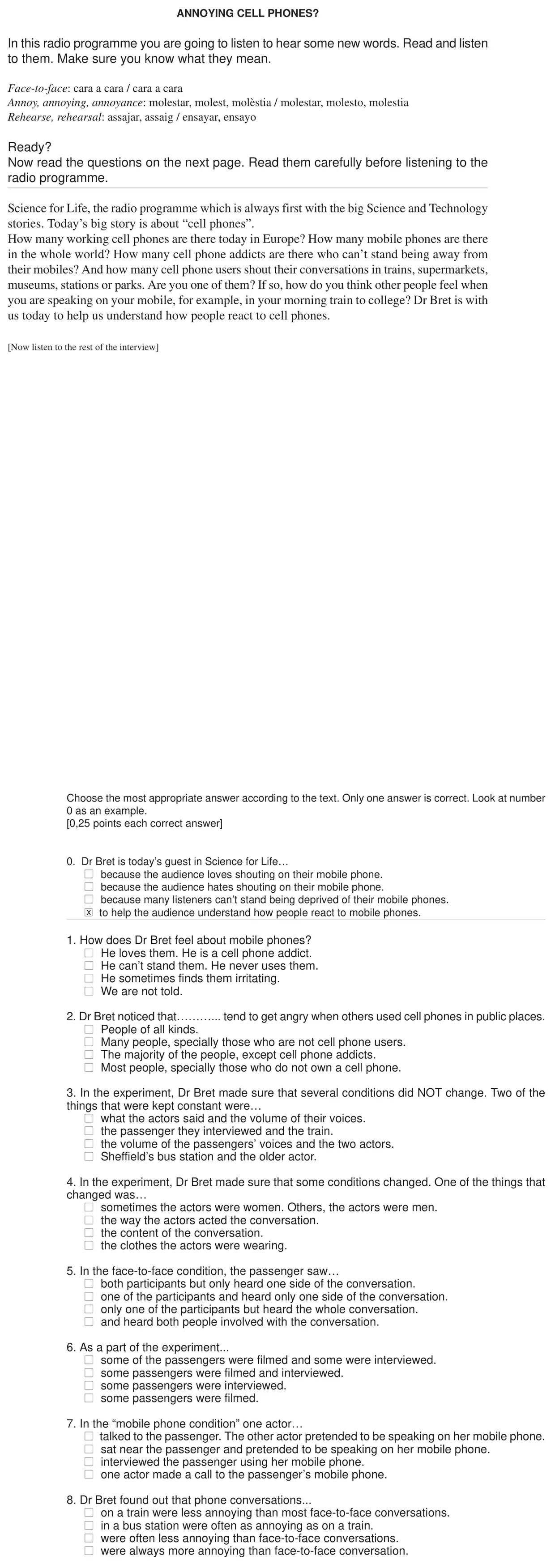
ANNOYING CELL PHONES?
In this radio programme you are going to listen to hear some new words. Read and listen
to them. Make sure you know what they mean.
Face-to-face: cara a cara / cara a cara
Annoy, annoying, annoyance: molestar, molest, molèstia / molestar, molesto, molestia
Rehearse, rehearsal: assajar, assaig / ensayar, ensayo
Ready?
Now read the questions on the next page. Read them carefully before listening to the
radio programme.
Science for Life, the radio programme which is always first with the big Science and Technology
stories. Today’s big story is about “cell phones”.
How many working cell phones are there today in Europe? How many mobile phones are there
in the whole world? How many cell phone addicts are there who can’t stand being away from
their mobiles? And how many cell phone users shout their conversations in trains, supermarkets,
museums, stations or parks. Are you one of them? If so, how do you think other people feel when
you are speaking on your mobile, for example, in your morning train to college? Dr Bret is with
us today to help us understand how people react to cell phones.
[Now listen to the rest of the interview]
Choose the most appropriate answer according to the text. Only one answer is correct. Look at number
0 as an example.
[0,25 points each correct answer]
0. Dr Bret is today’s guest in Science for Life…
■ because the audience loves shouting on their mobile phone.
■ because the audience hates shouting on their mobile phone.
■ because many listeners can’t stand being deprived of their mobile phones.
■x to help the audience understand how people react to mobile phones.
1. How does Dr Bret feel about mobile phones?
■ He loves them. He is a cell phone addict.
■ He can’t stand them. He never uses them.
■ He sometimes finds them irritating.
■ We are not told.
2. Dr Bret noticed that………... tend to get angry when others used cell phones in public places.
■ People of all kinds.
■ Many people, specially those who are not cell phone users.
■ The majority of the people, except cell phone addicts.
■ Most people, specially those who do not own a cell phone.
3. In the experiment, Dr Bret made sure that several conditions did NOT change. Two of the
things that were kept constant were…
■ what the actors said and the volume of their voices.
■ the passenger they interviewed and the train.
■ the volume of the passengers’ voices and the two actors.
■ Sheffield’s bus station and the older actor.
4. In the experiment, Dr Bret made sure that some conditions changed. One of the things that
changed was…
■ sometimes the actors were women. Others, the actors were men.
■ the way the actors acted the conversation.
■ the content of the conversation.
■ the clothes the actors were wearing.
5. In the face-to-face condition, the passenger saw…
■ both participants but only heard one side of the conversation.
■ one of the participants and heard only one side of the conversation.
■ only one of the participants but heard the whole conversation.
■ and heard both people involved with the conversation.
6. As a part of the experiment...
■ some of the passengers were filmed and some were interviewed.
■ some passengers were filmed and interviewed.
■ some passengers were interviewed.
■ some passengers were filmed.
7. In the “mobile phone condition” one actor…
■ talked to the passenger. The other actor pretended to be speaking on her mobile phone.
■ sat near the passenger and pretended to be speaking on her mobile phone.
■ interviewed the passenger using her mobile phone.
■ one actor made a call to the passenger’s mobile phone.
8. Dr Bret found out that phone conversations...
■ on a train were less annoying than most face-to-face conversations.
■ in a bus station were often as annoying as on a train.
■ were often less annoying than face-to-face conversations.
■ were always more annoying than face-to-face conversation.
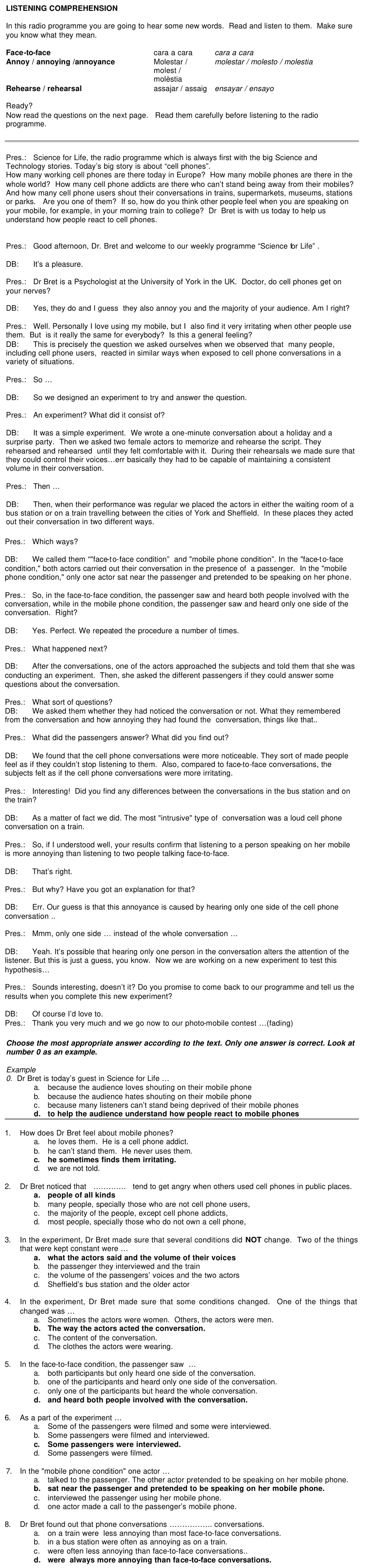
Criteris oficials de correcció
Resolució pas a pas
Aquest exercici no té una resolució escrita pas a pas (requereix l'àudio de la prova). Fes servir els criteris oficials de correcció.
Font: enunciat i criteris de correcció oficials de les PAU 2005 de Catalunya, publicats per la Generalitat de Catalunya (universitats.gencat.cat) i les universitats catalanes. La resolució pas a pas és pròpia de L'Acadèmia de Vic.
Altres exercicis d'aquest examen
- Part 1 · Reading comprehension Reading comprehension
- Part 2 · Writing Writing
Tots els exercicis de Listening comprehension · PAU de Anglès