
PAU Anglès 2005 · Juny · Sèrie 1 · Part 3 · Listening comprehension
Enunciat
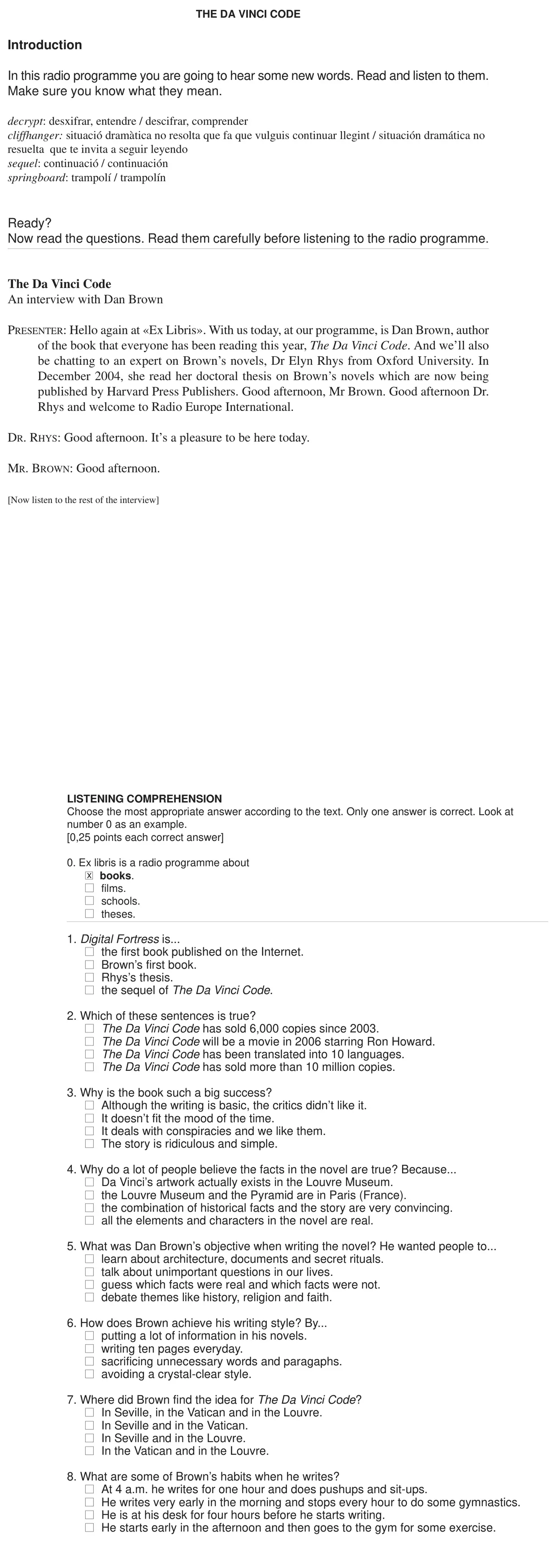
Text de l'enunciat (transcripció automàtica)
THE DA VINCI CODE
Introduction
In this radio programme you are going to hear some new words. Read and listen to them.
Make sure you know what they mean.
decrypt: desxifrar, entendre / descifrar, comprender
cliffhanger: situació dramàtica no resolta que fa que vulguis continuar llegint / situación dramática no
resuelta que te invita a seguir leyendo
sequel: continuació / continuación
springboard: trampolí / trampolín
Ready?
Now read the questions. Read them carefully before listening to the radio programme.
The Da Vinci Code
An interview with Dan Brown
PRESENTER: Hello again at «Ex Libris». With us today, at our programme, is Dan Brown, author
of the book that everyone has been reading this year, The Da Vinci Code. And we’ll also
be chatting to an expert on Brown’s novels, Dr Elyn Rhys from Oxford University. In
December 2004, she read her doctoral thesis on Brown’s novels which are now being
published by Harvard Press Publishers. Good afternoon, Mr Brown. Good afternoon Dr.
Rhys and welcome to Radio Europe International.
DR. RHYS: Good afternoon. It’s a pleasure to be here today.
MR. BROWN: Good afternoon.
[Now listen to the rest of the interview]
LISTENING COMPREHENSION
Choose the most appropriate answer according to the text. Only one answer is correct. Look at
number 0 as an example.
[0,25 points each correct answer]
0. Ex libris is a radio programme about
■x books.
■ films.
■ schools.
■ theses.
1. Digital Fortress is...
■ the first book published on the Internet.
■ Brown’s first book.
■ Rhys’s thesis.
■ the sequel of The Da Vinci Code.
2. Which of these sentences is true?
■ The Da Vinci Code has sold 6,000 copies since 2003.
■ The Da Vinci Code will be a movie in 2006 starring Ron Howard.
■ The Da Vinci Code has been translated into 10 languages.
■ The Da Vinci Code has sold more than 10 million copies.
3. Why is the book such a big success?
■ Although the writing is basic, the critics didn’t like it.
■ It doesn’t fit the mood of the time.
■ It deals with conspiracies and we like them.
■ The story is ridiculous and simple.
4. Why do a lot of people believe the facts in the novel are true? Because...
■ Da Vinci’s artwork actually exists in the Louvre Museum.
■ the Louvre Museum and the Pyramid are in Paris (France).
■ the combination of historical facts and the story are very convincing.
■ all the elements and characters in the novel are real.
5. What was Dan Brown’s objective when writing the novel? He wanted people to...
■ learn about architecture, documents and secret rituals.
■ talk about unimportant questions in our lives.
■ guess which facts were real and which facts were not.
■ debate themes like history, religion and faith.
6. How does Brown achieve his writing style? By...
■ putting a lot of information in his novels.
■ writing ten pages everyday.
■ sacrificing unnecessary words and paragaphs.
■ avoiding a crystal-clear style.
7. Where did Brown find the idea for The Da Vinci Code?
■ In Seville, in the Vatican and in the Louvre.
■ In Seville and in the Vatican.
■ In Seville and in the Louvre.
■ In the Vatican and in the Louvre.
8. What are some of Brown’s habits when he writes?
■ At 4 a.m. he writes for one hour and does pushups and sit-ups.
■ He writes very early in the morning and stops every hour to do some gymnastics.
■ He is at his desk for four hours before he starts writing.
■ He starts early in the afternoon and then goes to the gym for some exercise.
Criteris oficials de correcció
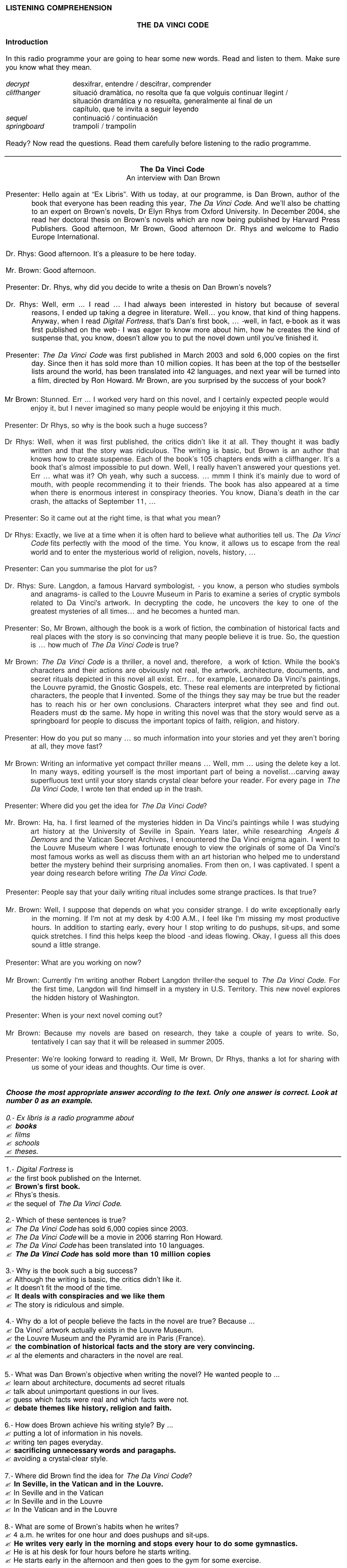
Text dels criteris (transcripció automàtica)
LISTENING COMPREHENSION
THE DA VINCI CODE
Introduction
In this radio programme your are going to hear some new words. Read and listen to them. Make sure
you know what they mean.
decrypt desxifrar, entendre / descifrar, comprender
cliffhanger situació dramàtica, no resolta que fa que volguis continuar llegint /
situación dramática y no resuelta, generalmente al final de un
capítulo, que te invita a seguir leyendo
sequel continuació / continuación
springboard trampolí / trampolín
Ready? Now read the questions. Read them carefully before listening to the radio programme.
The Da Vinci Code
An interview with Dan Brown
Presenter: Hello again at “Ex Libris”. With us today, at our programme, is Dan Brown, author of the
book that everyone has been reading this year, The Da Vinci Code. And we’ll also be chatting
to an expert on Brown’s novels, Dr Elyn Rhys from Oxford University. In December 2004, she
read her doctoral thesis on Brown’s novels which are now being published by Harvard Press
Publi […]
Resolució pas a pas
Aquest exercici no té una resolució escrita pas a pas (requereix l'àudio de la prova). Fes servir els criteris oficials de correcció.
Font: enunciat i criteris de correcció oficials de les PAU 2005 de Catalunya, publicats per la Generalitat de Catalunya (universitats.gencat.cat) i les universitats catalanes. La resolució pas a pas és pròpia de L'Acadèmia de Vic.
Altres exercicis d'aquest examen
- Part 1 · Reading comprehension Reading comprehension
- Part 2 · Writing Writing
Tots els exercicis de Listening comprehension · PAU de Anglès