
PAU Anglès 2004 · Juny · Sèrie 3 · Part 1 · Reading comprehension
Enunciat
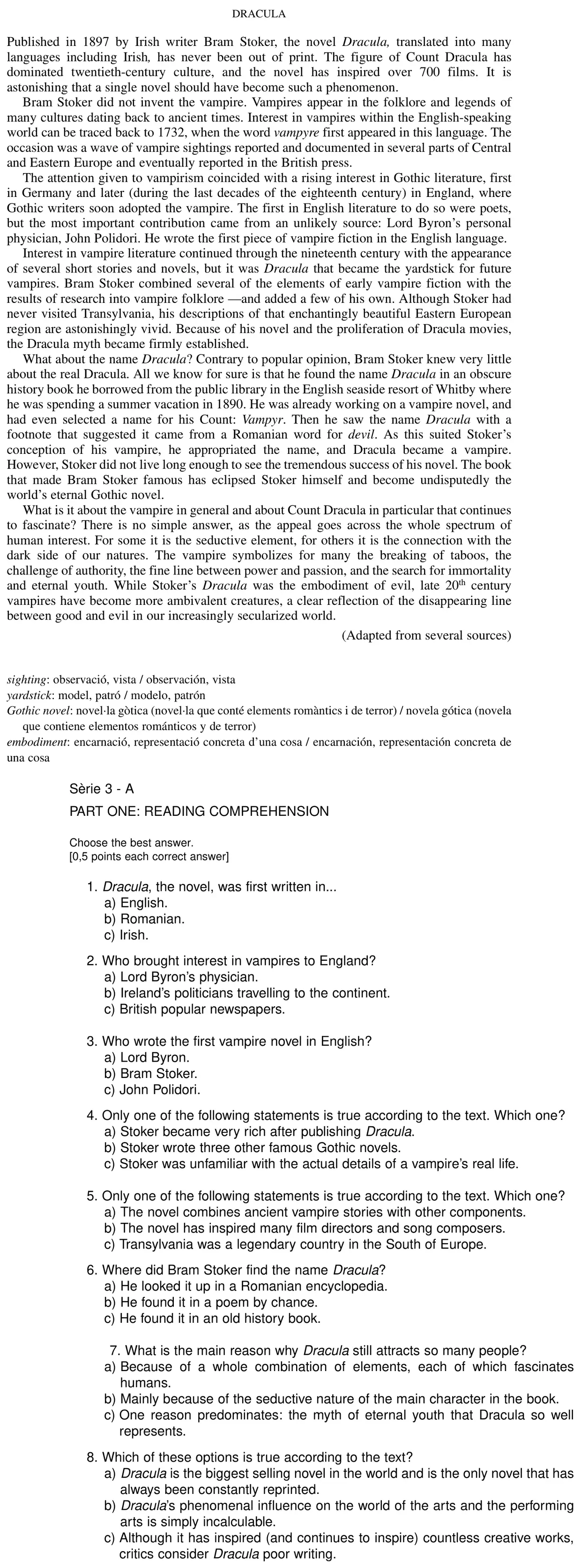
Text de l'enunciat (transcripció automàtica)
DRACULA
Published in 1897 by Irish writer Bram Stoker, the novel Dracula, translated into many
languages including Irish, has never been out of print. The figure of Count Dracula has
dominated twentieth-century culture, and the novel has inspired over 700 films. It is
astonishing that a single novel should have become such a phenomenon.
Bram Stoker did not invent the vampire. Vampires appear in the folklore and legends of
many cultures dating back to ancient times. Interest in vampires within the English-speaking
world can be traced back to 1732, when the word vampyre first appeared in this language. The
occasion was a wave of vampire sightings reported and documented in several parts of Central
and Eastern Europe and eventually reported in the British press.
The attention given to vampirism coincided with a rising interest in Gothic literature, first
in Germany and later (during the last decades of the eighteenth century) in England, where
Gothic writers soon adopted the vampire. The first in English literature to do so were poets,
but the most important contribution came from an unlikely source: Lord Byron’s personal
physician, John Polidori. He wrote the first piece of vampire fiction in the English language.
Interest in vampire literature continued through the nineteenth century with the appearance
of several short stories and novels, but it was Dracula that became the yardstick for future
vampires. Bram Stoker combined several of the elements of early vampire fiction with the
results of research into vampire folklore —and added a few of his own. Although Stoker had
never visited Transylvania, his descriptions of that enchantingly beautiful Eastern European
region are astonishingly vivid. Because of his novel and the proliferation of Dracula movies,
the Dracula myth became firmly established.
What about the name Dracula? Contrary to popular opinion, Bram Stoker knew very little
about the real Dracula. All we know for sure is that he found the name Dracula in an obscure
history book he borrowed from the public library in the English seaside resort of Whitby where
he was spending a summer vacation in 1890. He was already working on a vampire novel, and
had even selected a name for his Count: Vampyr. Then he saw the name Dracula with a
footnote that suggested it came from a Romanian word for devil. As this suited Stoker’s
conception of his vampire, he appropriated the name, and Dracula became a vampire.
However, Stoker did not live long enough to see the tremendous success of his novel. The book
that made Bram Stoker famous has eclipsed Stoker himself and become undisputedly the
world’s eternal Gothic novel.
What is it about the vampire in general and about Count Dracula in particular that continues
to fascinate? There is no simple answer, as the appeal goes across the whole spectrum of
human interest. For some it is the seductive element, for others it is the connection with the
dark side of our natures. The vampire symbolizes for many the breaking of taboos, the
challenge of authority, the fine line between power and passion, and the search for immortality
and eternal youth. While Stoker’s Dracula was the embodiment of evil, late 20th century
vampires have become more ambivalent creatures, a clear reflection of the disappearing line
between good and evil in our increasingly secularized world.
(Adapted from several sources)
sighting: observació, vista / observación, vista
yardstick: model, patró / modelo, patrón
Gothic novel: novel·la gòtica (novel·la que conté elements romàntics i de terror) / novela gótica (novela
que contiene elementos románticos y de terror)
embodiment: encarnació, representació concreta d’una cosa / encarnación, representación concreta de
una cosa
Sèrie 3 - A
PART ONE: READING COMPREHENSION
Choose the best answer.
[0,5 points each correct answer]
1. Dracula, the novel, was first written in...
a) English.
b) Romanian.
c) Irish.
2. Who brought interest in vampires to England?
a) Lord Byron’s physician.
b)
Criteris oficials de correcció
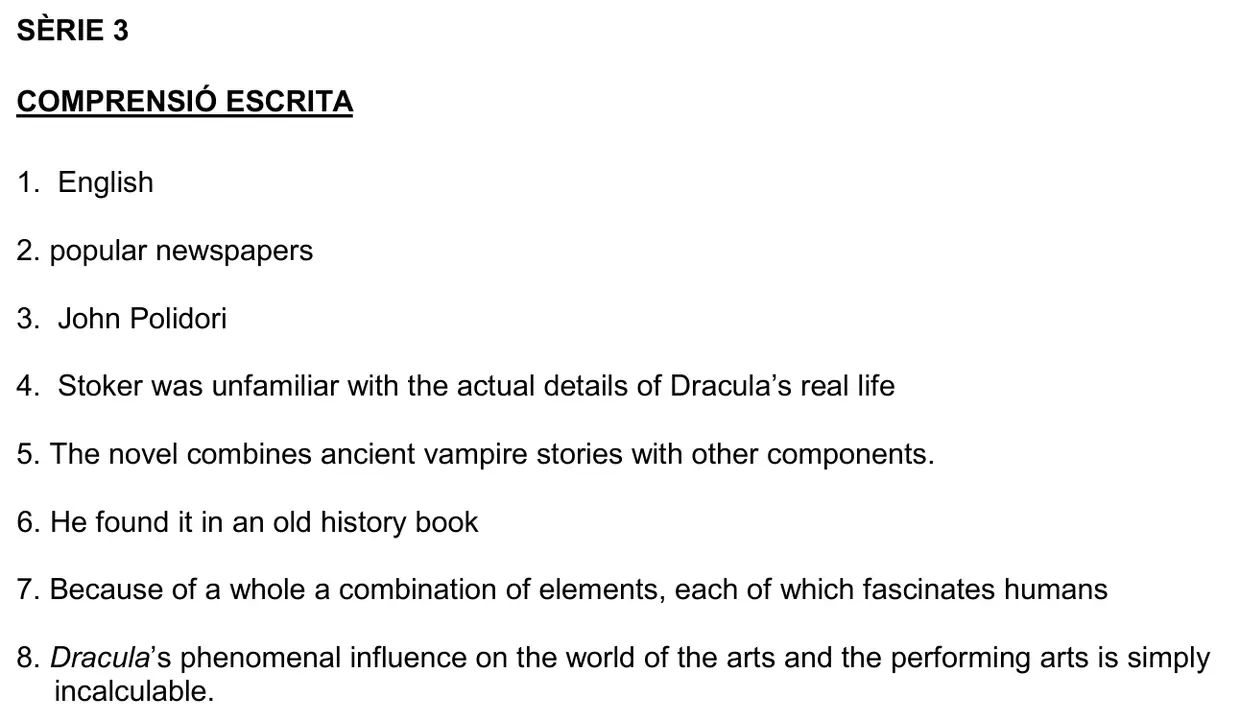
Text dels criteris (transcripció automàtica)
1. English
2. popular newspapers
3. John Polidori
4. Stoker was unfamiliar with the actual details of Dracula’s real life
5. The novel combines ancient vampire stories with other components.
6. He found it in an old history book
7. Because of a whole a combination of elements, each of which fascinates humans
8. Dracula’s phenomenal influence on the world of the arts and the performing arts is simply
incalculable.
PART AUDITIVA
CLOWN
Introduction
In this radio programme your are going to hear some new words. Read and listen to them. Make sure
you know what they mean.
starve tenir fam, morir-se de gana / estar hambriento, morirse de hambre
schedule programa, horari / horario, programa
shed light il.luminar, projectar llum sobre... / iluminar, arrojar luz sobre ...
willing Desitjós, disposat a ... / deseoso de..., dispuesto a ...
Ready?
Now read the questions slowly before listening to the radio programme.
CLOWN
Welcome to “A different world”, a program about people working for a world fu […]
Resolució pas a pas
Encara no hi ha resolució pròpia verificada d'aquest exercici. Mentrestant, tens els criteris oficials de correcció a sobre. Si tens dubtes, pregunta'ls al xat de la Sala d'estudi.
Font: enunciat i criteris de correcció oficials de les PAU 2004 de Catalunya, publicats per la Generalitat de Catalunya (universitats.gencat.cat) i les universitats catalanes. La resolució pas a pas és pròpia de L'Acadèmia de Vic.
Altres exercicis d'aquest examen
- Part 2 · Writing Writing
- Part 3 · Listening comprehension Listening comprehension