
PAU Anglès 2004 · Juny · Sèrie 3 · Part 3 · Listening comprehension
Enunciat
Text de l'enunciat (transcripció automàtica)
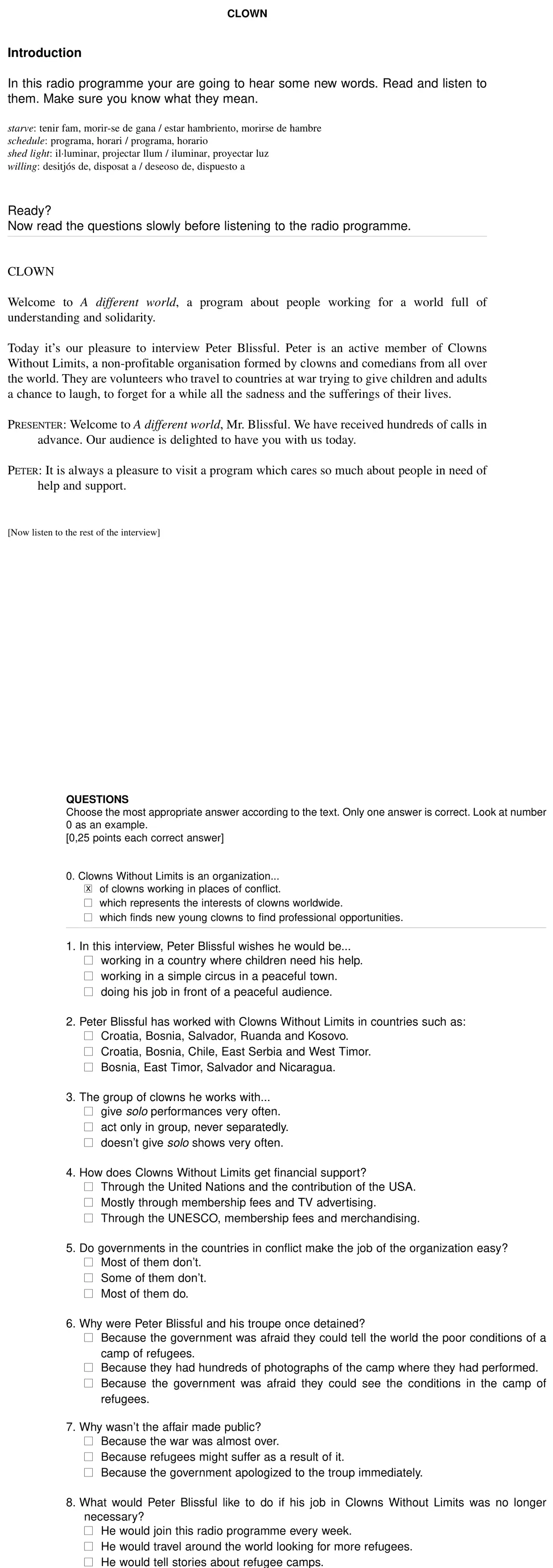
CLOWN
Introduction
In this radio programme your are going to hear some new words. Read and listen to
them. Make sure you know what they mean.
starve: tenir fam, morir-se de gana / estar hambriento, morirse de hambre
schedule: programa, horari / programa, horario
shed light: il·luminar, projectar llum / iluminar, proyectar luz
willing: desitjós de, disposat a / deseoso de, dispuesto a
Ready?
Now read the questions slowly before listening to the radio programme.
CLOWN
Welcome to A different world, a program about people working for a world full of
understanding and solidarity.
Today it’s our pleasure to interview Peter Blissful. Peter is an active member of Clowns
Without Limits, a non-profitable organisation formed by clowns and comedians from all over
the world. They are volunteers who travel to countries at war trying to give children and adults
a chance to laugh, to forget for a while all the sadness and the sufferings of their lives.
PRESENTER: Welcome to A different world, Mr. Blissful. We have received hundreds of calls in
advance. Our audience is delighted to have you with us today.
PETER: It is always a pleasure to visit a program which cares so much about people in need of
help and support.
[Now listen to the rest of the interview]
QUESTIONS
Choose the most appropriate answer according to the text. Only one answer is correct. Look at number
0 as an example.
[0,25 points each correct answer]
0. Clowns Without Limits is an organization...
Ix of clowns working in places of conflict.
I which represents the interests of clowns worldwide.
I which finds new young clowns to find professional opportunities.
1. In this interview, Peter Blissful wishes he would be...
I working in a country where children need his help.
I working in a simple circus in a peaceful town.
I doing his job in front of a peaceful audience.
2. Peter Blissful has worked with Clowns Without Limits in countries such as:
I Croatia, Bosnia, Salvador, Ruanda and Kosovo.
I Croatia, Bosnia, Chile, East Serbia and West Timor.
I Bosnia, East Timor, Salvador and Nicaragua.
3. The group of clowns he works with...
I give solo performances very often.
I act only in group, never separatedly.
I doesn’t give solo shows very often.
4. How does Clowns Without Limits get financial support?
I Through the United Nations and the contribution of the USA.
I Mostly through membership fees and TV advertising.
I Through the UNESCO, membership fees and merchandising.
5. Do governments in the countries in conflict make the job of the organization easy?
I Most of them don’t.
I Some of them don’t.
I Most of them do.
6. Why were Peter Blissful and his troupe once detained?
I Because the government was afraid they could tell the world the poor conditions of a
camp of refugees.
I Because they had hundreds of photographs of the camp where they had performed.
I Because the government was afraid they could see the conditions in the camp of
refugees.
7. Why wasn’t the affair made public?
I Because the war was almost over.
I Because refugees might suffer as a result of it.
I Because the government apologized to the troup immediately.
8. What would Peter Blissful like to do if his job in Clowns Without Limits was no longer
necessary?
I He would join this radio programme every week.
I He would travel around the world looking for more refugees.
I He would tell stories about refugee camps.
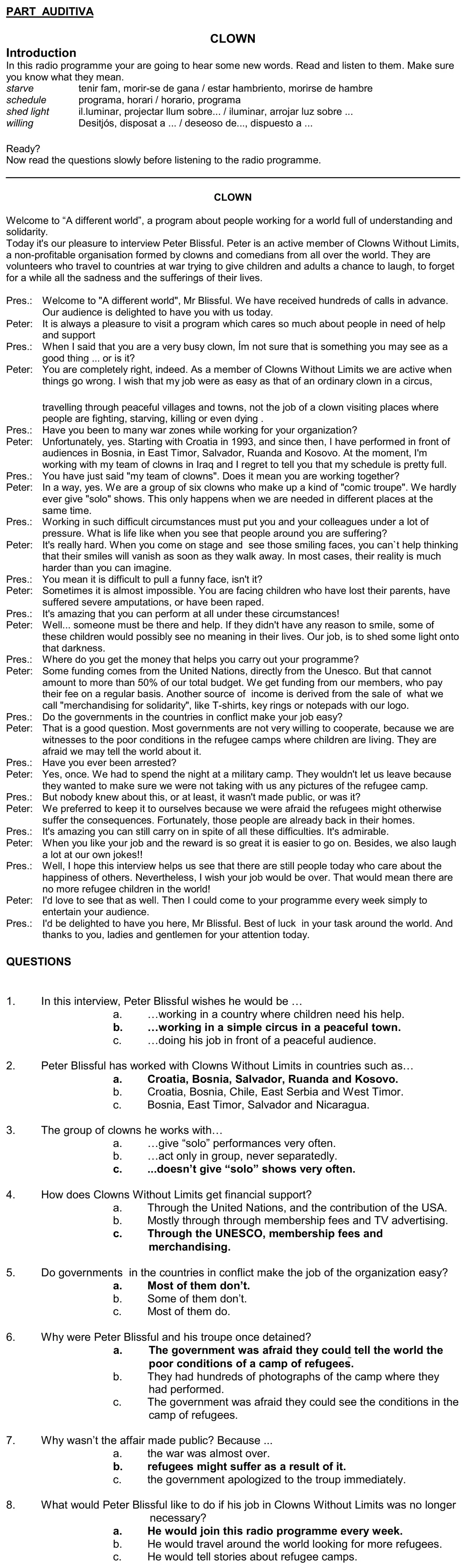
Criteris oficials de correcció
Resolució pas a pas
Aquest exercici no té una resolució escrita pas a pas (requereix l'àudio de la prova). Fes servir els criteris oficials de correcció.
Font: enunciat i criteris de correcció oficials de les PAU 2004 de Catalunya, publicats per la Generalitat de Catalunya (universitats.gencat.cat) i les universitats catalanes. La resolució pas a pas és pròpia de L'Acadèmia de Vic.
Altres exercicis d'aquest examen
- Part 1 · Reading comprehension Reading comprehension
- Part 2 · Writing Writing
Tots els exercicis de Listening comprehension · PAU de Anglès