
PAU Anglès 2003 · Setembre · Sèrie 3 · Part 1 · Reading comprehension
Enunciat
Text de l'enunciat (transcripció automàtica)
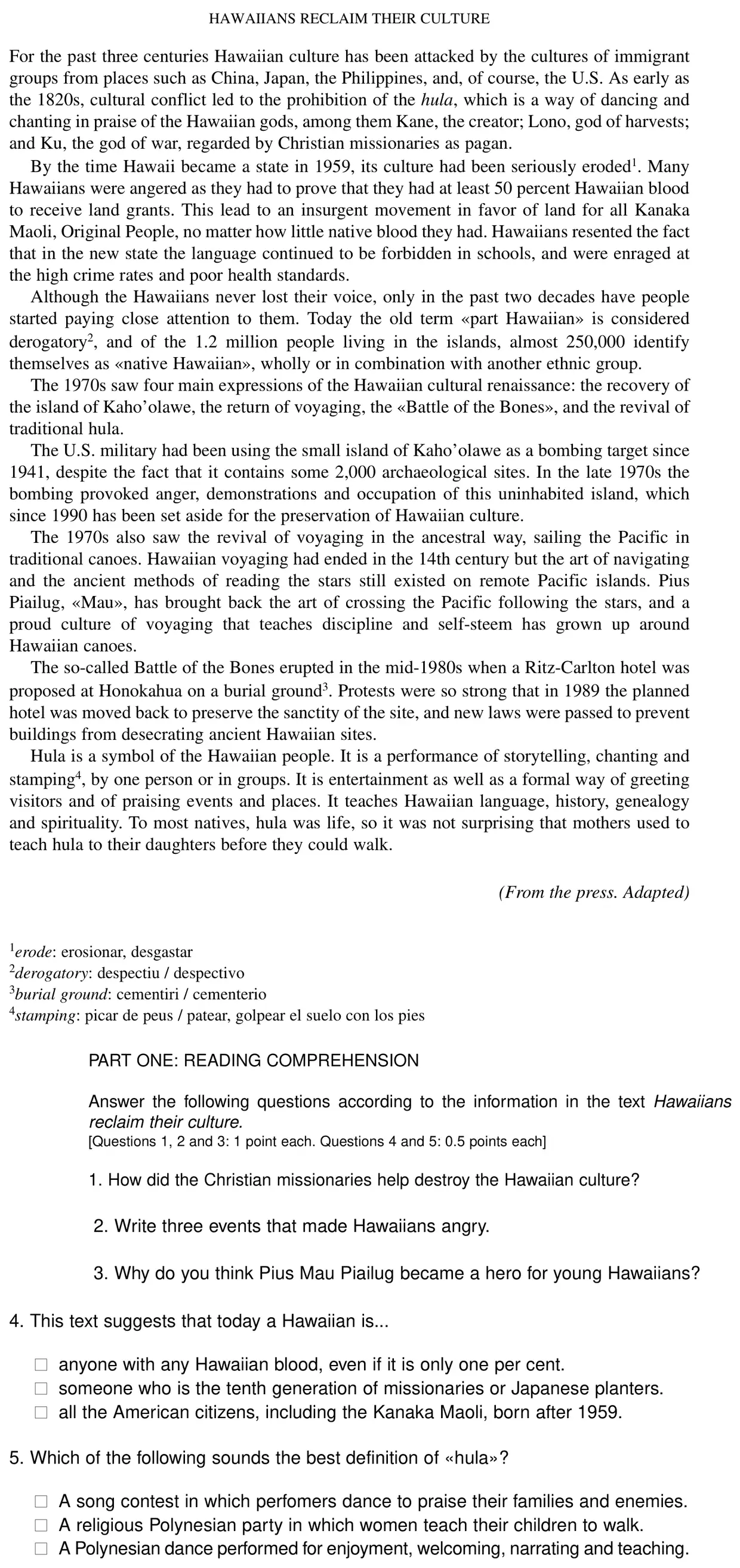
HAWAIIANS RECLAIM THEIR CULTURE
For the past three centuries Hawaiian culture has been attacked by the cultures of immigrant
groups from places such as China, Japan, the Philippines, and, of course, the U.S. As early as
the 1820s, cultural conflict led to the prohibition of the hula, which is a way of dancing and
chanting in praise of the Hawaiian gods, among them Kane, the creator; Lono, god of harvests;
and Ku, the god of war, regarded by Christian missionaries as pagan.
By the time Hawaii became a state in 1959, its culture had been seriously eroded1. Many
Hawaiians were angered as they had to prove that they had at least 50 percent Hawaiian blood
to receive land grants. This lead to an insurgent movement in favor of land for all Kanaka
Maoli, Original People, no matter how little native blood they had. Hawaiians resented the fact
that in the new state the language continued to be forbidden in schools, and were enraged at
the high crime rates and poor health standards.
Although the Hawaiians never lost their voice, only in the past two decades have people
started paying close attention to them. Today the old term «part Hawaiian» is considered
derogatory2, and of the 1.2 million people living in the islands, almost 250,000 identify
themselves as «native Hawaiian», wholly or in combination with another ethnic group.
The 1970s saw four main expressions of the Hawaiian cultural renaissance: the recovery of
the island of Kaho’olawe, the return of voyaging, the «Battle of the Bones», and the revival of
traditional hula.
The U.S. military had been using the small island of Kaho’olawe as a bombing target since
1941, despite the fact that it contains some 2,000 archaeological sites. In the late 1970s the
bombing provoked anger, demonstrations and occupation of this uninhabited island, which
since 1990 has been set aside for the preservation of Hawaiian culture.
The 1970s also saw the revival of voyaging in the ancestral way, sailing the Pacific in
traditional canoes. Hawaiian voyaging had ended in the 14th century but the art of navigating
and the ancient methods of reading the stars still existed on remote Pacific islands. Pius
Piailug, «Mau», has brought back the art of crossing the Pacific following the stars, and a
proud culture of voyaging that teaches discipline and self-steem has grown up around
Hawaiian canoes.
The so-called Battle of the Bones erupted in the mid-1980s when a Ritz-Carlton hotel was
proposed at Honokahua on a burial ground3. Protests were so strong that in 1989 the planned
hotel was moved back to preserve the sanctity of the site, and new laws were passed to prevent
buildings from desecrating ancient Hawaiian sites.
Hula is a symbol of the Hawaiian people. It is a performance of storytelling, chanting and
stamping4, by one person or in groups. It is entertainment as well as a formal way of greeting
visitors and of praising events and places. It teaches Hawaiian language, history, genealogy
and spirituality. To most natives, hula was life, so it was not surprising that mothers used to
teach hula to their daughters before they could walk.
(From the press. Adapted)
1erode: erosionar, desgastar
2derogatory: despectiu / despectivo
3burial ground: cementiri / cementerio
4stamping: picar de peus / patear, golpear el suelo con los pies
PART ONE: READING COMPREHENSION
Answer the following questions according to the information in the text Hawaiians
reclaim their culture.
[Questions 1, 2 and 3: 1 point each. Questions 4 and 5: 0.5 points each]
1. How did the Christian missionaries help destroy the Hawaiian culture?
2. Write three events that made Hawaiians angry.
3. Why do you think Pius Mau Piailug became a hero for young Hawaiians?
4. This text suggests that today a Hawaiian is...
I anyone with any Hawaiian blood, even if it is only one per cent.
I someone who is the tenth generation of missionaries or Japanese planters.
I all the American citizens, including the Kanaka Maoli, born after 1959.
5. Which of the foll
Criteris oficials de correcció
Text dels criteris (transcripció automàtica)
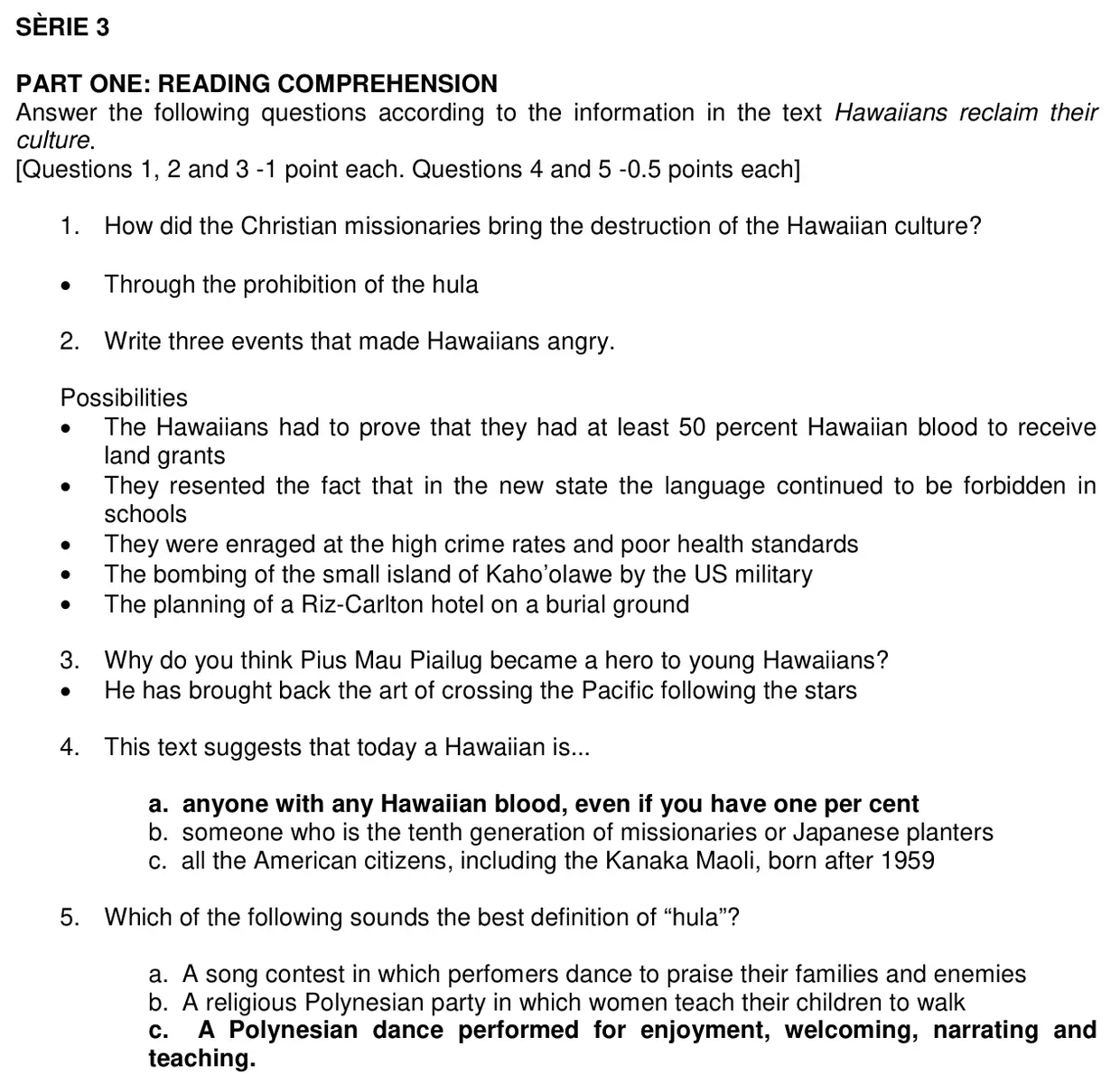
1. How did the Christian missionaries bring the destruction of the Hawaiian culture?
! Through the prohibition of the hula
2. Write three events that made Hawaiians angry.
Possibilities
! The Hawaiians had to prove that they had at least 50 percent Hawaiian blood to receive
land grants
! They resented the fact that in the new state the language continued to be forbidden in
schools
! They were enraged at the high crime rates and poor health standards
! The bombing of the small island of Kaho’olawe by the US military
! The planning of a Riz-Carlton hotel on a burial ground
3. Why do you think Pius Mau Piailug became a hero to young Hawaiians?
! He has brought back the art of crossing the Pacific following the stars
4. This text suggests that today a Hawaiian is...
a. anyone with any Hawaiian blood, even if you have one per cent
b. someone who is the tenth generation of missionaries or Japanese planters
c. all the American citizens, including the Kanaka Maoli, born after 1959
5. Which of […]
Resolució pas a pas
Encara no hi ha resolució pròpia verificada d'aquest exercici. Mentrestant, tens els criteris oficials de correcció a sobre. Si tens dubtes, pregunta'ls al xat de la Sala d'estudi.
Font: enunciat i criteris de correcció oficials de les PAU 2003 de Catalunya, publicats per la Generalitat de Catalunya (universitats.gencat.cat) i les universitats catalanes. La resolució pas a pas és pròpia de L'Acadèmia de Vic.
Altres exercicis d'aquest examen
- Part 2 · Writing Writing
- Part 3 · Listening comprehension Listening comprehension