
PAU Anglès 2004 · Juny · Sèrie 1 · Part 1 · Reading comprehension
Enunciat
Text de l'enunciat (transcripció automàtica)
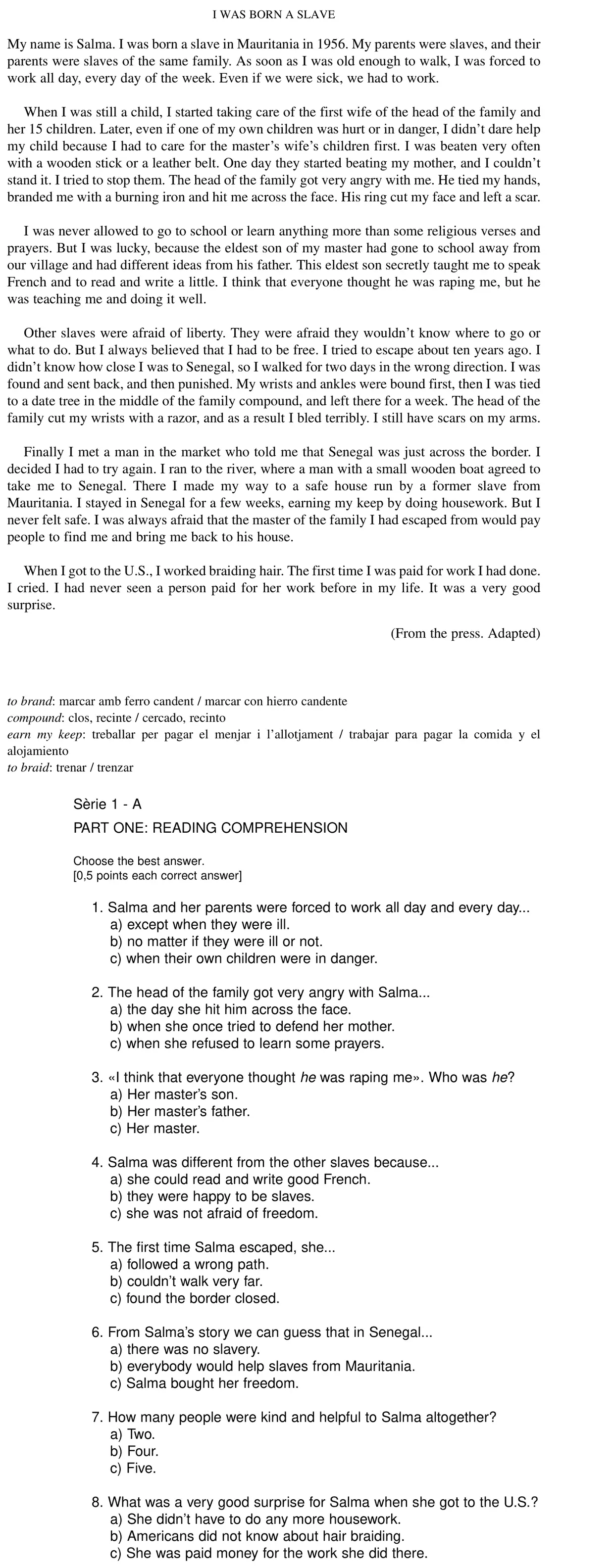
I WAS BORN A SLAVE
My name is Salma. I was born a slave in Mauritania in 1956. My parents were slaves, and their
parents were slaves of the same family. As soon as I was old enough to walk, I was forced to
work all day, every day of the week. Even if we were sick, we had to work.
When I was still a child, I started taking care of the first wife of the head of the family and
her 15 children. Later, even if one of my own children was hurt or in danger, I didn’t dare help
my child because I had to care for the master’s wife’s children first. I was beaten very often
with a wooden stick or a leather belt. One day they started beating my mother, and I couldn’t
stand it. I tried to stop them. The head of the family got very angry with me. He tied my hands,
branded me with a burning iron and hit me across the face. His ring cut my face and left a scar.
I was never allowed to go to school or learn anything more than some religious verses and
prayers. But I was lucky, because the eldest son of my master had gone to school away from
our village and had different ideas from his father. This eldest son secretly taught me to speak
French and to read and write a little. I think that everyone thought he was raping me, but he
was teaching me and doing it well.
Other slaves were afraid of liberty. They were afraid they wouldn’t know where to go or
what to do. But I always believed that I had to be free. I tried to escape about ten years ago. I
didn’t know how close I was to Senegal, so I walked for two days in the wrong direction. I was
found and sent back, and then punished. My wrists and ankles were bound first, then I was tied
to a date tree in the middle of the family compound, and left there for a week. The head of the
family cut my wrists with a razor, and as a result I bled terribly. I still have scars on my arms.
Finally I met a man in the market who told me that Senegal was just across the border. I
decided I had to try again. I ran to the river, where a man with a small wooden boat agreed to
take me to Senegal. There I made my way to a safe house run by a former slave from
Mauritania. I stayed in Senegal for a few weeks, earning my keep by doing housework. But I
never felt safe. I was always afraid that the master of the family I had escaped from would pay
people to find me and bring me back to his house.
When I got to the U.S., I worked braiding hair. The first time I was paid for work I had done.
I cried. I had never seen a person paid for her work before in my life. It was a very good
surprise.
(From the press. Adapted)
to brand: marcar amb ferro candent / marcar con hierro candente
compound: clos, recinte / cercado, recinto
earn my keep: treballar per pagar el menjar i l’allotjament / trabajar para pagar la comida y el
alojamiento
to braid: trenar / trenzar
Sèrie 1 - A
PART ONE: READING COMPREHENSION
Choose the best answer.
[0,5 points each correct answer]
1. Salma and her parents were forced to work all day and every day...
a) except when they were ill.
b) no matter if they were ill or not.
c) when their own children were in danger.
2. The head of the family got very angry with Salma...
a) the day she hit him across the face.
b) when she once tried to defend her mother.
c) when she refused to learn some prayers.
3. «I think that everyone thought he was raping me». Who was he?
a) Her master’s son.
b) Her master’s father.
c) Her master.
4. Salma was different from the other slaves because...
a) she could read and write good French.
b) they were happy to be slaves.
c) she was not afraid of freedom.
5. The first time Salma escaped, she...
a) followed a wrong path.
b) couldn’t walk very far.
c) found the border closed.
6. From Salma’s story we can guess that in Senegal...
a) there was no slavery.
b) everybody would help slaves from Mauritania.
c) Salma bought her freedom.
7. How many people were kind and helpful to Salma altogether?
a) Two.
b) Four.
c) Five.
8. What was a very good surprise for Salma when she got to the U.S.?
a) She d
Criteris oficials de correcció
Text dels criteris (transcripció automàtica)
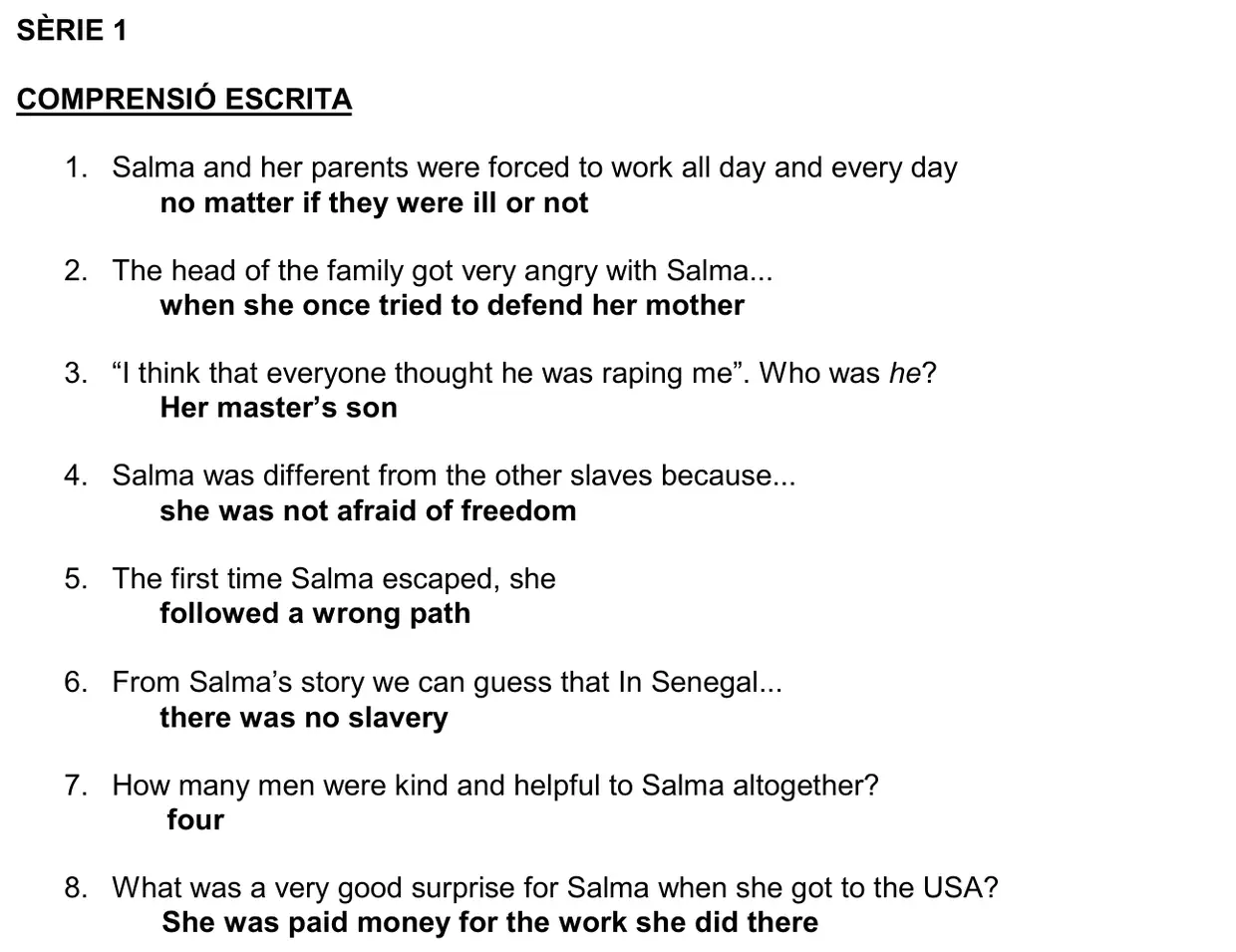
1. Salma and her parents were forced to work all day and every day
no matter if they were ill or not
2. The head of the family got very angry with Salma...
when she once tried to defend her mother
3. “I think that everyone thought he was raping me”. Who was he?
Her master’s son
4. Salma was different from the other slaves because...
she was not afraid of freedom
5. The first time Salma escaped, she
followed a wrong path
6. From Salma’s story we can guess that In Senegal...
there was no slavery
7. How many men were kind and helpful to Salma altogether?
four
8. What was a very good surprise for Salma when she got to the USA?
She was paid money for the work she did there
PART AUDITIVA
ORPHANS OF THE STORM
Introduction
Hi,
In this radio programme, you are going to hear the following words. Read and listen to them. Make
sure you know what they mean.
AIDS (acquired immunodeficiency syndrome) SIDA
HIV (human immunodeficiency virus) virus d’immunodefici3ncia adquirida, virus causant
de la SIDA […]
Resolució pas a pas
Encara no hi ha resolució pròpia verificada d'aquest exercici. Mentrestant, tens els criteris oficials de correcció a sobre. Si tens dubtes, pregunta'ls al xat de la Sala d'estudi.
Font: enunciat i criteris de correcció oficials de les PAU 2004 de Catalunya, publicats per la Generalitat de Catalunya (universitats.gencat.cat) i les universitats catalanes. La resolució pas a pas és pròpia de L'Acadèmia de Vic.
Altres exercicis d'aquest examen
- Part 2 · Writing Writing
- Part 3 · Listening comprehension Listening comprehension