
PAU Anglès 2004 · Juny · Sèrie 1 · Part 3 · Listening comprehension
Enunciat
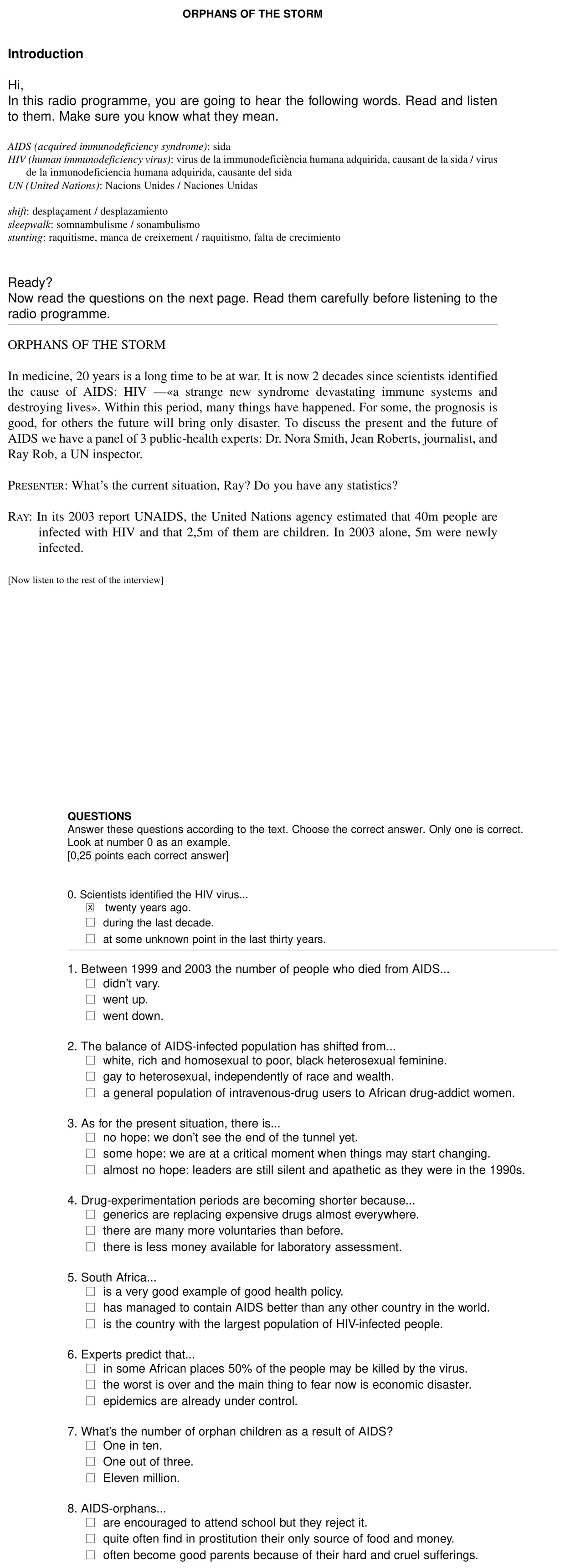
Text de l'enunciat (transcripció automàtica)
ORPHANS OF THE STORM
Introduction
Hi,
In this radio programme, you are going to hear the following words. Read and listen
to them. Make sure you know what they mean.
AIDS (acquired immunodeficiency syndrome): sida
HIV (human immunodeficiency virus): virus de la immunodeficiència humana adquirida, causant de la sida / virus
de la inmunodeficiencia humana adquirida, causante del sida
UN (United Nations): Nacions Unides / Naciones Unidas
shift: desplaçament / desplazamiento
sleepwalk: somnambulisme / sonambulismo
stunting: raquitisme, manca de creixement / raquitismo, falta de crecimiento
Ready?
Now read the questions on the next page. Read them carefully before listening to the
radio programme.
ORPHANS OF THE STORM
In medicine, 20 years is a long time to be at war. It is now 2 decades since scientists identified
the cause of AIDS: HIV —«a strange new syndrome devastating immune systems and
destroying lives». Within this period, many things have happened. For some, the prognosis is
good, for others the future will bring only disaster. To discuss the present and the future of
AIDS we have a panel of 3 public-health experts: Dr. Nora Smith, Jean Roberts, journalist, and
Ray Rob, a UN inspector.
PRESENTER: What’s the current situation, Ray? Do you have any statistics?
RAY: In its 2003 report UNAIDS, the United Nations agency estimated that 40m people are
infected with HIV and that 2,5m of them are children. In 2003 alone, 5m were newly
infected.
[Now listen to the rest of the interview]
QUESTIONS
Answer these questions according to the text. Choose the correct answer. Only one is correct.
Look at number 0 as an example.
[0,25 points each correct answer]
0. Scientists identified the HIV virus...
Ix twenty years ago.
I during the last decade.
I at some unknown point in the last thirty years.
1. Between 1999 and 2003 the number of people who died from AIDS...
I didn’t vary.
I went up.
I went down.
2. The balance of AIDS-infected population has shifted from...
I white, rich and homosexual to poor, black heterosexual feminine.
I gay to heterosexual, independently of race and wealth.
I a general population of intravenous-drug users to African drug-addict women.
3. As for the present situation, there is...
I no hope: we don’t see the end of the tunnel yet.
I some hope: we are at a critical moment when things may start changing.
I almost no hope: leaders are still silent and apathetic as they were in the 1990s.
4. Drug-experimentation periods are becoming shorter because...
I generics are replacing expensive drugs almost everywhere.
I there are many more voluntaries than before.
I there is less money available for laboratory assessment.
5. South Africa...
I is a very good example of good health policy.
I has managed to contain AIDS better than any other country in the world.
I is the country with the largest population of HIV-infected people.
6. Experts predict that...
I in some African places 50% of the people may be killed by the virus.
I the worst is over and the main thing to fear now is economic disaster.
I epidemics are already under control.
7. What’s the number of orphan children as a result of AIDS?
I One in ten.
I One out of three.
I Eleven million.
8. AIDS-orphans...
I are encouraged to attend school but they reject it.
I quite often find in prostitution their only source of food and money.
I often become good parents because of their hard and cruel sufferings.
Criteris oficials de correcció
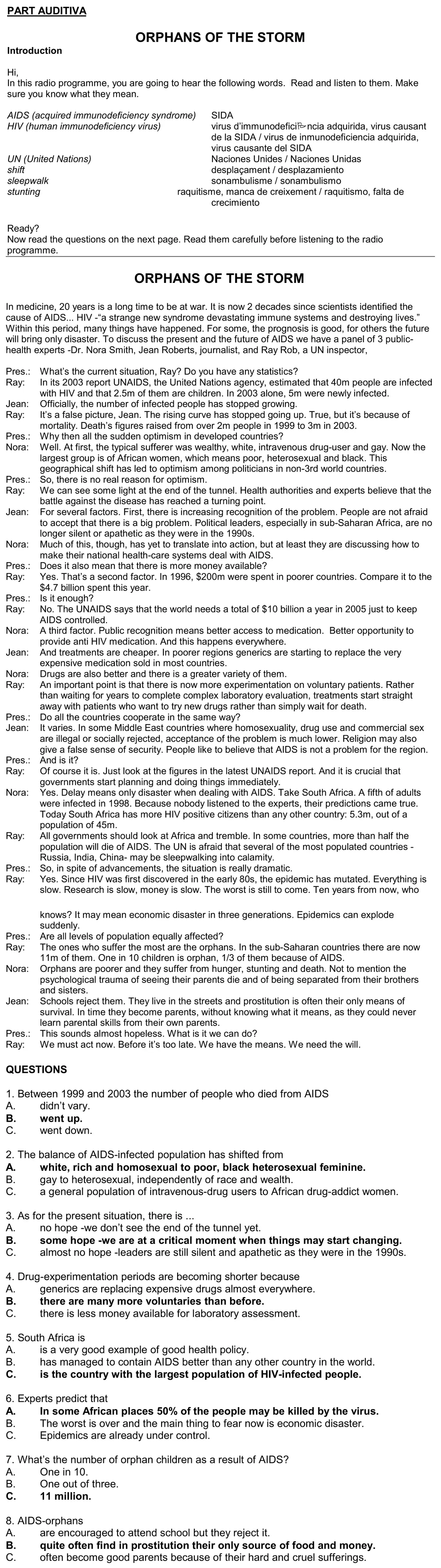
Resolució pas a pas
Aquest exercici no té una resolució escrita pas a pas (requereix l'àudio de la prova). Fes servir els criteris oficials de correcció.
Font: enunciat i criteris de correcció oficials de les PAU 2004 de Catalunya, publicats per la Generalitat de Catalunya (universitats.gencat.cat) i les universitats catalanes. La resolució pas a pas és pròpia de L'Acadèmia de Vic.
Altres exercicis d'aquest examen
- Part 1 · Reading comprehension Reading comprehension
- Part 2 · Writing Writing
Tots els exercicis de Listening comprehension · PAU de Anglès