
PAU Anglès 2003 · Juny · Sèrie 2 · Part 1 · Reading comprehension
Enunciat
Text de l'enunciat (transcripció automàtica)
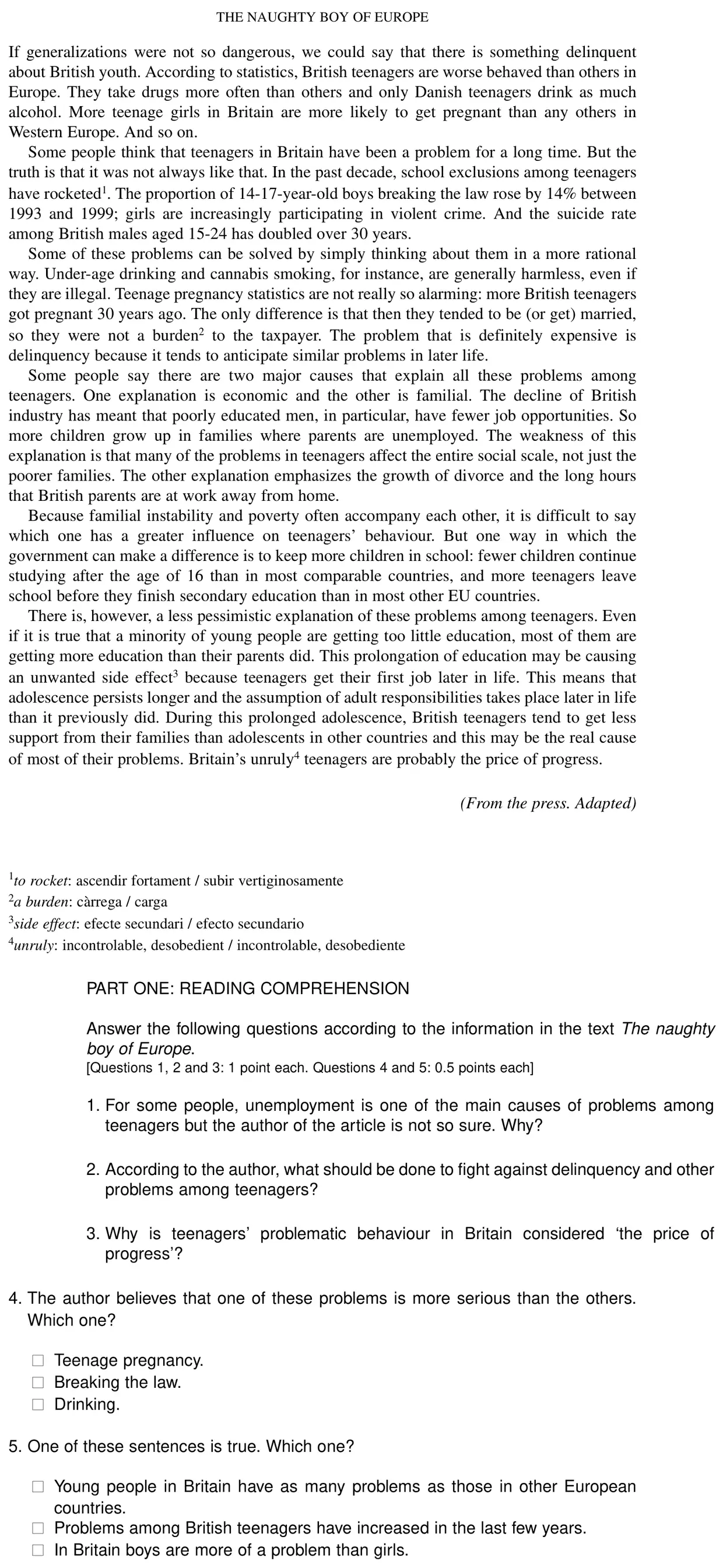
THE NAUGHTY BOY OF EUROPE
If generalizations were not so dangerous, we could say that there is something delinquent
about British youth. According to statistics, British teenagers are worse behaved than others in
Europe. They take drugs more often than others and only Danish teenagers drink as much
alcohol. More teenage girls in Britain are more likely to get pregnant than any others in
Western Europe. And so on.
Some people think that teenagers in Britain have been a problem for a long time. But the
truth is that it was not always like that. In the past decade, school exclusions among teenagers
have rocketed1. The proportion of 14-17-year-old boys breaking the law rose by 14% between
1993 and 1999; girls are increasingly participating in violent crime. And the suicide rate
among British males aged 15-24 has doubled over 30 years.
Some of these problems can be solved by simply thinking about them in a more rational
way. Under-age drinking and cannabis smoking, for instance, are generally harmless, even if
they are illegal. Teenage pregnancy statistics are not really so alarming: more British teenagers
got pregnant 30 years ago. The only difference is that then they tended to be (or get) married,
so they were not a burden2 to the taxpayer. The problem that is definitely expensive is
delinquency because it tends to anticipate similar problems in later life.
Some people say there are two major causes that explain all these problems among
teenagers. One explanation is economic and the other is familial. The decline of British
industry has meant that poorly educated men, in particular, have fewer job opportunities. So
more children grow up in families where parents are unemployed. The weakness of this
explanation is that many of the problems in teenagers affect the entire social scale, not just the
poorer families. The other explanation emphasizes the growth of divorce and the long hours
that British parents are at work away from home.
Because familial instability and poverty often accompany each other, it is difficult to say
which one has a greater influence on teenagers’ behaviour. But one way in which the
government can make a difference is to keep more children in school: fewer children continue
studying after the age of 16 than in most comparable countries, and more teenagers leave
school before they finish secondary education than in most other EU countries.
There is, however, a less pessimistic explanation of these problems among teenagers. Even
if it is true that a minority of young people are getting too little education, most of them are
getting more education than their parents did. This prolongation of education may be causing
an unwanted side effect3 because teenagers get their first job later in life. This means that
adolescence persists longer and the assumption of adult responsibilities takes place later in life
than it previously did. During this prolonged adolescence, British teenagers tend to get less
support from their families than adolescents in other countries and this may be the real cause
of most of their problems. Britain’s unruly4 teenagers are probably the price of progress.
(From the press. Adapted)
1to rocket: ascendir fortament / subir vertiginosamente
2a burden: càrrega / carga
3side effect: efecte secundari / efecto secundario
4unruly: incontrolable, desobedient / incontrolable, desobediente
PART ONE: READING COMPREHENSION
Answer the following questions according to the information in the text The naughty
boy of Europe.
[Questions 1, 2 and 3: 1 point each. Questions 4 and 5: 0.5 points each]
1. For some people, unemployment is one of the main causes of problems among
teenagers but the author of the article is not so sure. Why?
2. According to the author, what should be done to fight against delinquency and other
problems among teenagers?
3. Why is teenagers’ problematic behaviour in Britain considered ‘the price of
progress’?
4. The author believes that one of these problems is more serious than the
Criteris oficials de correcció
Text dels criteris (transcripció automàtica)
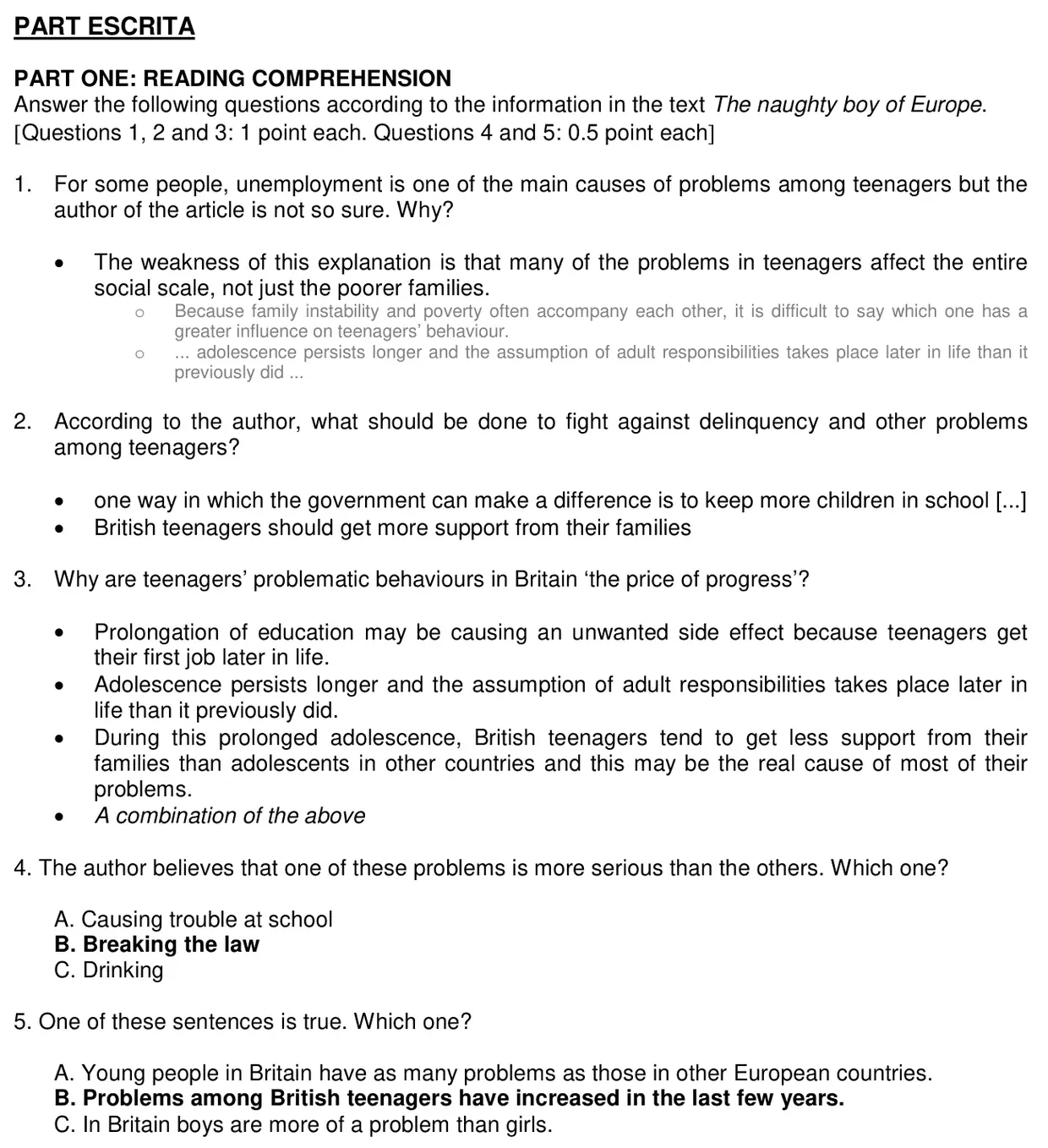
PART ONE: READING COMPREHENSION
Answer the following questions according to the information in the text The naughty boy of Europe.
!Questions 1, 2 and 3: 1 point each. Questions 4 and 5: 0.5 point each"
1. For some people, unemployment is one of the main causes of problems among teenagers but the
author of the article is not so sure. Why?
# The weakness of this explanation is that many of the problems in teenagers affect the entire
social scale, not just the poorer families.
o Because family instability and poverty often accompany each other, it is difficult to say which one has a
greater influence on teenagers’ behaviour.
o ... adolescence persists longer and the assumption of adult responsibilities takes place later in life than it
previously did ...
2. According to the author, what should be done to fight against delinquency and other problems
among teenagers?
# one way in which the government can make a difference is to keep more children in school [...]
# British teenagers should […]
Resolució pas a pas
Encara no hi ha resolució pròpia verificada d'aquest exercici. Mentrestant, tens els criteris oficials de correcció a sobre. Si tens dubtes, pregunta'ls al xat de la Sala d'estudi.
Font: enunciat i criteris de correcció oficials de les PAU 2003 de Catalunya, publicats per la Generalitat de Catalunya (universitats.gencat.cat) i les universitats catalanes. La resolució pas a pas és pròpia de L'Acadèmia de Vic.
Altres exercicis d'aquest examen
- Part 2 · Writing Writing
- Part 3 · Listening comprehension Listening comprehension