
PAU Anglès 2003 · Juny · Sèrie 5 · Part 1 · Reading comprehension
Enunciat
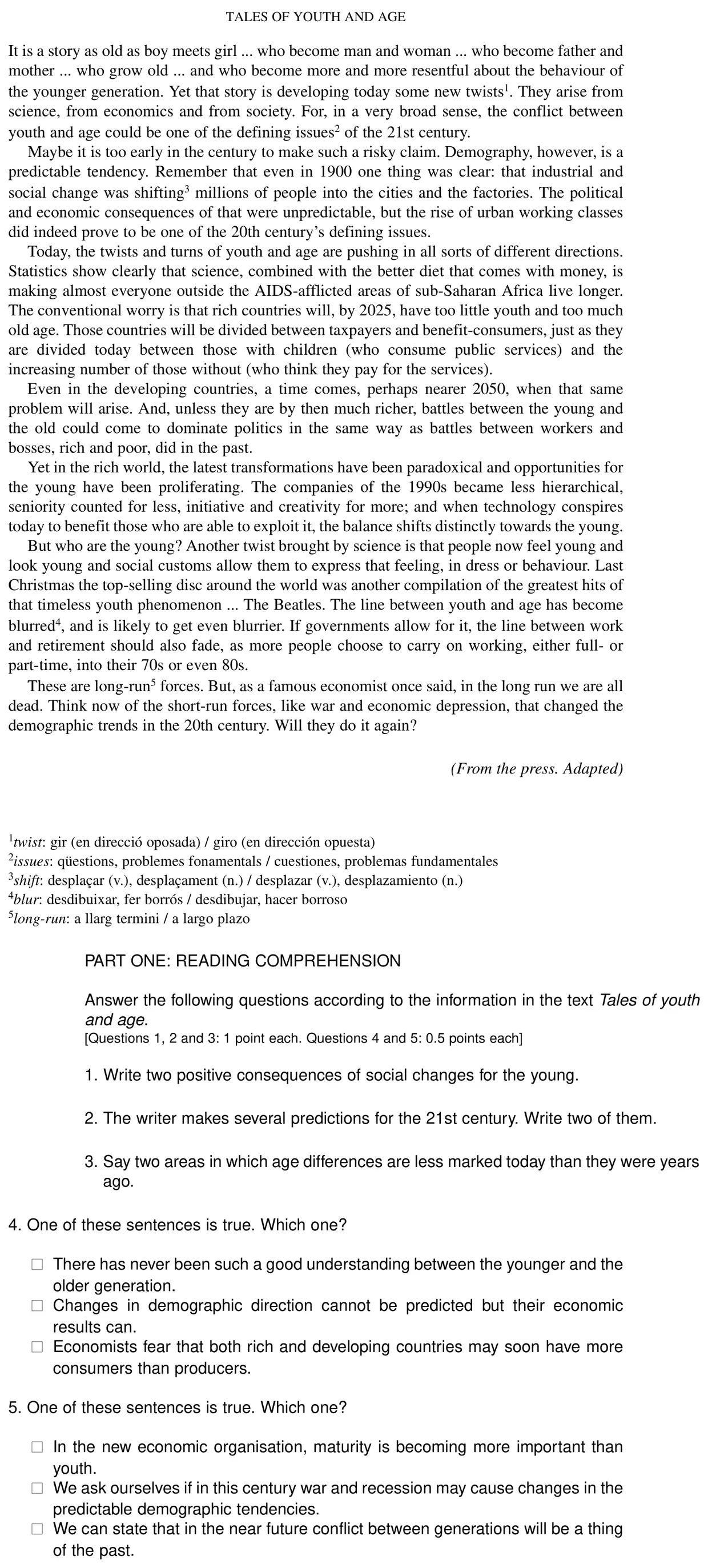
Text de l'enunciat (transcripció automàtica)
TALES OF YOUTH AND AGE
It is a story as old as boy meets girl ... who become man and woman ... who become father and
mother ... who grow old ... and who become more and more resentful about the behaviour of
the younger generation. Yet that story is developing today some new twists1. They arise from
science, from economics and from society. For, in a very broad sense, the conflict between
youth and age could be one of the defining issues2 of the 21st century.
Maybe it is too early in the century to make such a risky claim. Demography, however, is a
predictable tendency. Remember that even in 1900 one thing was clear: that industrial and
social change was shifting3 millions of people into the cities and the factories. The political
and economic consequences of that were unpredictable, but the rise of urban working classes
did indeed prove to be one of the 20th century’s defining issues.
Today, the twists and turns of youth and age are pushing in all sorts of different directions.
Statistics show clearly that science, combined with the better diet that comes with money, is
making almost everyone outside the AIDS-afflicted areas of sub-Saharan Africa live longer.
The conventional worry is that rich countries will, by 2025, have too little youth and too much
old age. Those countries will be divided between taxpayers and benefit-consumers, just as they
are divided today between those with children (who consume public services) and the
increasing number of those without (who think they pay for the services).
Even in the developing countries, a time comes, perhaps nearer 2050, when that same
problem will arise. And, unless they are by then much richer, battles between the young and
the old could come to dominate politics in the same way as battles between workers and
bosses, rich and poor, did in the past.
Yet in the rich world, the latest transformations have been paradoxical and opportunities for
the young have been proliferating. The companies of the 1990s became less hierarchical,
seniority counted for less, initiative and creativity for more; and when technology conspires
today to benefit those who are able to exploit it, the balance shifts distinctly towards the young.
But who are the young? Another twist brought by science is that people now feel young and
look young and social customs allow them to express that feeling, in dress or behaviour. Last
Christmas the top-selling disc around the world was another compilation of the greatest hits of
that timeless youth phenomenon ... The Beatles. The line between youth and age has become
blurred4, and is likely to get even blurrier. If governments allow for it, the line between work
and retirement should also fade, as more people choose to carry on working, either full- or
part-time, into their 70s or even 80s.
These are long-run5 forces. But, as a famous economist once said, in the long run we are all
dead. Think now of the short-run forces, like war and economic depression, that changed the
demographic trends in the 20th century. Will they do it again?
(From the press. Adapted)
1twist: gir (en direcció oposada) / giro (en dirección opuesta)
2issues: qüestions, problemes fonamentals / cuestiones, problemas fundamentales
3shift: desplaçar (v.), desplaçament (n.) / desplazar (v.), desplazamiento (n.)
4blur: desdibuixar, fer borrós / desdibujar, hacer borroso
5long-run: a llarg termini / a largo plazo
PART ONE: READING COMPREHENSION
Answer the following questions according to the information in the text Tales of youth
and age.
[Questions 1, 2 and 3: 1 point each. Questions 4 and 5: 0.5 points each]
1. Write two positive consequences of social changes for the young.
2. The writer makes several predictions for the 21st century. Write two of them.
3. Say two areas in which age differences are less marked today than they were years
ago.
4. One of these sentences is true. Which one?
I There has never been such a good understanding between the younger and the
older generation.
I Changes in
Criteris oficials de correcció
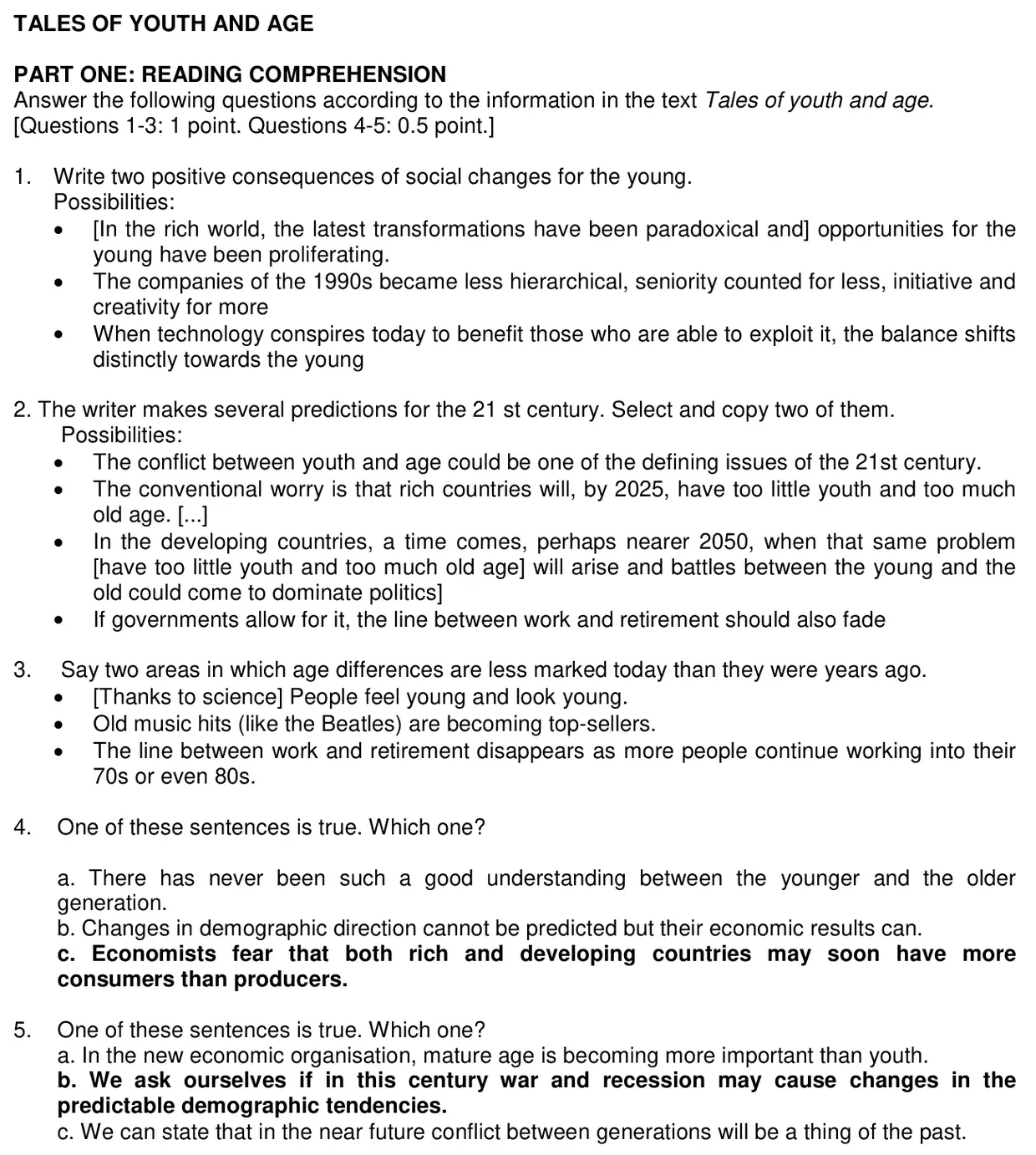
Text dels criteris (transcripció automàtica)
1. Write two positive consequences of social changes for the young.
Possibilities:
# [In the rich world, the latest transformations have been paradoxical and] opportunities for the
young have been proliferating.
# The companies of the 1990s became less hierarchical, seniority counted for less, initiative and
creativity for more
# When technology conspires today to benefit those who are able to exploit it, the balance shifts
distinctly towards the young
2. The writer makes several predictions for the 21 st century. Select and copy two of them.
Possibilities:
# The conflict between youth and age could be one of the defining issues of the 21st century.
# The conventional worry is that rich countries will, by 2025, have too little youth and too much
old age. [...]
# In the developing countries, a time comes, perhaps nearer 2050, when that same problem
[have too little youth and too much old age] will arise and battles between the young and the
old could come to dominate politics]
# If gove […]
Resolució pas a pas
Encara no hi ha resolució pròpia verificada d'aquest exercici. Mentrestant, tens els criteris oficials de correcció a sobre. Si tens dubtes, pregunta'ls al xat de la Sala d'estudi.
Font: enunciat i criteris de correcció oficials de les PAU 2003 de Catalunya, publicats per la Generalitat de Catalunya (universitats.gencat.cat) i les universitats catalanes. La resolució pas a pas és pròpia de L'Acadèmia de Vic.
Altres exercicis d'aquest examen
- Part 2 · Writing Writing
- Part 3 · Listening comprehension Listening comprehension