
PAU Anglès 2003 · Juny · Sèrie 2 · Part 3 · Listening comprehension
Enunciat
Text de l'enunciat (transcripció automàtica)
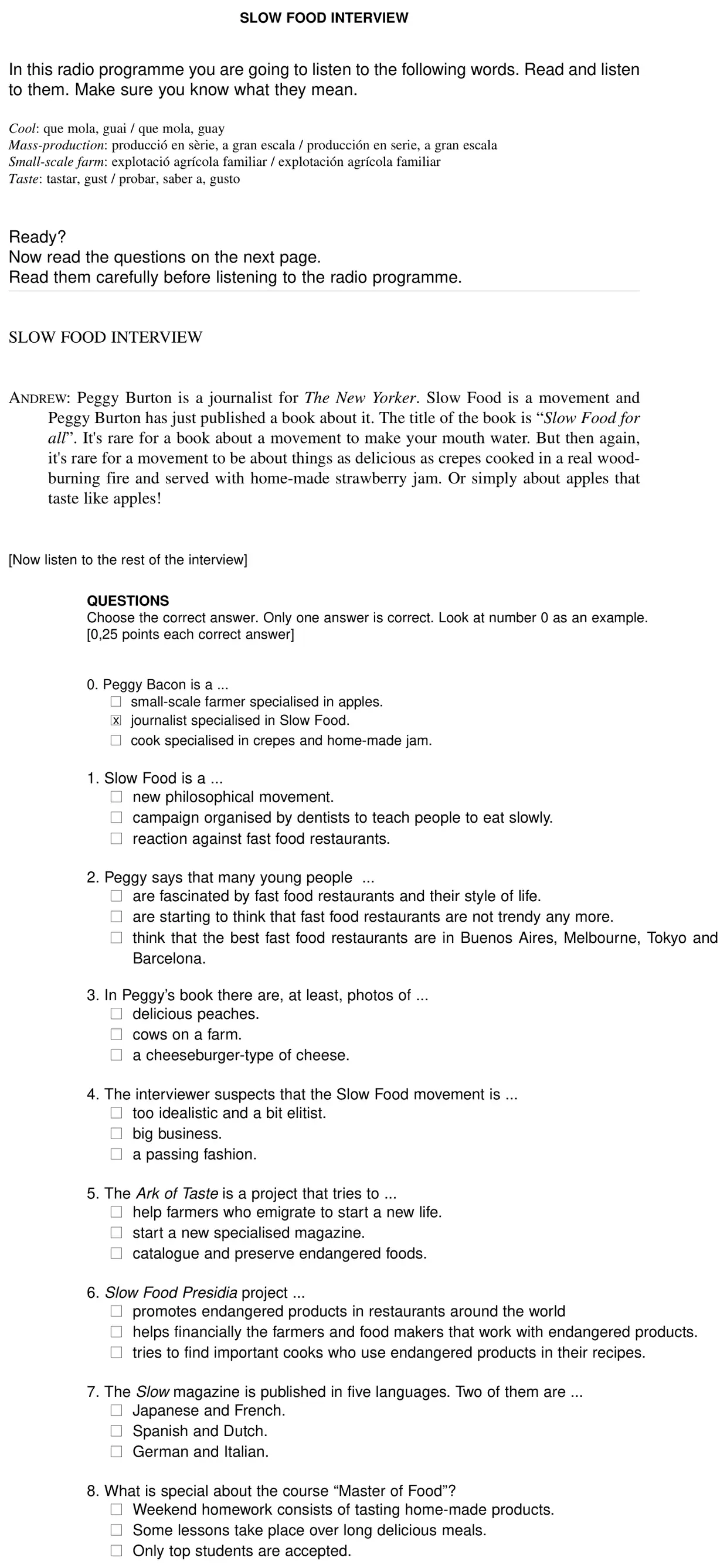
SLOW FOOD INTERVIEW
In this radio programme you are going to listen to the following words. Read and listen
to them. Make sure you know what they mean.
Cool: que mola, guai / que mola, guay
Mass-production: producció en sèrie, a gran escala / producción en serie, a gran escala
Small-scale farm: explotació agrícola familiar / explotación agrícola familiar
Taste: tastar, gust / probar, saber a, gusto
Ready?
Now read the questions on the next page.
Read them carefully before listening to the radio programme.
SLOW FOOD INTERVIEW
ANDREW: Peggy Burton is a journalist for The New Yorker. Slow Food is a movement and
Peggy Burton has just published a book about it. The title of the book is “Slow Food for
all”. It's rare for a book about a movement to make your mouth water. But then again,
it's rare for a movement to be about things as delicious as crepes cooked in a real wood-
burning fire and served with home-made strawberry jam. Or simply about apples that
taste like apples!
[Now listen to the rest of the interview]
QUESTIONS
Choose the correct answer. Only one answer is correct. Look at number 0 as an example.
[0,25 points each correct answer]
0. Peggy Bacon is a ...
I small-scale farmer specialised in apples.
Ix journalist specialised in Slow Food.
I cook specialised in crepes and home-made jam.
1. Slow Food is a ...
I new philosophical movement.
I campaign organised by dentists to teach people to eat slowly.
I reaction against fast food restaurants.
2. Peggy says that many young people ...
I are fascinated by fast food restaurants and their style of life.
I are starting to think that fast food restaurants are not trendy any more.
I think that the best fast food restaurants are in Buenos Aires, Melbourne, Tokyo and
Barcelona.
3. In Peggy’s book there are, at least, photos of ...
I delicious peaches.
I cows on a farm.
I a cheeseburger-type of cheese.
4. The interviewer suspects that the Slow Food movement is ...
I too idealistic and a bit elitist.
I big business.
I a passing fashion.
5. The Ark of Taste is a project that tries to ...
I help farmers who emigrate to start a new life.
I start a new specialised magazine.
I catalogue and preserve endangered foods.
6. Slow Food Presidia project ...
I promotes endangered products in restaurants around the world
I helps financially the farmers and food makers that work with endangered products.
I tries to find important cooks who use endangered products in their recipes.
7. The Slow magazine is published in five languages. Two of them are ...
I Japanese and French.
I Spanish and Dutch.
I German and Italian.
8. What is special about the course “Master of Food”?
I Weekend homework consists of tasting home-made products.
I Some lessons take place over long delicious meals.
I Only top students are accepted.
Criteris oficials de correcció
Text dels criteris (transcripció automàtica)
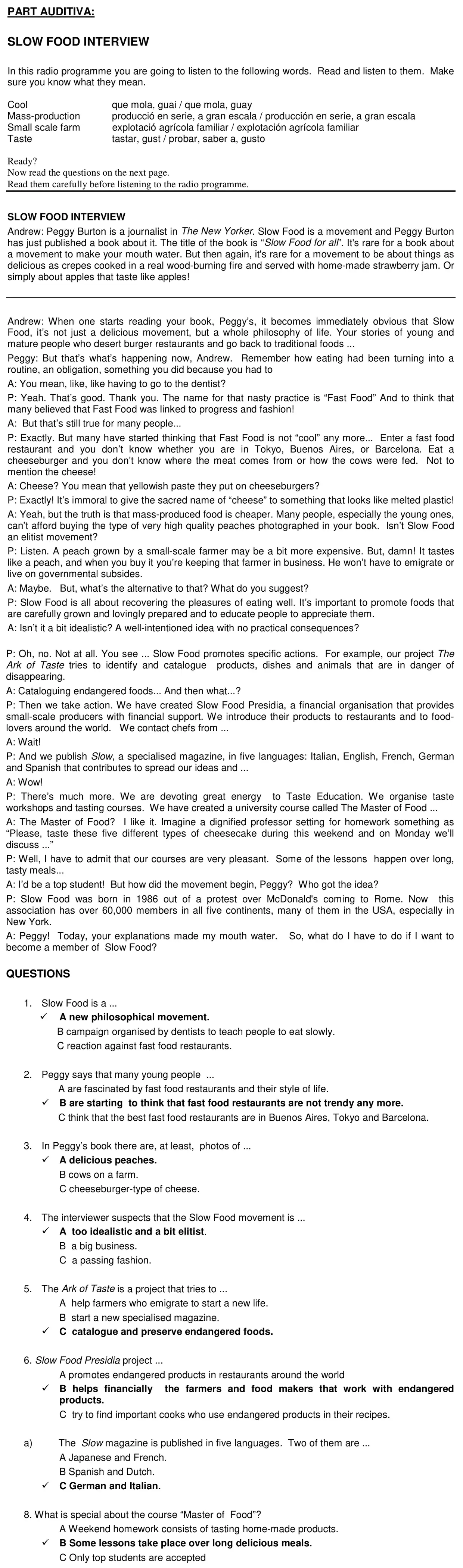
Read them carefully before listening to the radio programme.
SLOW FOOD INTERVIEW
Andrew: Peggy Burton is a journalist in The New Yorker. Slow Food is a movement and Peggy Burton
has just published a book about it. The title of the book is “Slow Food for all”. It's rare for a book about
a movement to make your mouth water. But then again, it's rare for a movement to be about things as
delicious as crepes cooked in a real wood-burning fire and served with home-made strawberry jam. Or
simply about apples that taste like apples!
Andrew: When one starts reading your book, Peggy’s, it becomes immediately obvious that Slow
Food, it’s not just a delicious movement, but a whole philosophy of life. Your stories of young and
mature people who desert burger restaurants and go back to traditional foods ...
Peggy: But that’s what’s happening now, Andrew. Remember how eating had been turning into a
routine, an obligation, something you did because you had to
A: You mean, like, like having to go to th […]
Resolució pas a pas
Aquest exercici no té una resolució escrita pas a pas (requereix l'àudio de la prova). Fes servir els criteris oficials de correcció.
Font: enunciat i criteris de correcció oficials de les PAU 2003 de Catalunya, publicats per la Generalitat de Catalunya (universitats.gencat.cat) i les universitats catalanes. La resolució pas a pas és pròpia de L'Acadèmia de Vic.
Altres exercicis d'aquest examen
- Part 1 · Reading comprehension Reading comprehension
- Part 2 · Writing Writing
Tots els exercicis de Listening comprehension · PAU de Anglès