
PAU Anglès 2002 · Setembre · Sèrie 1 · Part 1 · Reading comprehension
Enunciat
Text de l'enunciat (transcripció automàtica)
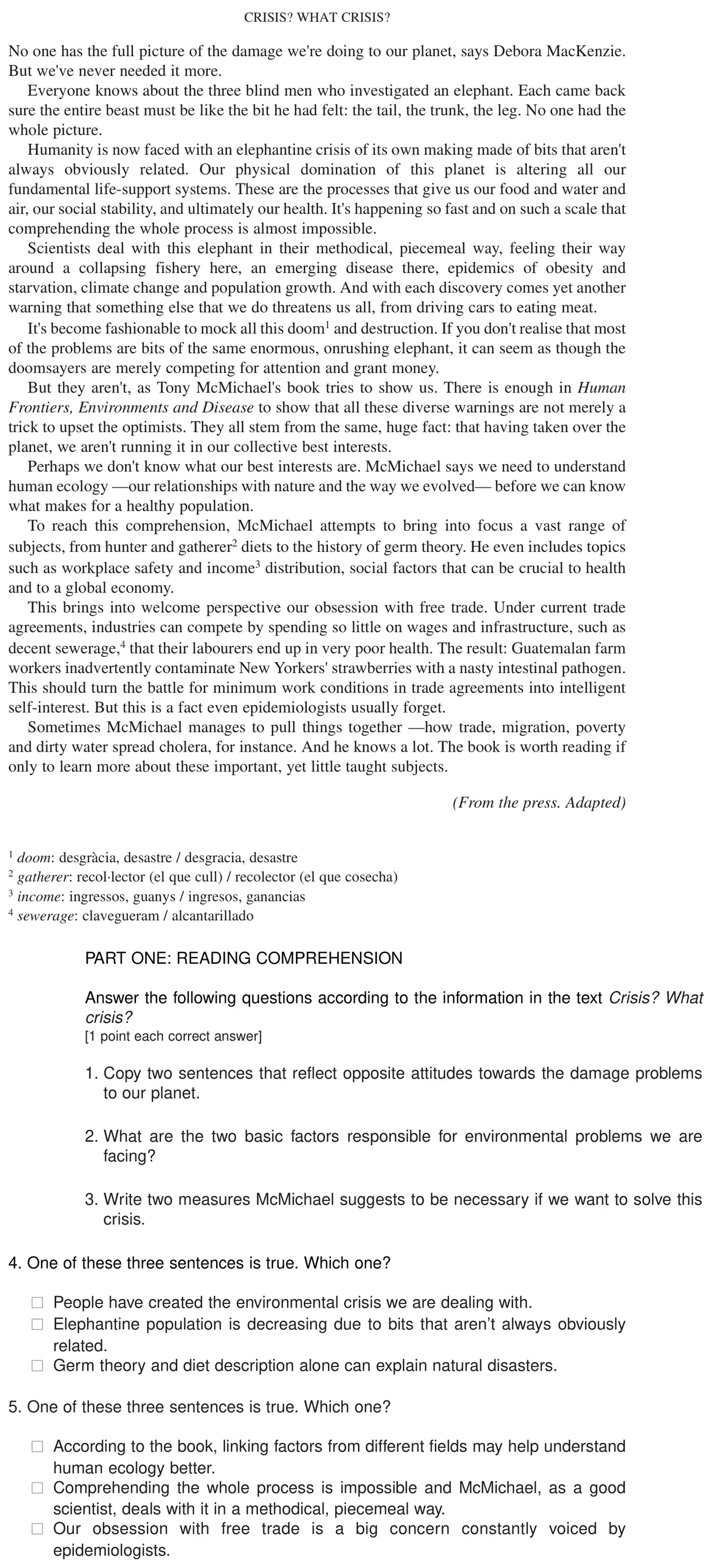
CRISIS? WHAT CRISIS?
No one has the full picture of the damage we're doing to our planet, says Debora MacKenzie.
But we've never needed it more.
Everyone knows about the three blind men who investigated an elephant. Each came back
sure the entire beast must be like the bit he had felt: the tail, the trunk, the leg. No one had the
whole picture.
Humanity is now faced with an elephantine crisis of its own making made of bits that aren't
always obviously related. Our physical domination of this planet is altering all our
fundamental life-support systems. These are the processes that give us our food and water and
air, our social stability, and ultimately our health. It's happening so fast and on such a scale that
comprehending the whole process is almost impossible.
Scientists deal with this elephant in their methodical, piecemeal way, feeling their way
around a collapsing fishery here, an emerging disease there, epidemics of obesity and
starvation, climate change and population growth. And with each discovery comes yet another
warning that something else that we do threatens us all, from driving cars to eating meat.
It's become fashionable to mock all this doom1 and destruction. If you don't realise that most
of the problems are bits of the same enormous, onrushing elephant, it can seem as though the
doomsayers are merely competing for attention and grant money.
But they aren't, as Tony McMichael's book tries to show us. There is enough in Human
Frontiers, Environments and Disease to show that all these diverse warnings are not merely a
trick to upset the optimists. They all stem from the same, huge fact: that having taken over the
planet, we aren't running it in our collective best interests.
Perhaps we don't know what our best interests are. McMichael says we need to understand
human ecology —our relationships with nature and the way we evolved— before we can know
what makes for a healthy population.
To reach this comprehension, McMichael attempts to bring into focus a vast range of
subjects, from hunter and gatherer2 diets to the history of germ theory. He even includes topics
such as workplace safety and income3 distribution, social factors that can be crucial to health
and to a global economy.
This brings into welcome perspective our obsession with free trade. Under current trade
agreements, industries can compete by spending so little on wages and infrastructure, such as
decent sewerage,4 that their labourers end up in very poor health. The result: Guatemalan farm
workers inadvertently contaminate New Yorkers' strawberries with a nasty intestinal pathogen.
This should turn the battle for minimum work conditions in trade agreements into intelligent
self-interest. But this is a fact even epidemiologists usually forget.
Sometimes McMichael manages to pull things together —how trade, migration, poverty
and dirty water spread cholera, for instance. And he knows a lot. The book is worth reading if
only to learn more about these important, yet little taught subjects.
(From the press. Adapted)
1 doom: desgràcia, desastre / desgracia, desastre
2 gatherer: recol·lector (el que cull) / recolector (el que cosecha)
3 income: ingressos, guanys / ingresos, ganancias
4 sewerage: clavegueram / alcantarillado
PART ONE: READING COMPREHENSION
Answer the following questions according to the information in the text Crisis? What
crisis?
[1 point each correct answer]
1. Copy two sentences that reflect opposite attitudes towards the damage problems
to our planet.
2. What are the two basic factors responsible for environmental problems we are
facing?
3. Write two measures McMichael suggests to be necessary if we want to solve this
crisis.
4. One of these three sentences is true. Which one?
■ People have created the environmental crisis we are dealing with.
■ Elephantine population is decreasing due to bits that aren’t always obviously
related.
■ Germ theory and diet description alone can explain natural disasters.
5. One of these three sentences
Criteris oficials de correcció
Text dels criteris (transcripció automàtica)
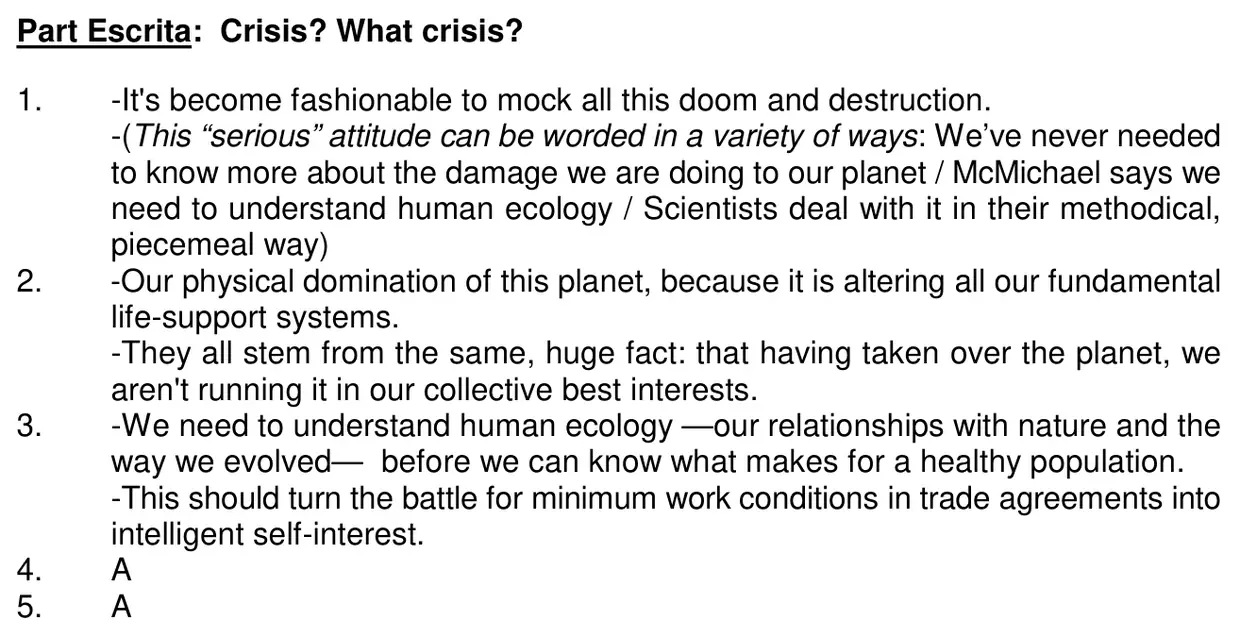
1. -It's become fashionable to mock all this doom and destruction.
-(This “serious” attitude can be worded in a variety of ways: We’ve never needed
to know more about the damage we are doing to our planet / McMichael says we
need to understand human ecology / Scientists deal with it in their methodical,
piecemeal way)
2. -Our physical domination of this planet, because it is altering all our fundamental
life-support systems.
-They all stem from the same, huge fact: that having taken over the planet, we
aren't running it in our collective best interests.
3. -We need to understand human ecology —our relationships with nature and the
way we evolved— before we can know what makes for a healthy population.
-This should turn the battle for minimum work conditions in trade agreements into
intelligent self-interest.
4. A
5. A
Part Oral: CATALAN COMPOSERS OF THE 20TH CENTURY
In this radio programme you are going to listen to the following words. Read and listen
to them. Make sure you know what […]
Resolució pas a pas
Encara no hi ha resolució pròpia verificada d'aquest exercici. Mentrestant, tens els criteris oficials de correcció a sobre. Si tens dubtes, pregunta'ls al xat de la Sala d'estudi.
Font: enunciat i criteris de correcció oficials de les PAU 2002 de Catalunya, publicats per la Generalitat de Catalunya (universitats.gencat.cat) i les universitats catalanes. La resolució pas a pas és pròpia de L'Acadèmia de Vic.
Altres exercicis d'aquest examen
- Part 2 · Writing Writing
- Part 3 · Listening comprehension Listening comprehension