
PAU Anglès 2002 · Setembre · Sèrie 1 · Part 3 · Listening comprehension
Enunciat
Text de l'enunciat (transcripció automàtica)
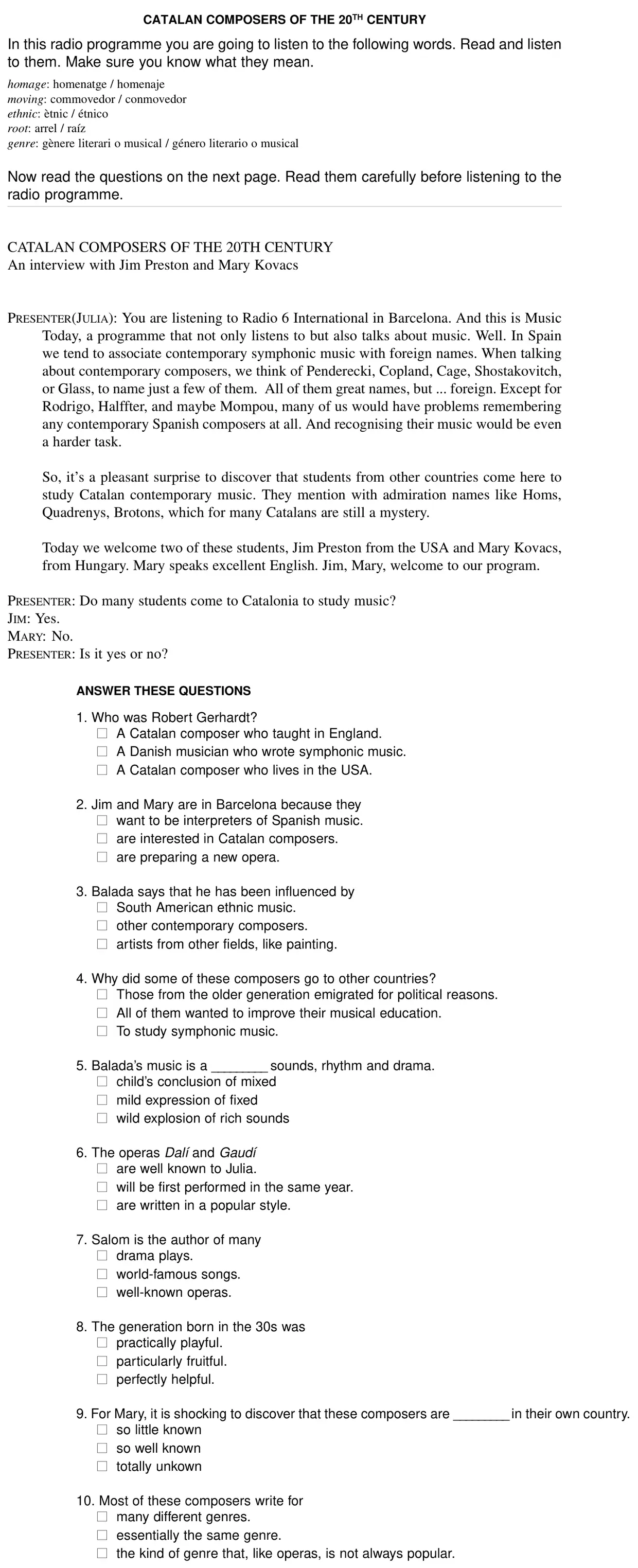
CATALAN COMPOSERS OF THE 20TH CENTURY
In this radio programme you are going to listen to the following words. Read and listen
to them. Make sure you know what they mean.
homage: homenatge / homenaje
moving: commovedor / conmovedor
ethnic: ètnic / étnico
root: arrel / raíz
genre: gènere literari o musical / género literario o musical
Now read the questions on the next page. Read them carefully before listening to the
radio programme.
CATALAN COMPOSERS OF THE 20TH CENTURY
An interview with Jim Preston and Mary Kovacs
PRESENTER(JULIA): You are listening to Radio 6 International in Barcelona. And this is Music
Today, a programme that not only listens to but also talks about music. Well. In Spain
we tend to associate contemporary symphonic music with foreign names. When talking
about contemporary composers, we think of Penderecki, Copland, Cage, Shostakovitch,
or Glass, to name just a few of them. All of them great names, but ... foreign. Except for
Rodrigo, Halffter, and maybe Mompou, many of us would have problems remembering
any contemporary Spanish composers at all. And recognising their music would be even
a harder task.
So, it’s a pleasant surprise to discover that students from other countries come here to
study Catalan contemporary music. They mention with admiration names like Homs,
Quadrenys, Brotons, which for many Catalans are still a mystery.
Today we welcome two of these students, Jim Preston from the USA and Mary Kovacs,
from Hungary. Mary speaks excellent English. Jim, Mary, welcome to our program.
PRESENTER: Do many students come to Catalonia to study music?
JIM: Yes.
MARY: No.
PRESENTER: Is it yes or no?
ANSWER THESE QUESTIONS
1. Who was Robert Gerhardt?
I A Catalan composer who taught in England.
I A Danish musician who wrote symphonic music.
I A Catalan composer who lives in the USA.
2. Jim and Mary are in Barcelona because they
I want to be interpreters of Spanish music.
I are interested in Catalan composers.
I are preparing a new opera.
3. Balada says that he has been influenced by
I South American ethnic music.
I other contemporary composers.
I artists from other fields, like painting.
4. Why did some of these composers go to other countries?
I Those from the older generation emigrated for political reasons.
I All of them wanted to improve their musical education.
I To study symphonic music.
5. Balada’s music is a _________ sounds, rhythm and drama.
I child’s conclusion of mixed
I mild expression of fixed
I wild explosion of rich sounds
6. The operas Dalí and Gaudí
I are well known to Julia.
I will be first performed in the same year.
I are written in a popular style.
7. Salom is the author of many
I drama plays.
I world-famous songs.
I well-known operas.
8. The generation born in the 30s was
I practically playful.
I particularly fruitful.
I perfectly helpful.
9. For Mary, it is shocking to discover that these composers are _________ in their own country.
I so little known
I so well known
I totally unkown
10. Most of these composers write for
I many different genres.
I essentially the same genre.
I the kind of genre that, like operas, is not always popular.
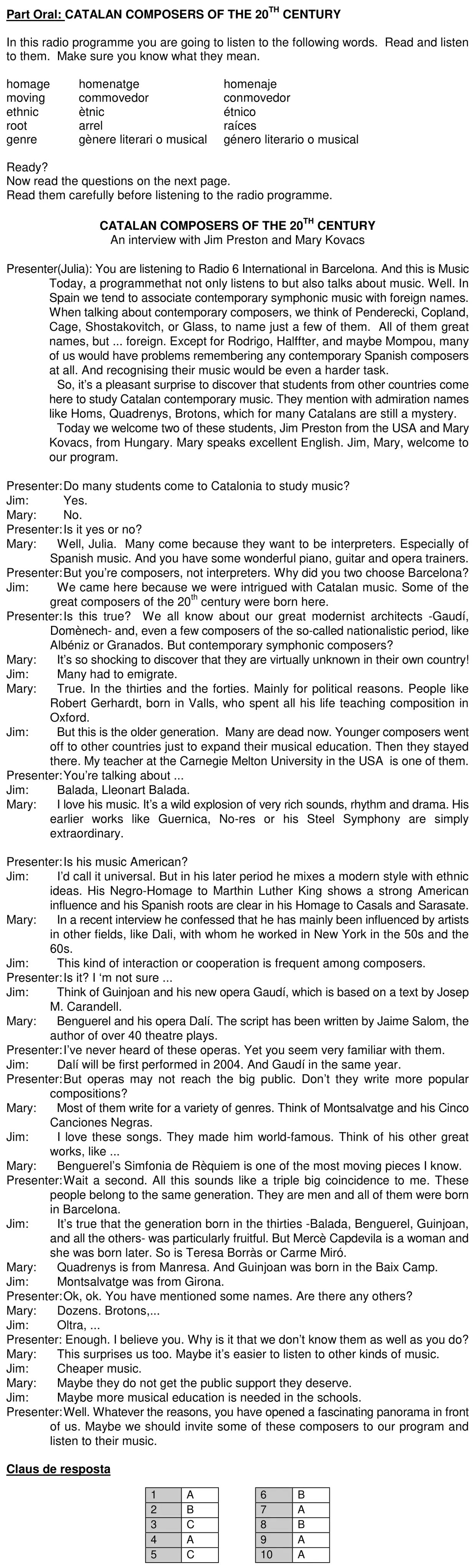
Criteris oficials de correcció
Resolució pas a pas
Aquest exercici no té una resolució escrita pas a pas (requereix l'àudio de la prova). Fes servir els criteris oficials de correcció.
Font: enunciat i criteris de correcció oficials de les PAU 2002 de Catalunya, publicats per la Generalitat de Catalunya (universitats.gencat.cat) i les universitats catalanes. La resolució pas a pas és pròpia de L'Acadèmia de Vic.
Altres exercicis d'aquest examen
- Part 1 · Reading comprehension Reading comprehension
- Part 2 · Writing Writing
Tots els exercicis de Listening comprehension · PAU de Anglès