
PAU Anglès 2002 · Juny · Sèrie 2 · Part 1 · Reading comprehension
Enunciat
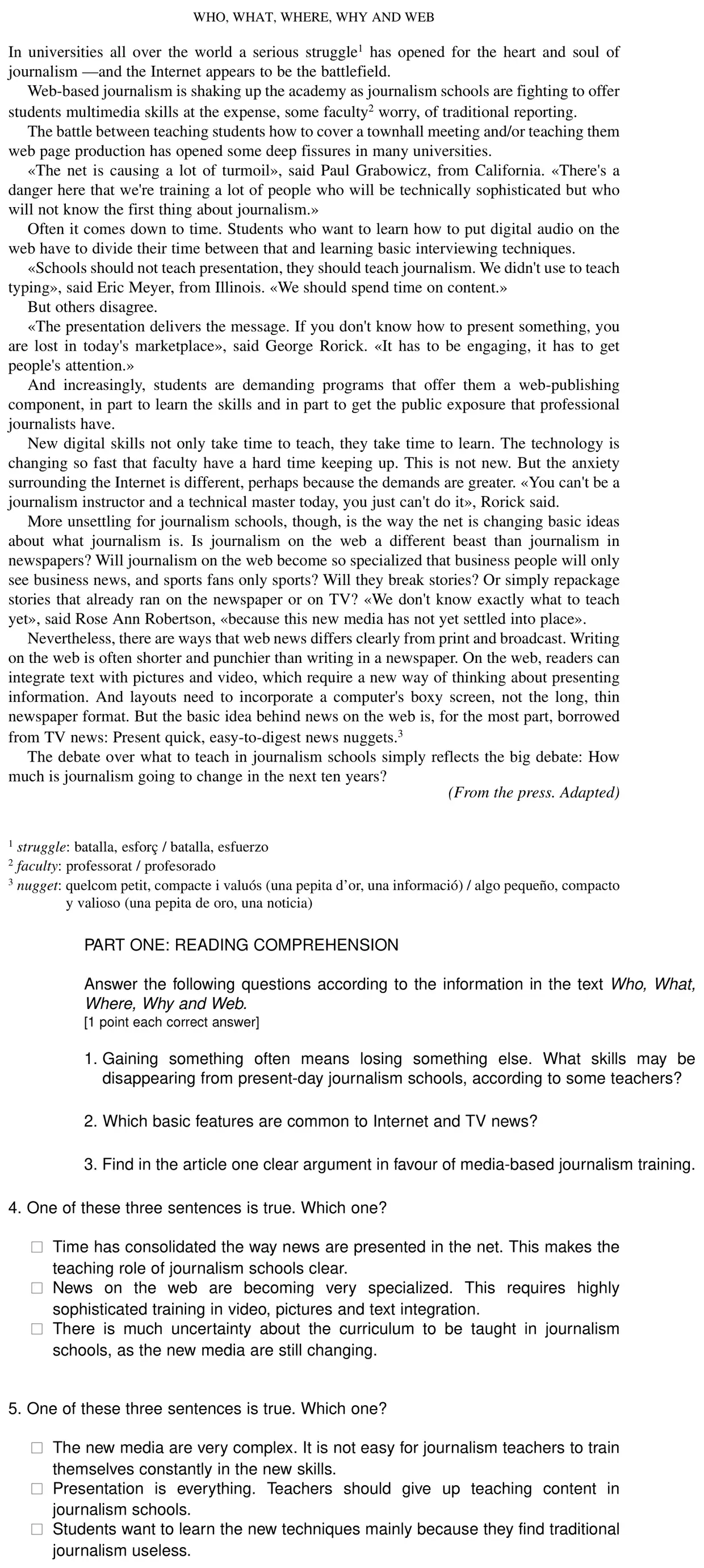
Text de l'enunciat (transcripció automàtica)
WHO, WHAT, WHERE, WHY AND WEB
In universities all over the world a serious struggle1 has opened for the heart and soul of
journalism —and the Internet appears to be the battlefield.
Web-based journalism is shaking up the academy as journalism schools are fighting to offer
students multimedia skills at the expense, some faculty2 worry, of traditional reporting.
The battle between teaching students how to cover a townhall meeting and/or teaching them
web page production has opened some deep fissures in many universities.
«The net is causing a lot of turmoil», said Paul Grabowicz, from California. «There's a
danger here that we're training a lot of people who will be technically sophisticated but who
will not know the first thing about journalism.»
Often it comes down to time. Students who want to learn how to put digital audio on the
web have to divide their time between that and learning basic interviewing techniques.
«Schools should not teach presentation, they should teach journalism. We didn't use to teach
typing», said Eric Meyer, from Illinois. «We should spend time on content.»
But others disagree.
«The presentation delivers the message. If you don't know how to present something, you
are lost in today's marketplace», said George Rorick. «It has to be engaging, it has to get
people's attention.»
And increasingly, students are demanding programs that offer them a web-publishing
component, in part to learn the skills and in part to get the public exposure that professional
journalists have.
New digital skills not only take time to teach, they take time to learn. The technology is
changing so fast that faculty have a hard time keeping up. This is not new. But the anxiety
surrounding the Internet is different, perhaps because the demands are greater. «You can't be a
journalism instructor and a technical master today, you just can't do it», Rorick said.
More unsettling for journalism schools, though, is the way the net is changing basic ideas
about what journalism is. Is journalism on the web a different beast than journalism in
newspapers? Will journalism on the web become so specialized that business people will only
see business news, and sports fans only sports? Will they break stories? Or simply repackage
stories that already ran on the newspaper or on TV? «We don't know exactly what to teach
yet», said Rose Ann Robertson, «because this new media has not yet settled into place».
Nevertheless, there are ways that web news differs clearly from print and broadcast. Writing
on the web is often shorter and punchier than writing in a newspaper. On the web, readers can
integrate text with pictures and video, which require a new way of thinking about presenting
information. And layouts need to incorporate a computer's boxy screen, not the long, thin
newspaper format. But the basic idea behind news on the web is, for the most part, borrowed
from TV news: Present quick, easy-to-digest news nuggets.3
The debate over what to teach in journalism schools simply reflects the big debate: How
much is journalism going to change in the next ten years?
(From the press. Adapted)
1 struggle: batalla, esforç / batalla, esfuerzo
2 faculty: professorat / profesorado
3 nugget: quelcom petit, compacte i valuós (una pepita d’or, una informació) / algo pequeño, compacto
y valioso (una pepita de oro, una noticia)
PART ONE: READING COMPREHENSION
Answer the following questions according to the information in the text Who, What,
Where, Why and Web.
[1 point each correct answer]
1. Gaining something often means losing something else. What skills may be
disappearing from present-day journalism schools, according to some teachers?
2. Which basic features are common to Internet and TV news?
3. Find in the article one clear argument in favour of media-based journalism training.
4. One of these three sentences is true. Which one?
I Time has consolidated the way news are presented in the net. This makes the
teaching role of journalism schools clear.
I News on
Criteris oficials de correcció
La pauta oficial d'aquesta convocatòria no inclou els criteris d'aquest exercici (sovint passa amb les redaccions de llengües estrangeres o les pautes antigues).
Resolució pas a pas
Encara no hi ha resolució pròpia verificada d'aquest exercici. Mentrestant, tens els criteris oficials de correcció a sobre. Si tens dubtes, pregunta'ls al xat de la Sala d'estudi.
Font: enunciat i criteris de correcció oficials de les PAU 2002 de Catalunya, publicats per la Generalitat de Catalunya (universitats.gencat.cat) i les universitats catalanes. La resolució pas a pas és pròpia de L'Acadèmia de Vic.
Altres exercicis d'aquest examen
- Part 2 · Writing Writing
- Part 3 · Listening comprehension Listening comprehension