
PAU Anglès 2002 · Juny · Sèrie 3 · Part 1 · Reading comprehension
Enunciat
Text de l'enunciat (transcripció automàtica)
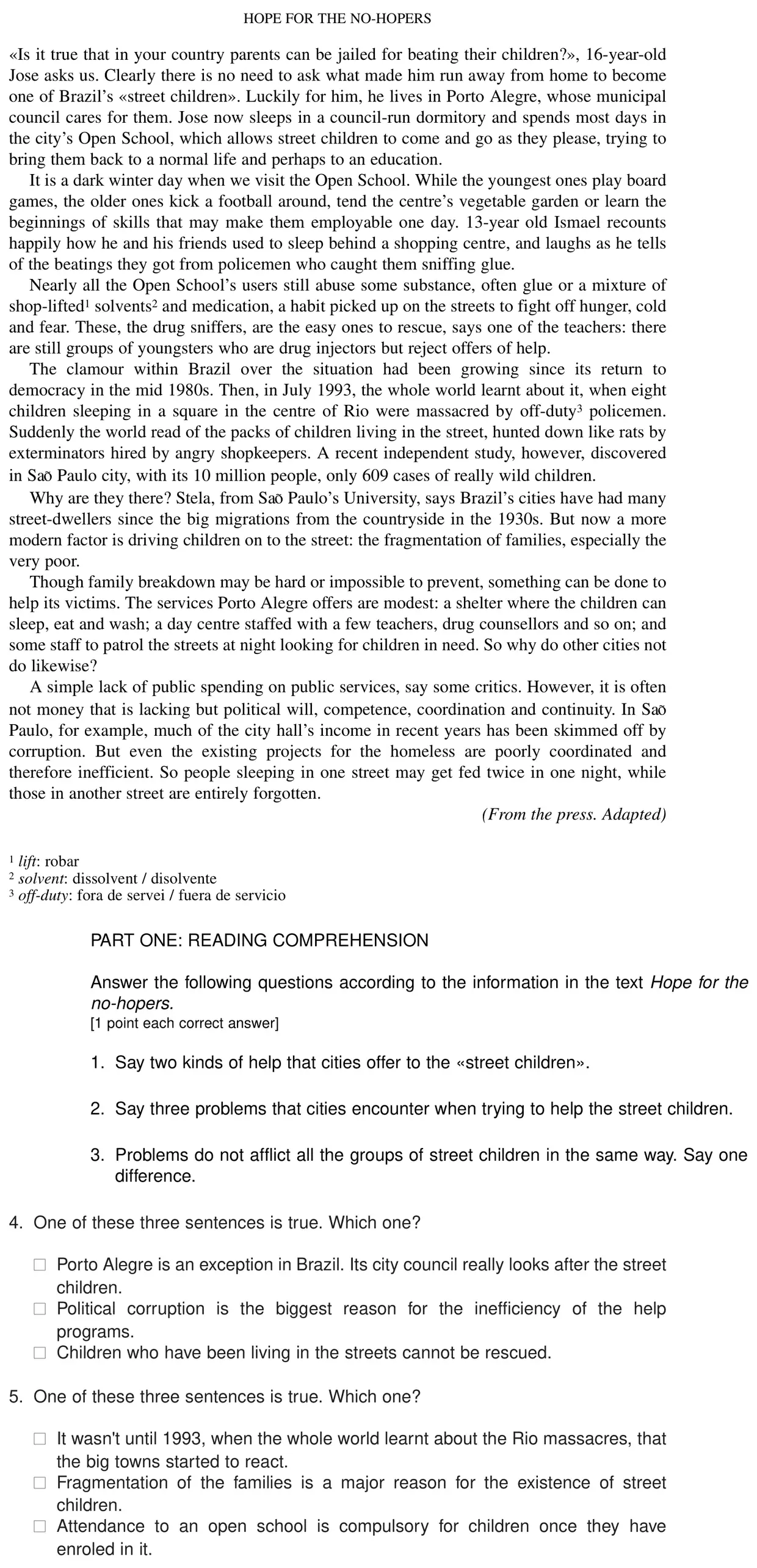
HOPE FOR THE NO-HOPERS
«Is it true that in your country parents can be jailed for beating their children?», 16-year-old
Jose asks us. Clearly there is no need to ask what made him run away from home to become
one of Brazil’s «street children». Luckily for him, he lives in Porto Alegre, whose municipal
council cares for them. Jose now sleeps in a council-run dormitory and spends most days in
the city’s Open School, which allows street children to come and go as they please, trying to
bring them back to a normal life and perhaps to an education.
It is a dark winter day when we visit the Open School. While the youngest ones play board
games, the older ones kick a football around, tend the centre’s vegetable garden or learn the
beginnings of skills that may make them employable one day. 13-year old Ismael recounts
happily how he and his friends used to sleep behind a shopping centre, and laughs as he tells
of the beatings they got from policemen who caught them sniffing glue.
Nearly all the Open School’s users still abuse some substance, often glue or a mixture of
shop-lifted1 solvents2 and medication, a habit picked up on the streets to fight off hunger, cold
and fear. These, the drug sniffers, are the easy ones to rescue, says one of the teachers: there
are still groups of youngsters who are drug injectors but reject offers of help.
The clamour within Brazil over the situation had been growing since its return to
democracy in the mid 1980s. Then, in July 1993, the whole world learnt about it, when eight
children sleeping in a square in the centre of Rio were massacred by off-duty3 policemen.
Suddenly the world read of the packs of children living in the street, hunted down like rats by
exterminators hired by angry shopkeepers. A recent independent study, however, discovered
in Sa~o Paulo city, with its 10 million people, only 609 cases of really wild children.
Why are they there? Stela, from Sa~o Paulo’s University, says Brazil’s cities have had many
street-dwellers since the big migrations from the countryside in the 1930s. But now a more
modern factor is driving children on to the street: the fragmentation of families, especially the
very poor.
Though family breakdown may be hard or impossible to prevent, something can be done to
help its victims. The services Porto Alegre offers are modest: a shelter where the children can
sleep, eat and wash; a day centre staffed with a few teachers, drug counsellors and so on; and
some staff to patrol the streets at night looking for children in need. So why do other cities not
do likewise?
A simple lack of public spending on public services, say some critics. However, it is often
not money that is lacking but political will, competence, coordination and continuity. In Sa~o
Paulo, for example, much of the city hall’s income in recent years has been skimmed off by
corruption. But even the existing projects for the homeless are poorly coordinated and
therefore inefficient. So people sleeping in one street may get fed twice in one night, while
those in another street are entirely forgotten.
(From the press. Adapted)
1 lift: robar
2 solvent: dissolvent / disolvente
3 off-duty: fora de servei / fuera de servicio
PART ONE: READING COMPREHENSION
Answer the following questions according to the information in the text Hope for the
no-hopers.
[1 point each correct answer]
1. Say two kinds of help that cities offer to the «street children».
2. Say three problems that cities encounter when trying to help the street children.
3. Problems do not afflict all the groups of street children in the same way. Say one
difference.
4. One of these three sentences is true. Which one?
■ Porto Alegre is an exception in Brazil. Its city council really looks after the street
children.
■ Political corruption is the biggest reason for the inefficiency of the help
programs.
■ Children who have been living in the streets cannot be rescued.
5. One of these three sentences is true. Which one?
■ It wasn't until 1993, whe
Criteris oficials de correcció
Text dels criteris (transcripció automàtica)
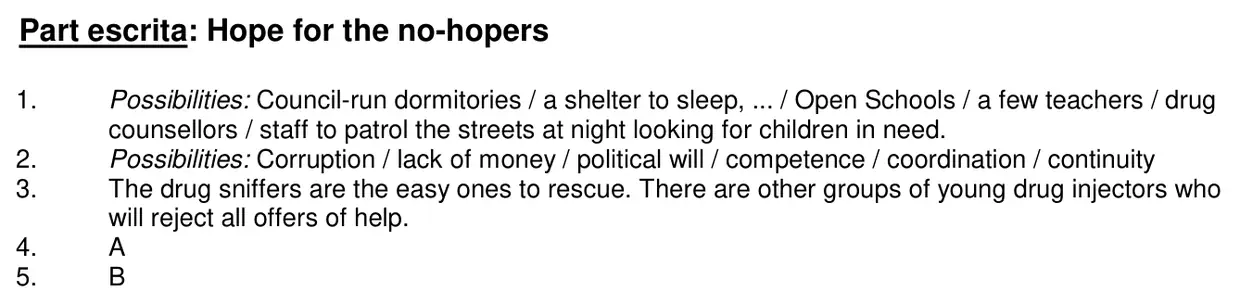
1. Possibilities: Council-run dormitories / a shelter to sleep, ... / Open Schools / a few teachers / drug
counsellors / staff to patrol the streets at night looking for children in need.
2. Possibilities: Corruption / lack of money / political will / competence / coordination / continuity
3. The drug sniffers are the easy ones to rescue. There are other groups of young drug injectors who
will reject all offers of help.
4. A
5. B
Part oral: The Power of a Hobbit
Introduction
In this radio programme you are going to hear the following words. Read and listen to them. Make sure you
know what they mean.
Shire comtat condado
Quest expedició de cavallers a la recerca de quelcom màgic empresa caballeresca en
búsqueda de algo mágico
Middle Earth Terra Mitja Tierra Media
Rooted arrelat enraizado/a
Dwarf nan enano
Ready?
Now read the questions on the next page.
Read them carefully before listening to the radio programme.
Presenter: It’s December 2001. The first film of the trilogy of The Lord of […]
Resolució pas a pas
Encara no hi ha resolució pròpia verificada d'aquest exercici. Mentrestant, tens els criteris oficials de correcció a sobre. Si tens dubtes, pregunta'ls al xat de la Sala d'estudi.
Font: enunciat i criteris de correcció oficials de les PAU 2002 de Catalunya, publicats per la Generalitat de Catalunya (universitats.gencat.cat) i les universitats catalanes. La resolució pas a pas és pròpia de L'Acadèmia de Vic.
Altres exercicis d'aquest examen
- Part 2 · Writing Writing
- Part 3 · Listening comprehension Listening comprehension