
PAU Anglès 2001 · Setembre · Sèrie 4 · Part 1 · Reading comprehension
Enunciat
Text de l'enunciat (transcripció automàtica)
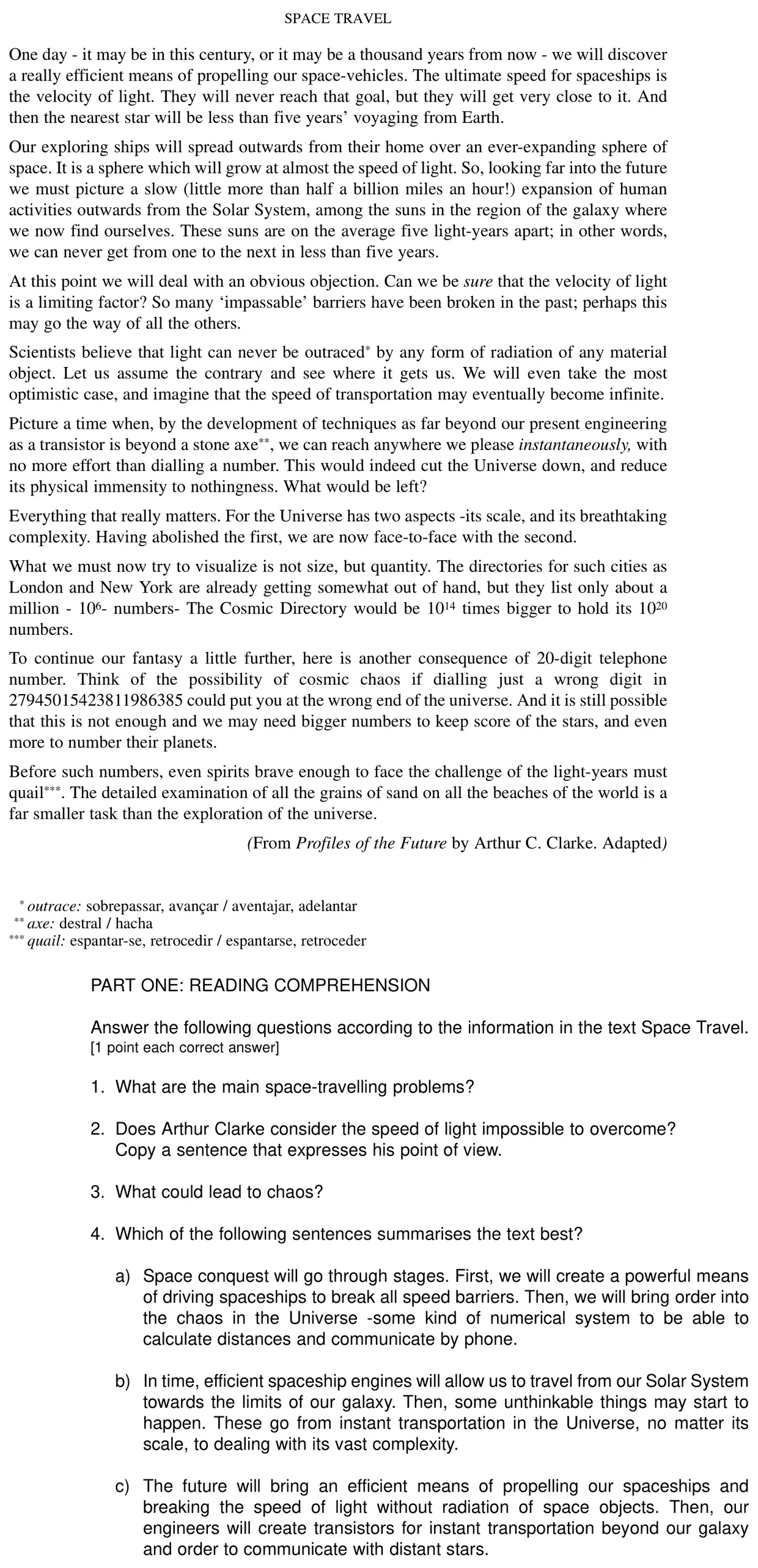
SPACE TRAVEL
One day - it may be in this century, or it may be a thousand years from now - we will discover
a really efficient means of propelling our space-vehicles. The ultimate speed for spaceships is
the velocity of light. They will never reach that goal, but they will get very close to it. And
then the nearest star will be less than five years’ voyaging from Earth.
Our exploring ships will spread outwards from their home over an ever-expanding sphere of
space. It is a sphere which will grow at almost the speed of light. So, looking far into the future
we must picture a slow (little more than half a billion miles an hour!) expansion of human
activities outwards from the Solar System, among the suns in the region of the galaxy where
we now find ourselves. These suns are on the average five light-years apart; in other words,
we can never get from one to the next in less than five years.
At this point we will deal with an obvious objection. Can we be sure that the velocity of light
is a limiting factor? So many ‘impassable’ barriers have been broken in the past; perhaps this
may go the way of all the others.
Scientists believe that light can never be outraced* by any form of radiation of any material
object. Let us assume the contrary and see where it gets us. We will even take the most
optimistic case, and imagine that the speed of transportation may eventually become infinite.
Picture a time when, by the development of techniques as far beyond our present engineering
as a transistor is beyond a stone axe**, we can reach anywhere we please instantaneously, with
no more effort than dialling a number. This would indeed cut the Universe down, and reduce
its physical immensity to nothingness. What would be left?
Everything that really matters. For the Universe has two aspects -its scale, and its breathtaking
complexity. Having abolished the first, we are now face-to-face with the second.
What we must now try to visualize is not size, but quantity. The directories for such cities as
London and New York are already getting somewhat out of hand, but they list only about a
million - 106- numbers- The Cosmic Directory would be 1014 times bigger to hold its 1020
numbers.
To continue our fantasy a little further, here is another consequence of 20-digit telephone
number. Think of the possibility of cosmic chaos if dialling just a wrong digit in
27945015423811986385 could put you at the wrong end of the universe. And it is still possible
that this is not enough and we may need bigger numbers to keep score of the stars, and even
more to number their planets.
Before such numbers, even spirits brave enough to face the challenge of the light-years must
quail***. The detailed examination of all the grains of sand on all the beaches of the world is a
far smaller task than the exploration of the universe.
(From Profiles of the Future by Arthur C. Clarke. Adapted)
*** outrace: sobrepassar, avançar / aventajar, adelantar
*** axe: destral / hacha
*** quail: espantar-se, retrocedir / espantarse, retroceder
PART ONE: READING COMPREHENSION
Answer the following questions according to the information in the text Space Travel.
[1 point each correct answer]
1. What are the main space-travelling problems?
2. Does Arthur Clarke consider the speed of light impossible to overcome?
Copy a sentence that expresses his point of view.
3. What could lead to chaos?
4. Which of the following sentences summarises the text best?
a) Space conquest will go through stages. First, we will create a powerful means
of driving spaceships to break all speed barriers. Then, we will bring order into
the chaos in the Universe -some kind of numerical system to be able to
calculate distances and communicate by phone.
b) In time, efficient spaceship engines will allow us to travel from our Solar System
towards the limits of our galaxy. Then, some unthinkable things may start to
happen. These go from instant transportation in the Universe, no matter its
scale, to dealing with its vas
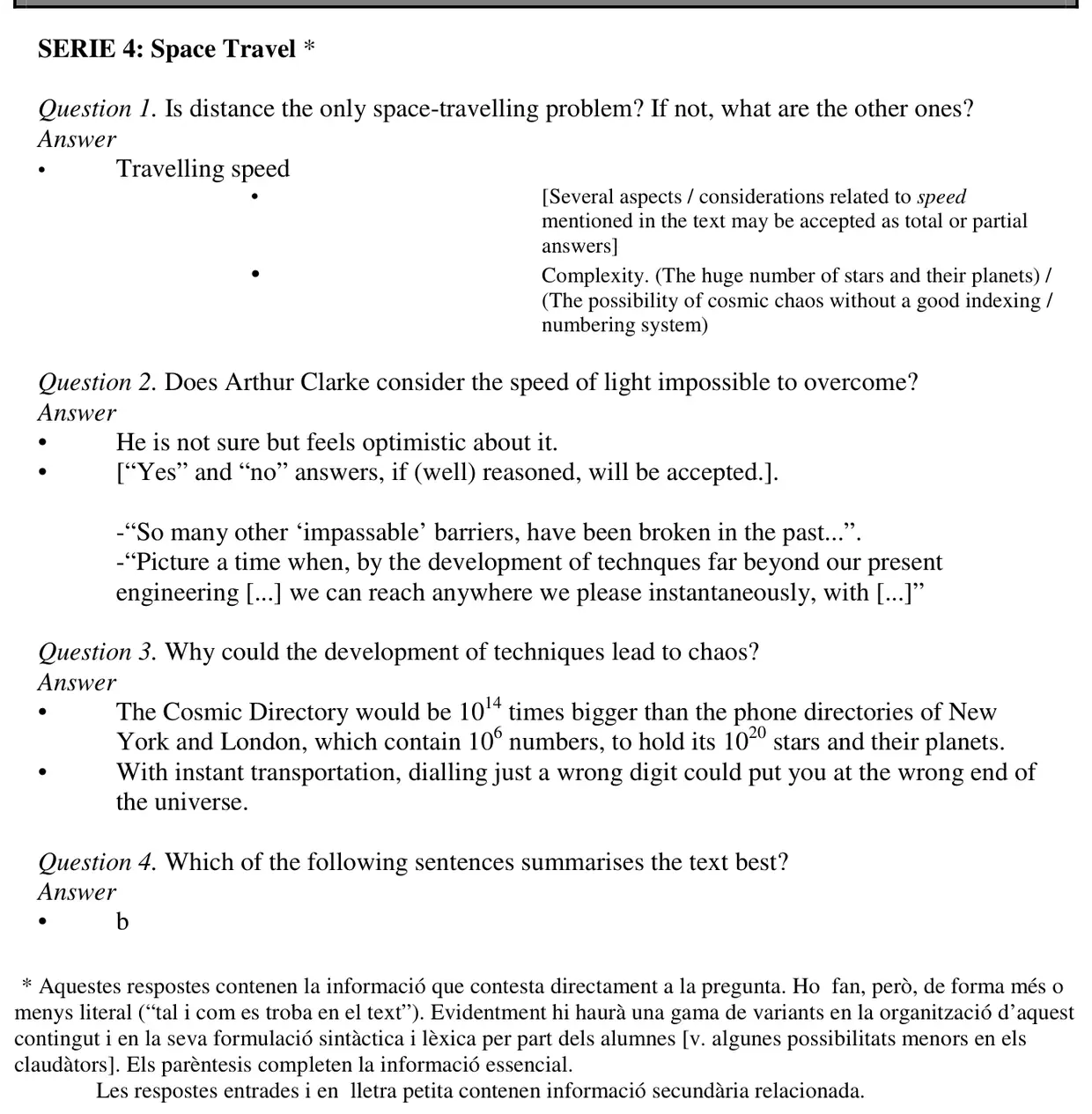
Criteris oficials de correcció
Resolució pas a pas
Encara no hi ha resolució pròpia verificada d'aquest exercici. Mentrestant, tens els criteris oficials de correcció a sobre. Si tens dubtes, pregunta'ls al xat de la Sala d'estudi.
Font: enunciat i criteris de correcció oficials de les PAU 2001 de Catalunya, publicats per la Generalitat de Catalunya (universitats.gencat.cat) i les universitats catalanes. La resolució pas a pas és pròpia de L'Acadèmia de Vic.
Altres exercicis d'aquest examen
- Part 2 · Writing Writing