
PAU Anglès 2002 · Juny · Sèrie 3 · Part 3 · Listening comprehension
Enunciat
Text de l'enunciat (transcripció automàtica)
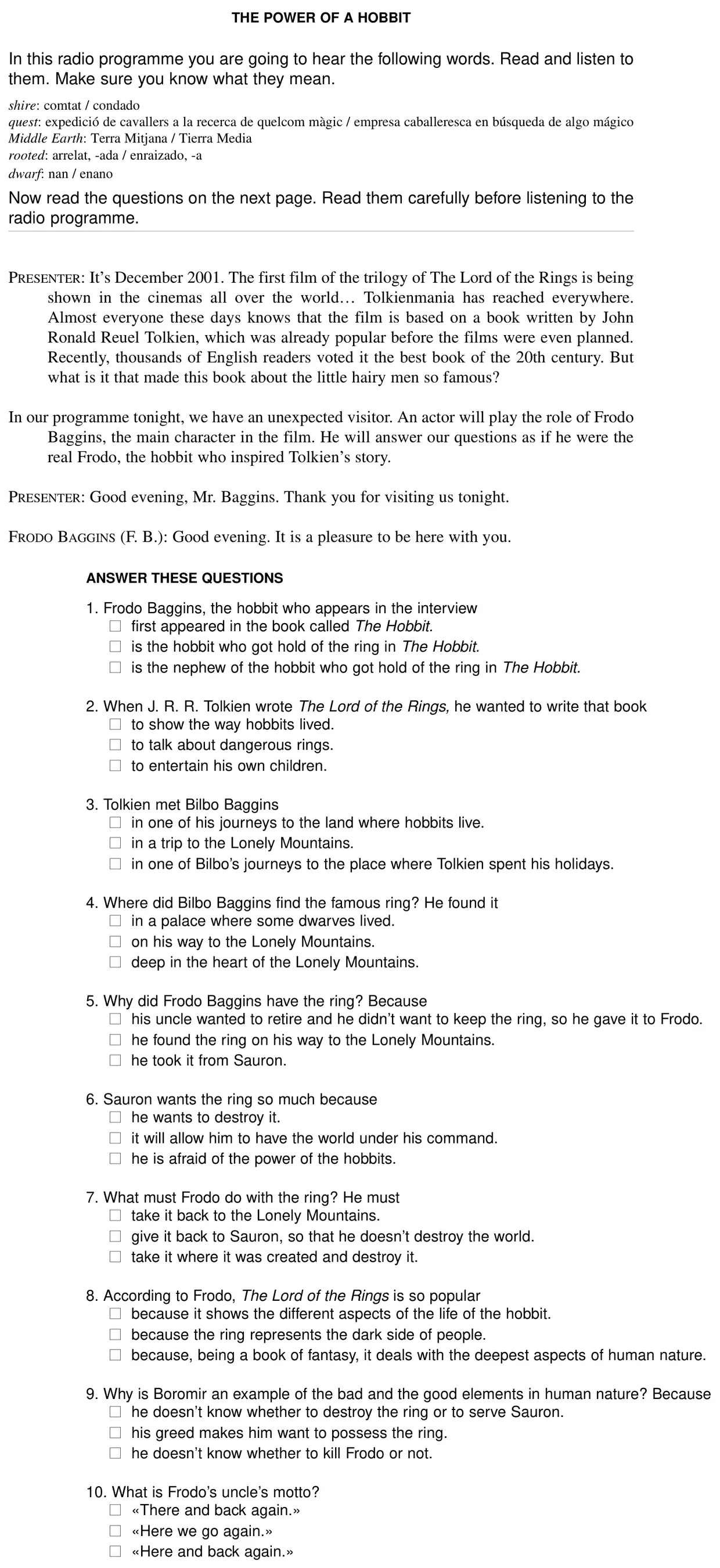
THE POWER OF A HOBBIT
In this radio programme you are going to hear the following words. Read and listen to
them. Make sure you know what they mean.
shire: comtat / condado
quest: expedició de cavallers a la recerca de quelcom màgic / empresa caballeresca en búsqueda de algo mágico
Middle Earth: Terra Mitjana / Tierra Media
rooted: arrelat, -ada / enraizado, -a
dwarf: nan / enano
Now read the questions on the next page. Read them carefully before listening to the
radio programme.
PRESENTER: It’s December 2001. The first film of the trilogy of The Lord of the Rings is being
shown in the cinemas all over the world… Tolkienmania has reached everywhere.
Almost everyone these days knows that the film is based on a book written by John
Ronald Reuel Tolkien, which was already popular before the films were even planned.
Recently, thousands of English readers voted it the best book of the 20th century. But
what is it that made this book about the little hairy men so famous?
In our programme tonight, we have an unexpected visitor. An actor will play the role of Frodo
Baggins, the main character in the film. He will answer our questions as if he were the
real Frodo, the hobbit who inspired Tolkien’s story.
PRESENTER: Good evening, Mr. Baggins. Thank you for visiting us tonight.
FRODO BAGGINS (F. B.): Good evening. It is a pleasure to be here with you.
ANSWER THESE QUESTIONS
1. Frodo Baggins, the hobbit who appears in the interview
I first appeared in the book called The Hobbit.
I is the hobbit who got hold of the ring in The Hobbit.
I is the nephew of the hobbit who got hold of the ring in The Hobbit.
2. When J. R. R. Tolkien wrote The Lord of the Rings, he wanted to write that book
I to show the way hobbits lived.
I to talk about dangerous rings.
I to entertain his own children.
3. Tolkien met Bilbo Baggins
I in one of his journeys to the land where hobbits live.
I in a trip to the Lonely Mountains.
I in one of Bilbo’s journeys to the place where Tolkien spent his holidays.
4. Where did Bilbo Baggins find the famous ring? He found it
I in a palace where some dwarves lived.
I on his way to the Lonely Mountains.
I deep in the heart of the Lonely Mountains.
5. Why did Frodo Baggins have the ring? Because
I his uncle wanted to retire and he didn’t want to keep the ring, so he gave it to Frodo.
I he found the ring on his way to the Lonely Mountains.
I he took it from Sauron.
6. Sauron wants the ring so much because
I he wants to destroy it.
I it will allow him to have the world under his command.
I he is afraid of the power of the hobbits.
7. What must Frodo do with the ring? He must
I take it back to the Lonely Mountains.
I give it back to Sauron, so that he doesn’t destroy the world.
I take it where it was created and destroy it.
8. According to Frodo, The Lord of the Rings is so popular
I because it shows the different aspects of the life of the hobbit.
I because the ring represents the dark side of people.
I because, being a book of fantasy, it deals with the deepest aspects of human nature.
9. Why is Boromir an example of the bad and the good elements in human nature? Because
I he doesn’t know whether to destroy the ring or to serve Sauron.
I his greed makes him want to possess the ring.
I he doesn’t know whether to kill Frodo or not.
10. What is Frodo’s uncle’s motto?
I «There and back again.»
I «Here we go again.»
I «Here and back again.»
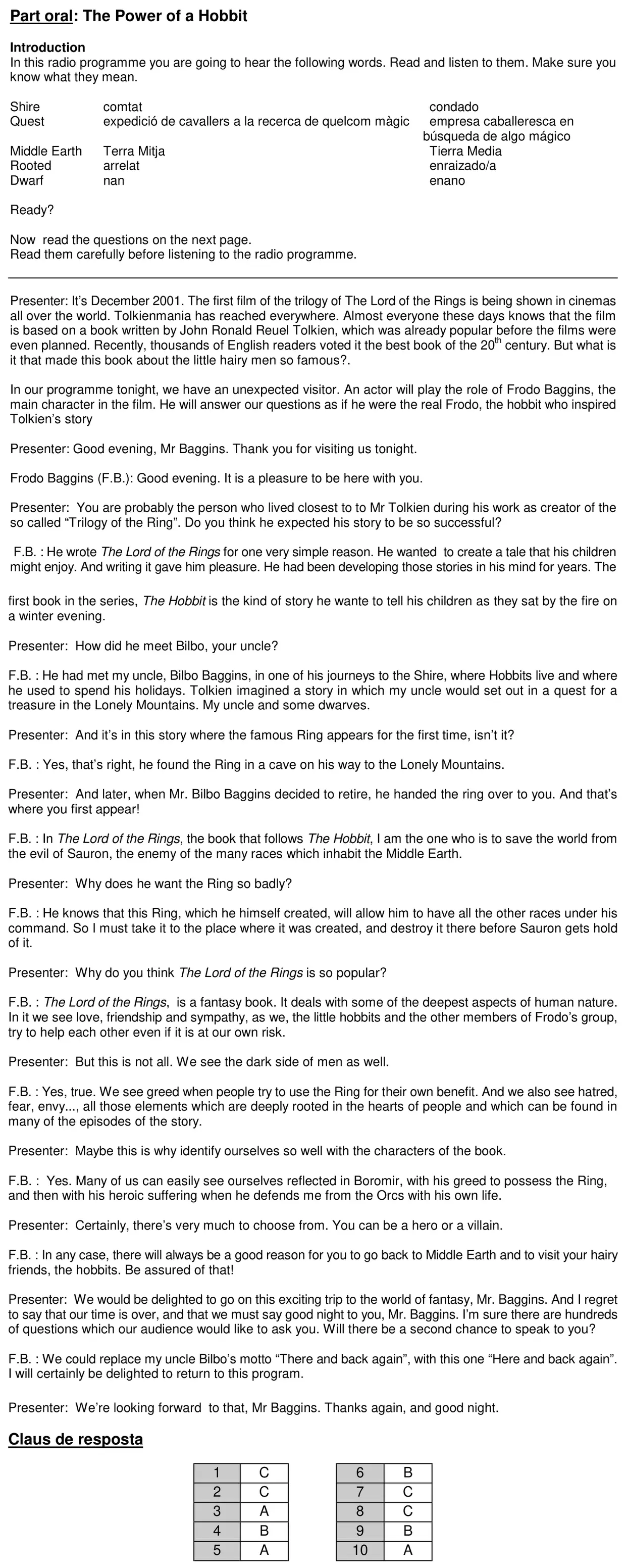
Criteris oficials de correcció
Resolució pas a pas
Aquest exercici no té una resolució escrita pas a pas (requereix l'àudio de la prova). Fes servir els criteris oficials de correcció.
Font: enunciat i criteris de correcció oficials de les PAU 2002 de Catalunya, publicats per la Generalitat de Catalunya (universitats.gencat.cat) i les universitats catalanes. La resolució pas a pas és pròpia de L'Acadèmia de Vic.
Altres exercicis d'aquest examen
- Part 1 · Reading comprehension Reading comprehension
- Part 2 · Writing Writing
Tots els exercicis de Listening comprehension · PAU de Anglès