
PAU Anglès 2025 · Setembre · Sèrie 3 · Part 1 · Listening comprehension
Enunciat
Text de l'enunciat (transcripció automàtica)
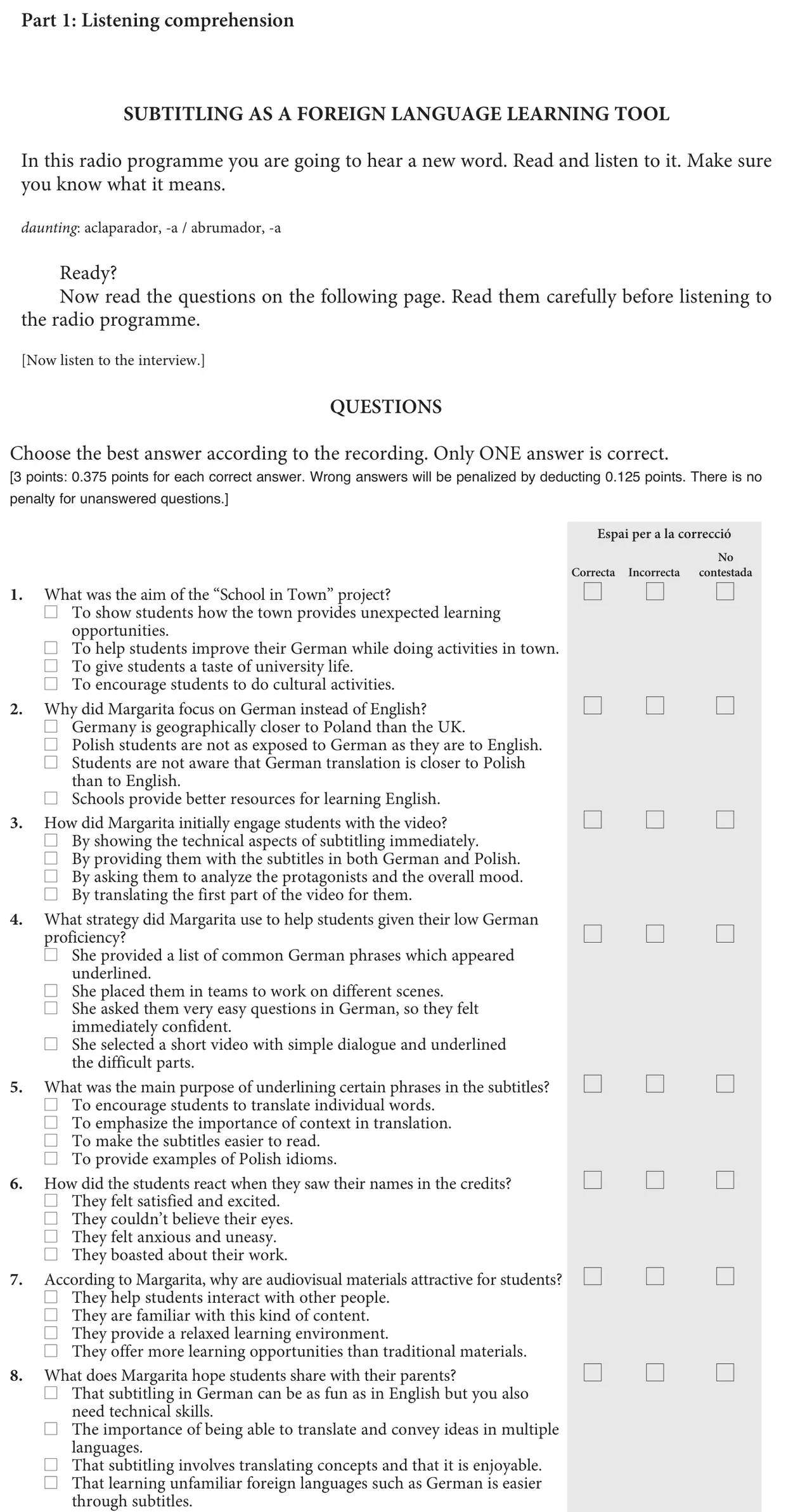
Part 1: Listening comprehension
SUBTITLING AS A FOREIGN LANGUAGE LEARNING TOOL
In this radio programme you are going to hear a new word. Read and listen to it. Make sure
you know what it means.
daunting: aclaparador, -a / abrumador, -a
Ready?
Now read the questions on the following page. Read them carefully before listening to
the radio programme.
[Now listen to the interview.]
QUESTIONS
Choose the best answer according to the recording. Only ONE answer is correct.
[3 points: 0.375 points for each correct answer. Wrong answers will be penalized by deducting 0.125 points. There is no
penalty for unanswered questions.]
1. What was the aim of the “School in Town” project?
■ To show students how the town provides unexpected learning
opportunities.
■ To help students improve their German while doing activities in town.
■ To give students a taste of university life.
■ To encourage students to do cultural activities.
2. Why did Margarita focus on German instead of English?
■ Germany is geographically closer to Poland than the UK.
■ Polish students are not as exposed to German as they are to English.
■ Students are not aware that German translation is closer to Polish
than to English.
■ Schools provide better resources for learning English.
3. How did Margarita initially engage students with the video?
■ By showing the technical aspects of subtitling immediately.
■ By providing them with the subtitles in both German and Polish.
■ By asking them to analyze the protagonists and the overall mood.
■ By translating the first part of the video for them.
4. What strategy did Margarita use to help students given their low German
proficiency?
■ She provided a list of common German phrases which appeared
underlined.
■ She placed them in teams to work on different scenes.
■ She asked them very easy questions in German, so they felt
immediately confident.
■ She selected a short video with simple dialogue and underlined
the difficult parts.
5. What was the main purpose of underlining certain phrases in the subtitles?
■ To encourage students to translate individual words.
■ To emphasize the importance of context in translation.
■ To make the subtitles easier to read.
■ To provide examples of Polish idioms.
6. How did the students react when they saw their names in the credits?
■ They felt satisfied and excited.
■ They couldn’t believe their eyes.
■ They felt anxious and uneasy.
■ They boasted about their work.
7. According to Margarita, why are audiovisual materials attractive for students?
■ They help students interact with other people.
■ They are familiar with this kind of content.
■ They provide a relaxed learning environment.
■ They offer more learning opportunities than traditional materials.
8. What does Margarita hope students share with their parents?
■ That subtitling in German can be as fun as in English but you also
need technical skills.
■ The importance of being able to translate and convey ideas in multiple
languages.
■ That subtitling involves translating concepts and that it is enjoyable.
■ That learning unfamiliar foreign languages such as German is easier
through subtitles.
Criteris oficials de correcció
Text dels criteris (transcripció automàtica)
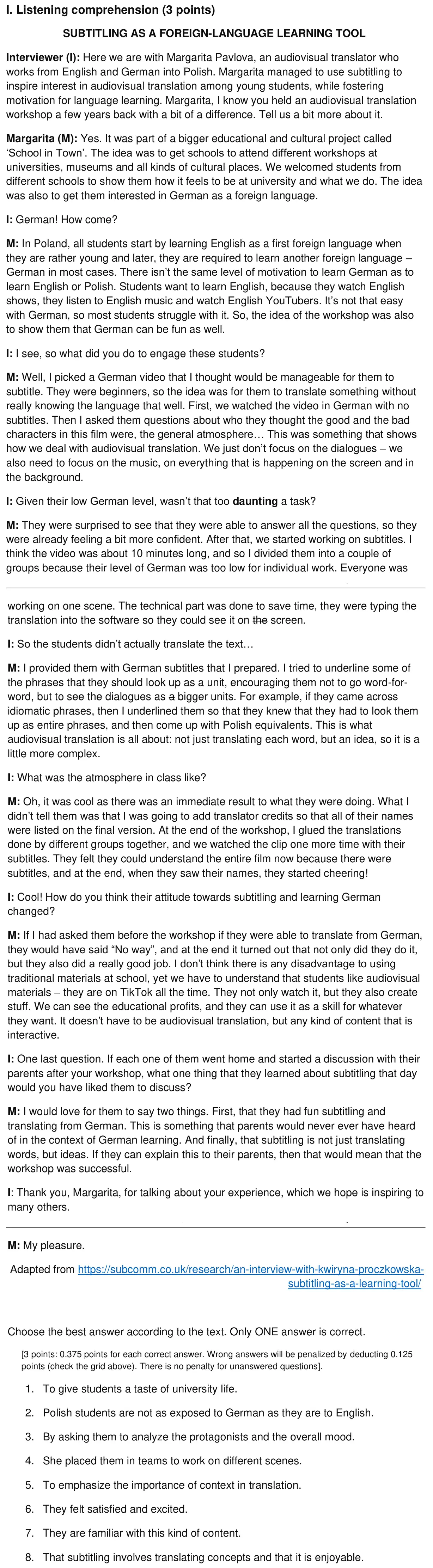
I. Listening comprehension (3 points)
SUBTITLING AS A FOREIGN-LANGUAGE LEARNING TOOL
Interviewer (I): Here we are with Margarita Pavlova, an audiovisual translator who
works from English and German into Polish. Margarita managed to use subtitling to
inspire interest in audiovisual translation among young students, while fostering
motivation for language learning. Margarita, I know you held an audiovisual translation
workshop a few years back with a bit of a difference. Tell us a bit more about it.
Margarita (M): Yes. It was part of a bigger educational and cultural project called
‘School in Town’. The idea was to get schools to attend different workshops at
universities, museums and all kinds of cultural places. We welcomed students from
different schools to show them how it feels to be at university and what we do. The idea
was also to get them interested in German as a foreign language.
I: German! How come?
M: In Poland, all students start by learning English as a first foreign langu […]
Resolució pas a pas
Aquest exercici no té una resolució escrita pas a pas (requereix l'àudio de la prova). Fes servir els criteris oficials de correcció.
Font: enunciat i criteris de correcció oficials de les PAU 2025 de Catalunya, publicats per la Generalitat de Catalunya (universitats.gencat.cat) i les universitats catalanes. La resolució pas a pas és pròpia de L'Acadèmia de Vic.
Altres exercicis d'aquest examen
- Part 2 · Reading comprehension Reading comprehension
- Part 3 · Writing Writing
Tots els exercicis de Listening comprehension · PAU de Anglès