
PAU Anglès 2026 · Juny · Sèrie 5 (incidències) · Part 1 · Listening comprehension
Enunciat
Text de l'enunciat (transcripció automàtica)
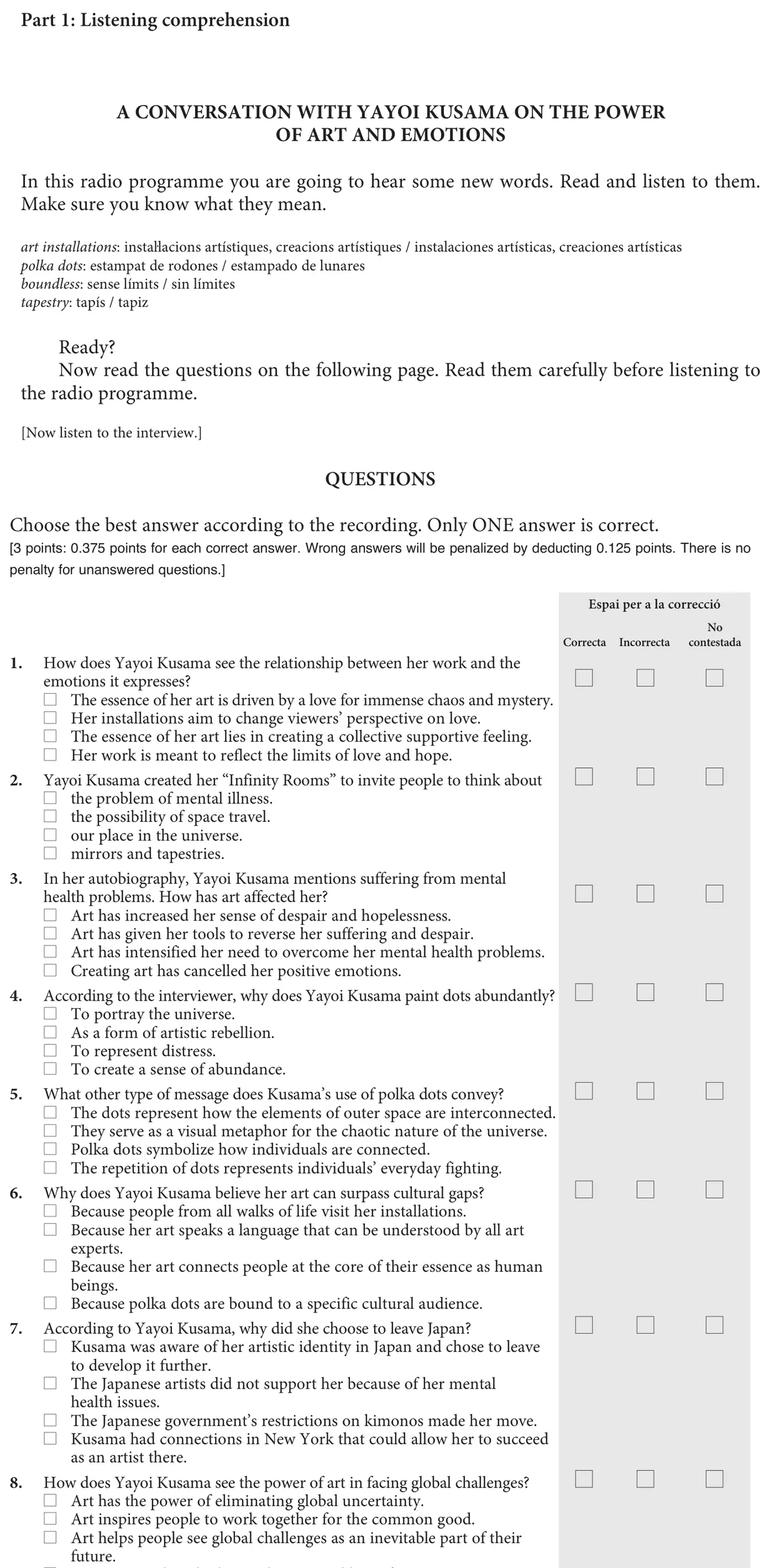
Part 1: Listening comprehension
A CONVERSATION WITH YAYOI KUSAMA ON THE POWER
OF ART AND EMOTIONS
In this radio programme you are going to hear some new words. Read and listen to them.
Make sure you know what they mean.
art installations: instaŀlacions artístiques, creacions artístiques / instalaciones artísticas, creaciones artísticas
polka dots: estampat de rodones / estampado de lunares
boundless: sense límits / sin límites
tapestry: tapís / tapiz
Ready?
Now read the questions on the following page. Read them carefully before listening to
the radio programme.
[Now listen to the interview.]
QUESTIONS
Choose the best answer according to the recording. Only ONE answer is correct.
[3 points: 0.375 points for each correct answer. Wrong answers will be penalized by deducting 0.125 points. There is no
penalty for unanswered questions.]
1. How does Yayoi Kusama see the relationship between her work and the
emotions it expresses?
■ The essence of her art is driven by a love for immense chaos and mystery.
■ Her installations aim to change viewers’ perspective on love.
■ The essence of her art lies in creating a collective supportive feeling.
■ Her work is meant to reflect the limits of love and hope.
2. Yayoi Kusama created her “Infinity Rooms” to invite people to think about
■ the problem of mental illness.
■ the possibility of space travel.
■ our place in the universe.
■ mirrors and tapestries.
3. In her autobiography, Yayoi Kusama mentions suffering from mental
health problems. How has art affected her?
■ Art has increased her sense of despair and hopelessness.
■ Art has given her tools to reverse her suffering and despair.
■ Art has intensified her need to overcome her mental health problems.
■ Creating art has cancelled her positive emotions.
4. According to the interviewer, why does Yayoi Kusama paint dots abundantly?
■ To portray the universe.
■ As a form of artistic rebellion.
■ To represent distress.
■ To create a sense of abundance.
5. What other type of message does Kusama’s use of polka dots convey?
■ The dots represent how the elements of outer space are interconnected .
■ They serve as a visual metaphor for the chaotic nature of the universe.
■ Polka dots symbolize how individuals are connected.
■ The repetition of dots represents individuals’ everyday fighting.
6. Why does Yayoi Kusama believe her art can surpass cultural gaps?
■ Because people from all walks of life visit her installations.
■ Because her art speaks a language that can be understood by all art
experts.
■ Because her art connects people at the core of their essence as human
beings.
■ Because polka dots are bound to a specific cultural audience.
7. According to Yayoi Kusama, why did she choose to leave Japan?
■ Kusama was aware of her artistic identity in Japan and chose to leave
to develop it further.
■ The Japanese artists did not support her because of her mental
health issues.
■ The Japanese government’s restrictions on kimonos made her move.
■ Kusama had connections in New York that could allow her to succeed
as an artist there.
8. How does Yayoi Kusama see the power of art in facing global challenges?
■ Art has the power of eliminating global uncertainty.
■ Art inspires people to work together for the common good.
■ Art helps people see global challenges as an inevitable part of their
future.
■ Art gets people to look into the past and learn from it.
Criteris oficials de correcció
Text dels criteris (transcripció automàtica)
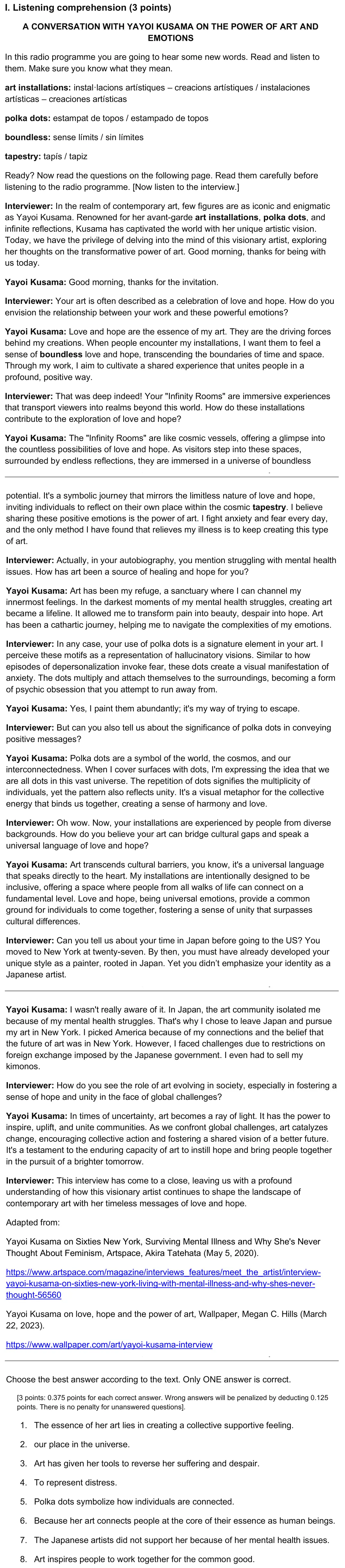
I. Listening comprehension (3 points)
A CONVERSATION WITH YAYOI KUSAMA ON THE POWER OF ART AND
EMOTIONS
In this radio programme you are going to hear some new words. Read and listen to
them. Make sure you know what they mean.
art installations: instal·lacions artístiques – creacions artístiques / instalaciones
artísticas – creaciones artísticas
polka dots: estampat de topos / estampado de topos
boundless: sense límits / sin límites
tapestry: tapís / tapiz
Ready? Now read the questions on the following page. Read them carefully before
listening to the radio programme. [Now listen to the interview.]
Interviewer: In the realm of contemporary art, few figures are as iconic and enigmatic
as Yayoi Kusama. Renowned for her avant-garde art installations, polka dots, and
infinite reflections, Kusama has captivated the world with her unique artistic vision.
Today, we have the privilege of delving into the mind of this visionary artist, exploring
her thoughts on the transformative power of art. G […]
Resolució pas a pas
Aquest exercici no té una resolució escrita pas a pas (requereix l'àudio de la prova). Fes servir els criteris oficials de correcció.
Font: enunciat i criteris de correcció oficials de les PAU 2026 de Catalunya, publicats per la Generalitat de Catalunya (universitats.gencat.cat) i les universitats catalanes. La resolució pas a pas és pròpia de L'Acadèmia de Vic.
Altres exercicis d'aquest examen
- Part 2 · Reading comprehension Reading comprehension
- Part 3 · Writing Writing
Tots els exercicis de Listening comprehension · PAU de Anglès