
PAU Anglès 2025 · Juny · Sèrie 1 · Part 1 · Listening comprehension
Enunciat
Text de l'enunciat (transcripció automàtica)
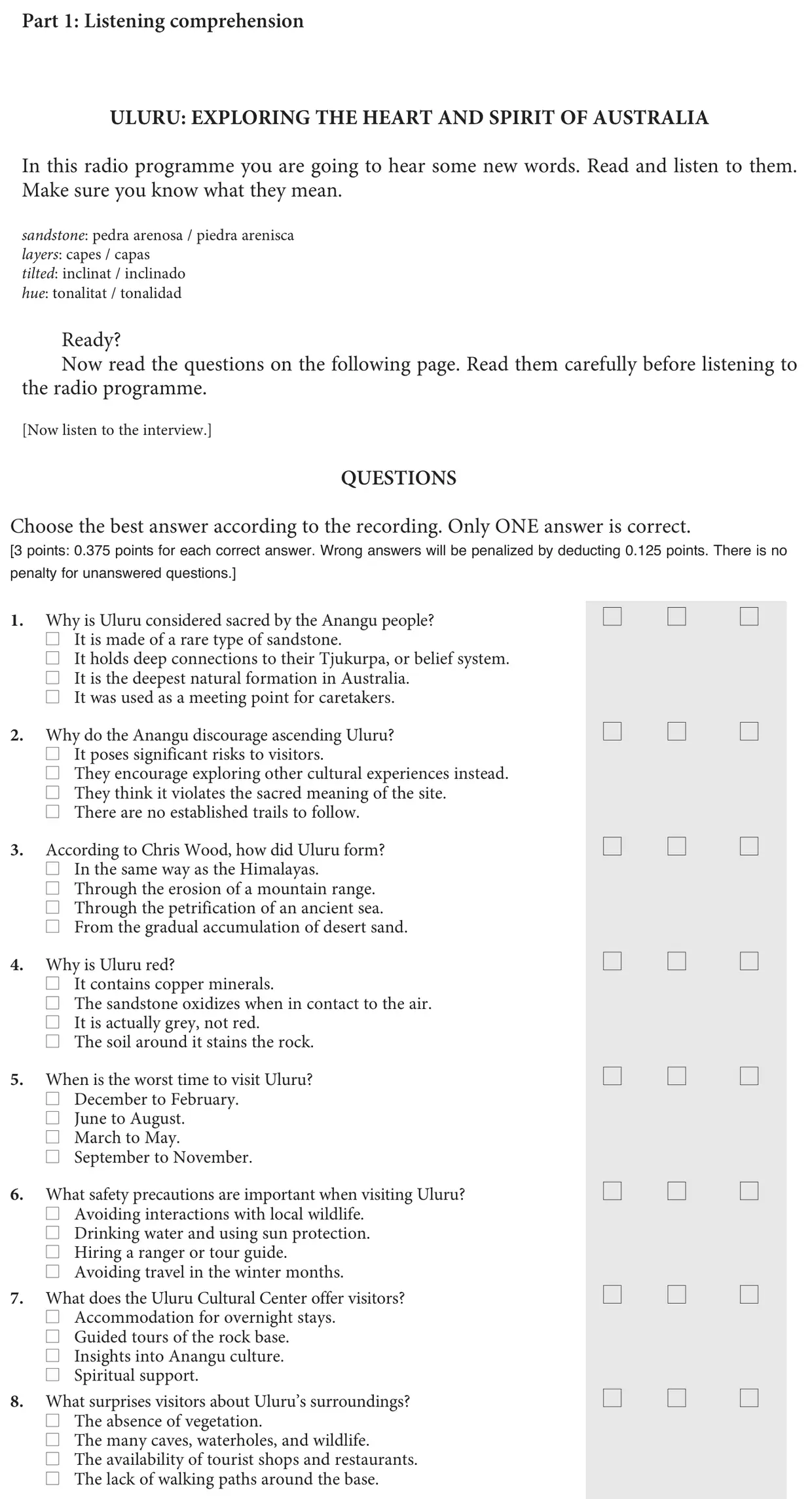
Part 1: Listening comprehension
ULURU: EXPLORING THE HEART AND SPIRIT OF AUSTRALIA
In this radio programme you are going to hear some new words. Read and listen to them.
Make sure you know what they mean.
sandstone: pedra arenosa / piedra arenisca
layers: capes / capas
tilted: inclinat / inclinado
hue: tonalitat / tonalidad
Ready?
Now read the questions on the following page. Read them carefully before listening to
the radio programme.
[Now listen to the interview.]
QUESTIONS
Choose the best answer according to the recording. Only ONE answer is correct.
[3 points: 0.375 points for each correct answer. Wrong answers will be penalized by deducting 0.125 points. There is no
penalty for unanswered questions.]
1. Why is Uluru considered sacred by the Anangu people?
■ It is made of a rare type of sandstone.
■ It holds deep connections to their Tjukurpa, or belief system.
■ It is the deepest natural formation in Australia.
■ It was used as a meeting point for caretakers.
2. Why do the Anangu discourage ascending Uluru?
■ It poses significant risks to visitors.
■ They encourage exploring other cultural experiences instead.
■ They think it violates the sacred meaning of the site.
■ There are no established trails to follow.
3. According to Chris Wood, how did Uluru form?
■ In the same way as the Himalayas.
■ Through the erosion of a mountain range.
■ Through the petrification of an ancient sea.
■ From the gradual accumulation of desert sand.
4. Why is Uluru red?
■ It contains copper minerals.
■ The sandstone oxidizes when in contact to the air.
■ It is actually grey, not red.
■ The soil around it stains the rock.
5. When is the worst time to visit Uluru?
■ December to February.
■ June to August.
■ March to May.
■ September to November.
6. What safety precautions are important when visiting Uluru?
■ Avoiding interactions with local wildlife.
■ Drinking water and using sun protection.
■ Hiring a ranger or tour guide.
■ Avoiding travel in the winter months.
7. What does the Uluru Cultural Center offer visitors?
■ Accommodation for overnight stays.
■ Guided tours of the rock base.
■ Insights into Anangu culture.
■ Spiritual support.
8. What surprises visitors about Uluru’s surroundings?
■ The absence of vegetation.
■ The many caves, waterholes, and wildlife.
■ The availability of tourist shops and restaurants.
■ The lack of walking paths around the base.
Criteris oficials de correcció
Text dels criteris (transcripció automàtica)
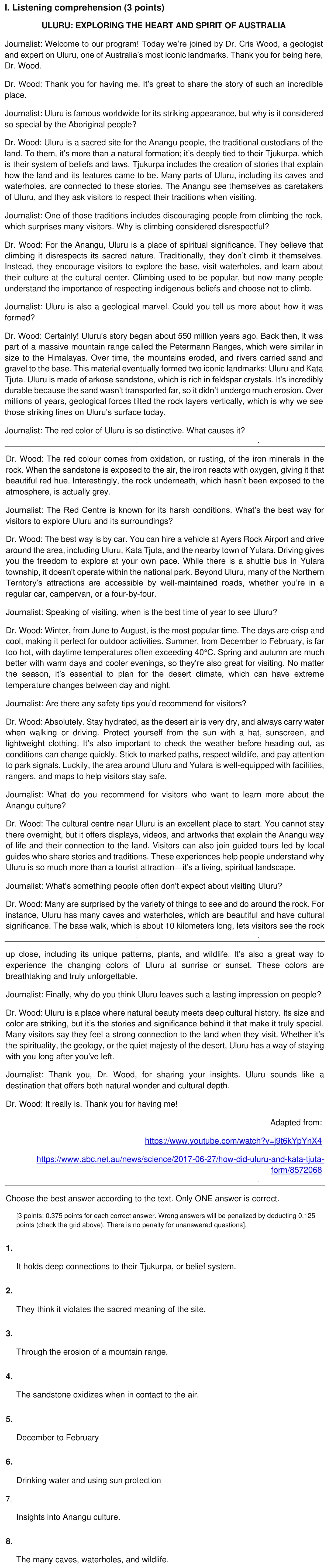
I. Listening comprehension (3 points)
ULURU: EXPLORING THE HEART AND SPIRIT OF AUSTRALIA
Journalist: Welcome to our program! Today we’re joined by Dr. Cris Wood, a geologist
and expert on Uluru, one of Australia’s most iconic landmarks. Thank you for being here,
Dr. Wood.
Dr. Wood: Thank you for having me. It’s great to share the story of such an incredible
place.
Journalist: Uluru is famous worldwide for its striking appearance, but why is it considered
so special by the Aboriginal people?
Dr. Wood: Uluru is a sacred site for the Anangu people, the traditional custodians of the
land. To them, it’s more than a natural formation; it’s deeply tied to their Tjukurpa, which
is their system of beliefs and laws. Tjukurpa includes the creation of stories that explain
how the land and its features came to be. Many parts of Uluru, including its caves and
waterholes, are connected to these stories. The Anangu see themselves as caretakers
of Uluru, and they ask visitors to respect their tradition […]
Resolució pas a pas
Aquest exercici no té una resolució escrita pas a pas (requereix l'àudio de la prova). Fes servir els criteris oficials de correcció.
Font: enunciat i criteris de correcció oficials de les PAU 2025 de Catalunya, publicats per la Generalitat de Catalunya (universitats.gencat.cat) i les universitats catalanes. La resolució pas a pas és pròpia de L'Acadèmia de Vic.
Altres exercicis d'aquest examen
- Part 2 · Reading comprehension Reading comprehension
- Part 3 · Writing Writing
Tots els exercicis de Listening comprehension · PAU de Anglès