
PAU Anglès 2019 · Juny · Sèrie 1 · Part 3 · Listening comprehension
Enunciat
Text de l'enunciat (transcripció automàtica)
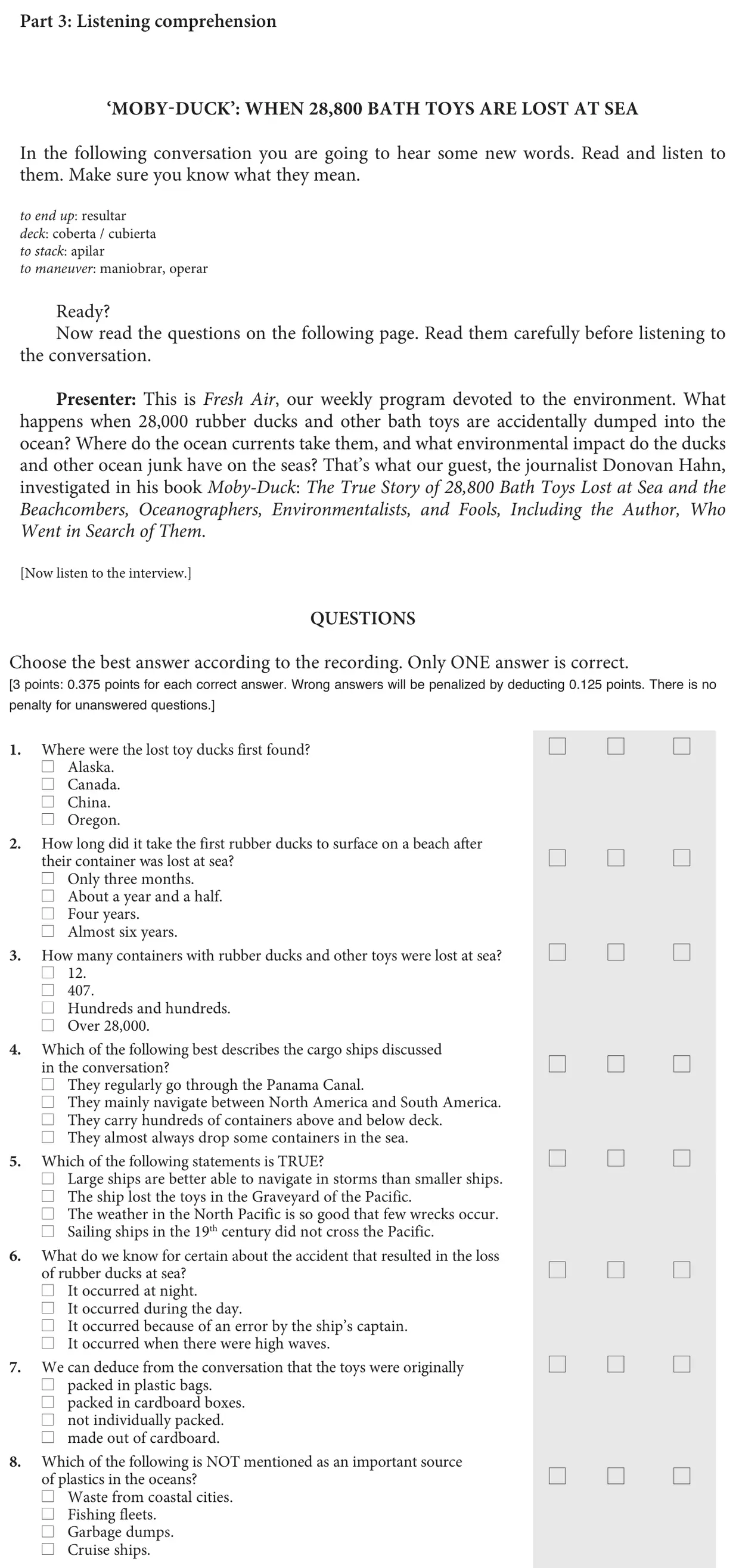
Part 3: Listening comprehension
‘MOBY-DUCK’: WHEN 28,800 BATH TOYS ARE LOST AT SEA
In the following conversation you are going to hear some new words. Read and listen to
them. Make sure you know what they mean.
to end up: resultar
deck: coberta / cubierta
to stack: apilar
to maneuver: maniobrar, operar
Ready?
Now read the questions on the following page. Read them carefully before listening to
the conversation.
Presenter: This is Fresh Air, our weekly program devoted to the environment. What
happens when 28,000 rubber ducks and other bath toys are accidentally dumped into the
ocean? Where do the ocean currents take them, and what environmental impact do the ducks
and other ocean junk have on the seas? That’s what our guest, the journalist Donovan Hahn,
investigated in his book Moby-Duck: The True Story of 28,800 Bath Toys Lost at Sea and the
Beachcombers, Oceanographers, Environmentalists, and Fools, Including the Author, Who
Went in Search of Them.
[Now listen to the interview.]
QUESTIONS
Choose the best answer according to the recording. Only ONE answer is correct.
[3 points: 0.375 points for each correct answer. Wrong answers will be penalized by deducting 0.125 points. There is no
penalty for unanswered questions.]
1. Where were the lost toy ducks first found?
Alaska.
Canada.
China.
Oregon.
2. How long did it take the first rubber ducks to surface on a beach after
their container was lost at sea?
Only three months.
About a year and a half.
Four years.
Almost six years.
3. How many containers with rubber ducks and other toys were lost at sea?
12.
407.
Hundreds and hundreds.
Over 28,000.
4. Which of the following best describes the cargo ships discussed
in the conversation?
They regularly go through the Panama Canal.
They mainly navigate between North America and South America.
They carry hundreds of containers above and below deck.
They almost always drop some containers in the sea.
5. Which of the following statements is TRUE?
Large ships are better able to navigate in storms than smaller ships.
The ship lost the toys in the Graveyard of the Pacific.
The weather in the North Pacific is so good that few wrecks occur.
Sailing ships in the 19th century did not cross the Pacific.
6. What do we know for certain about the accident that resulted in the loss
of rubber ducks at sea?
It occurred at night.
It occurred during the day.
It occurred because of an error by the ship’s captain.
It occurred when there were high waves.
7. We can deduce from the conversation that the toys were originally
packed in plastic bags.
packed in cardboard boxes.
not individually packed.
made out of cardboard.
8. Which of the following is NOT mentioned as an important source
of plastics in the oceans?
Waste from coastal cities.
Fishing fleets.
Garbage dumps.
Cruise ships.
Criteris oficials de correcció
Text dels criteris (transcripció automàtica)
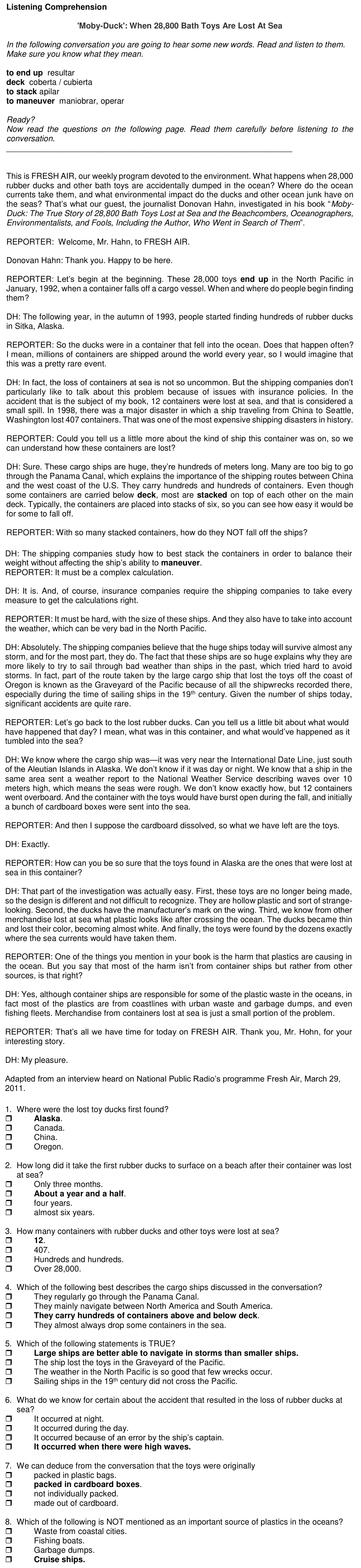
Listening Comprehension
'Moby-Duck': When 28,800 Bath Toys Are Lost At Sea
In the following conversation you are going to hear some new words. Read and listen to them.
Make sure you know what they mean.
to end up resultar
deck coberta / cubierta
to stack apilar
to maneuver maniobrar, operar
Ready?
Now read the questions on the following page. Read them carefully before listening to the
conversation.
_______________________________________________________________
This is FRESH AIR, our weekly program devoted to the environment. What happens when 28,000
rubber ducks and other bath toys are accidentally dumped in the ocean? Where do the ocean
currents take them, and what environmental impact do the ducks and other ocean junk have on
the seas? That’s what our guest, the journalist Donovan Hahn, investigated in his book “Moby-
Duck: The True Story of 28,800 Bath Toys Lost at Sea and the Beachcombers, Oceanographers,
Environmentalists, and Fools, Including the Author, Who Went in Search of T […]
Resolució pas a pas
Aquest exercici no té una resolució escrita pas a pas (requereix l'àudio de la prova). Fes servir els criteris oficials de correcció.
Font: enunciat i criteris de correcció oficials de les PAU 2019 de Catalunya, publicats per la Generalitat de Catalunya (universitats.gencat.cat) i les universitats catalanes. La resolució pas a pas és pròpia de L'Acadèmia de Vic.
Altres exercicis d'aquest examen
- Part 1 · Reading comprehension Reading comprehension
- Part 2 · Writing Writing
Tots els exercicis de Listening comprehension · PAU de Anglès